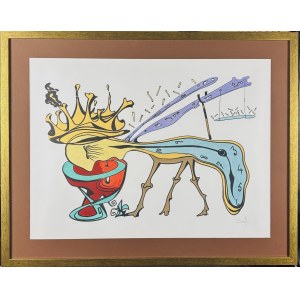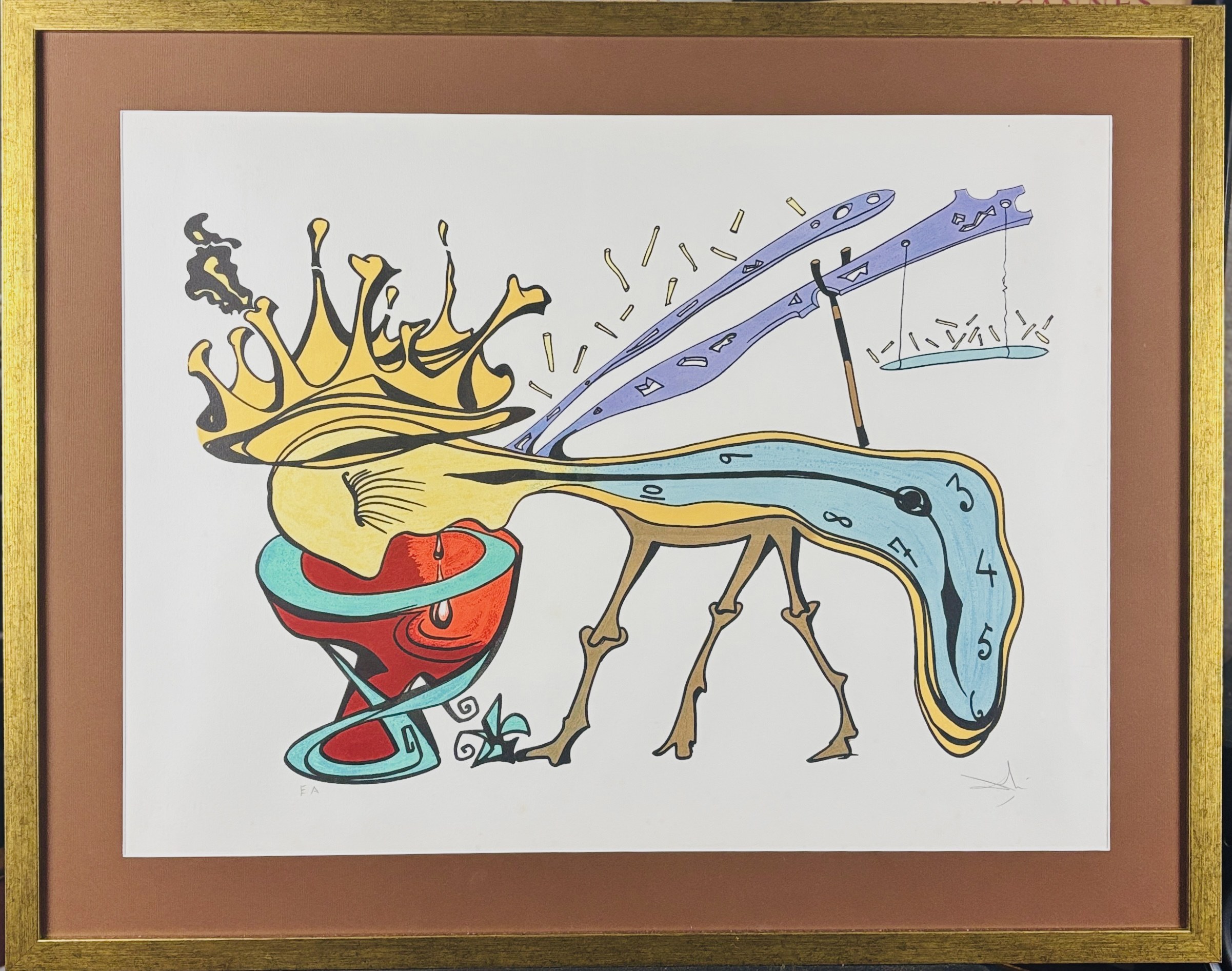
Color lithograph on Arches Velin paper, 47 x 63 cm (inner dimensions of the mat), (61 x 77 cm when framed);
Strictly limited edition of 250 pieces plus 15 E.A. pieces (Epreuve d’artiste – artist’s proof);
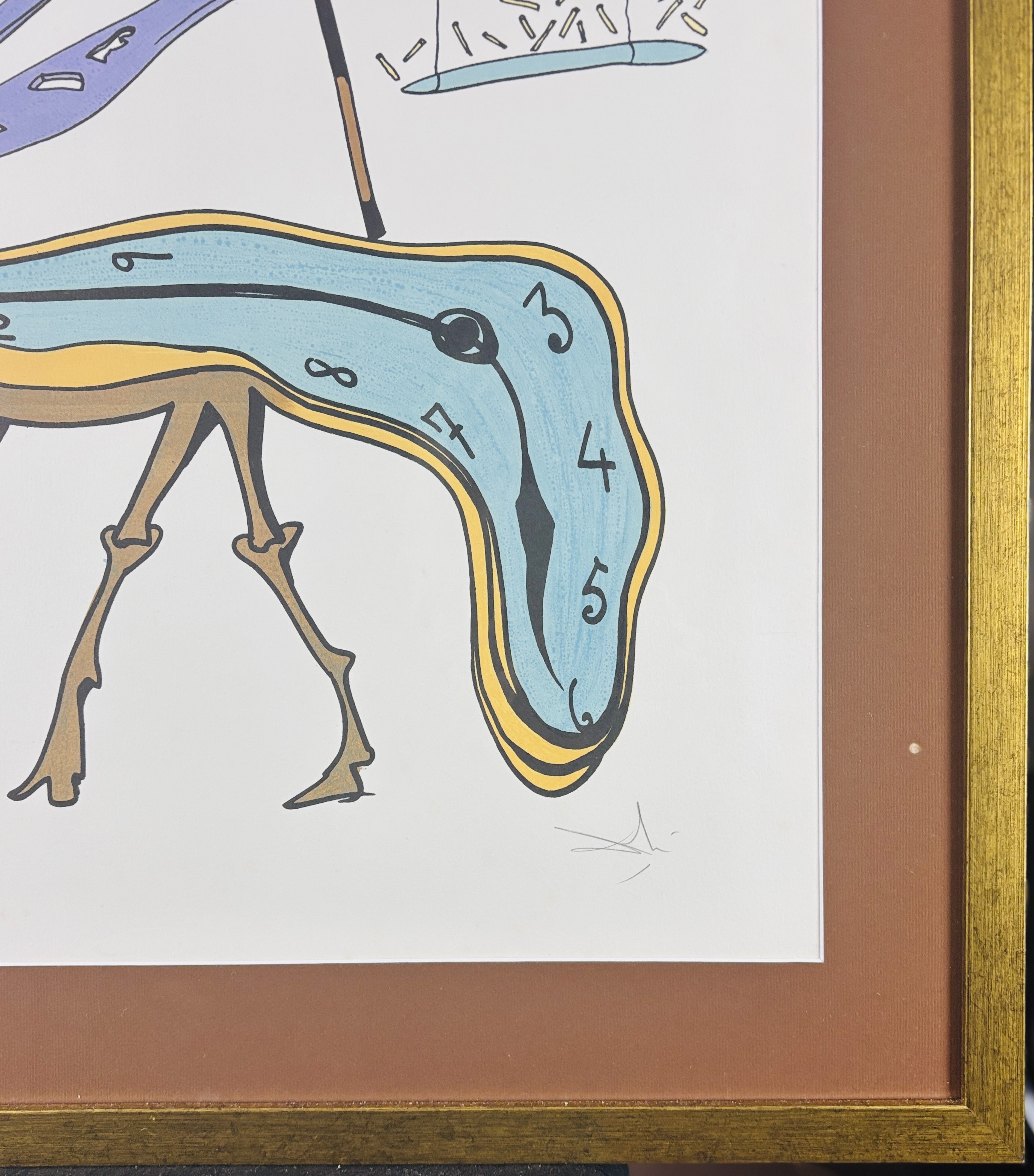
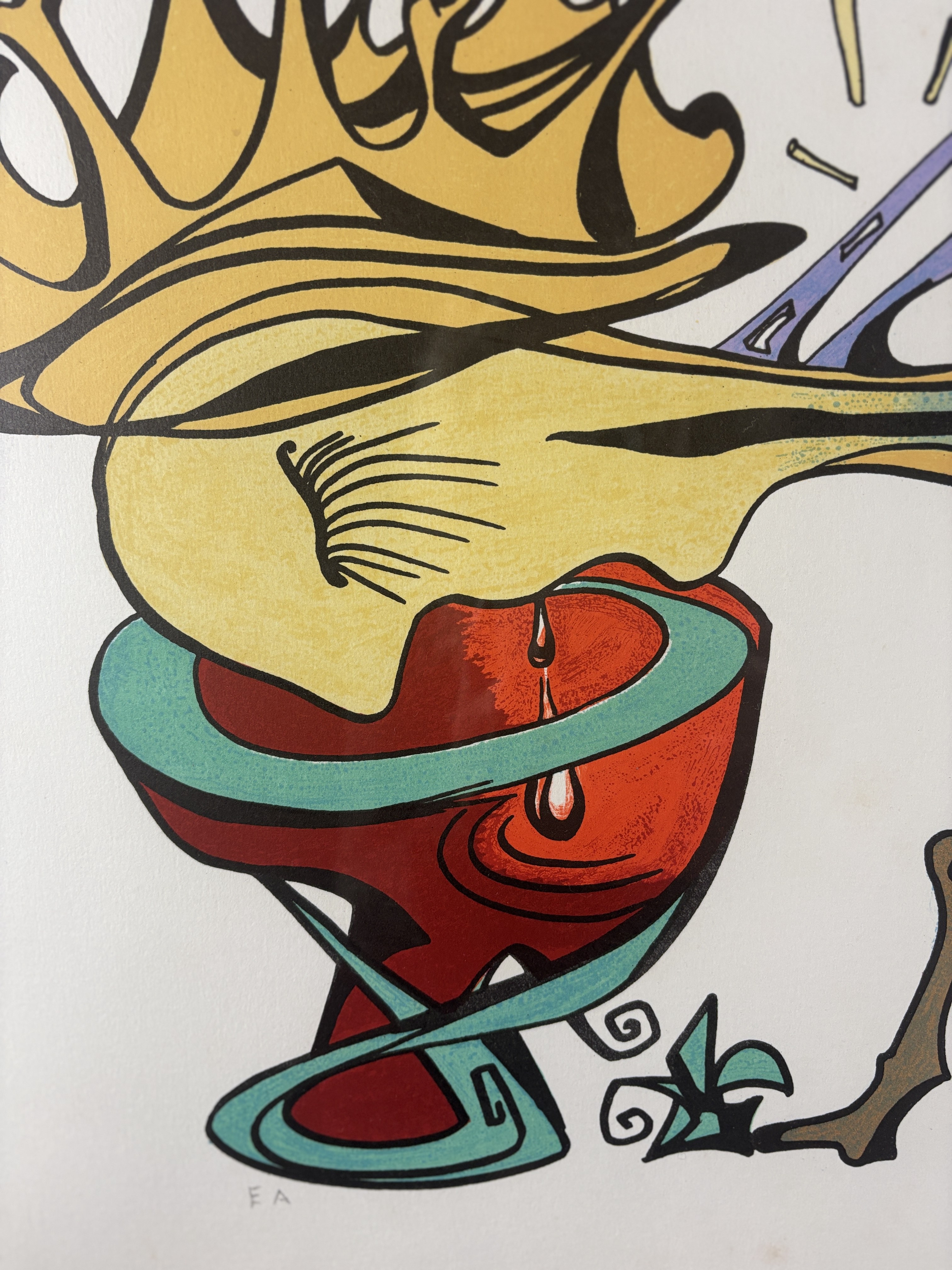
Signed in pencil by Salvador Dalí at the bottom right and authenticated “E.A.” at the bottom left;
Publisher: Jacques Carpentier & Simeon Weintrop (Editions Celami);
The work was printed on the presses of the renowned Parisian workshop Atelier Grapholith Paris
References:
-Ralf Michler, Lutz W. Löpsinger, Salvador Dalí: Catalogue Raisonné of Lithographs and Wood Engravings 1956–1980, Prestel Publishing, Munich–New York, 1995, cat. no. 1445;
-The Official Catalog of the Graphic Works of Salvador Dalí, Albert Field, pp. 74–75.
Provenance: private collection, France
The “Stained Glass” (Les Vitraux) series was created in 1974 and offers a fascinating example of how Salvador Dalí translated his surrealist world into the medium of light and glass.
Although the original works were created as colorful graphic compositions and engravings, Salvador Dalí designed them as templates for traditional lead-framed stained-glass windows.
At the time, Dalí was experimenting with movement, three-dimensionality, and the transmission of light, seeking to imbue his iconic motifs with a metaphysical, even sacred, dimension.
In this series, Dalí returns to the key themes of his work—the passage of time, the human psyche, religion, and a critique of the modern world. When designing sketches for the stained-glass windows, the artist layered associations on top of one another, creating hybrid forms (figures combined with objects or insects).
One of the most poignant works in this series is “The Rejection of Civilization” (often referred to by its French title, *Le Rejet de la Civilisation*, or its Italian title, *Rigetto della civiltà*). The composition is Dalí’s sharp, surrealist commentary on technological progress, consumerism, and the loss of human nature.
A soft clock as the torso of a hybrid: At the center of the composition is one of Dalí’s most recognizable motifs—a melting clock. Here, however, it is not merely a flat prop but forms the back of a surreal creature supported by stiff, insect-like legs. This symbolizes the collapse of the strict, rigid concept of time imposed by industrial civilization.
A royal crown rests on the creature’s head, from which smoke or fire rises. Dalí highlights the hubris of civilization’s governing structures and the illusion of power.
Stilts and supports: The creature’s insect-like legs resemble wooden supports—a characteristic motif of Dalí’s signifying instability and the need to artificially prop up something that would otherwise collapse immediately.
The Chalice and the Cup (Blood / The Substance of Life): The creature’s head rests on a red, chalice-shaped vessel from which drops are flowing. This is a reference to the biological, organic origin from which civilization tries to break free, yet on which it remains inextricably dependent.
The central theme of the work: Dalí depicts civilization as a monstrous, sluggish systemic structure—an artificially sustained construct that loses the authenticity of human experience somewhere along the way in favor of the mechanical cycle of time and power.
In 1979, an album containing reproductions of all 24 lithographs in the series was published by the Vatican.
Following the Second Vatican Council, the Catholic Church opened itself to dialogue with contemporary artists. Pope Paul VI initiated the creation of the Vatican Museums’ Collection of Contemporary Art (opened in 1973). The Vatican then began actively commissioning, publishing, and supporting the works of the most outstanding artists of the 20th century (including Picasso, Chagall, Matisse, and Dalí), interpreting their work through the lens of spirituality and the human condition.
A Vatican publication from 1979 included reproductions of 24 works from the series, accompanied by a text by the Italian writer and critic Luigi Testaferrata. Italian church circles and critics interpreted the series as a philosophical and theological narrative about the human condition