


79.5 x 100.0cm - oil, canvas
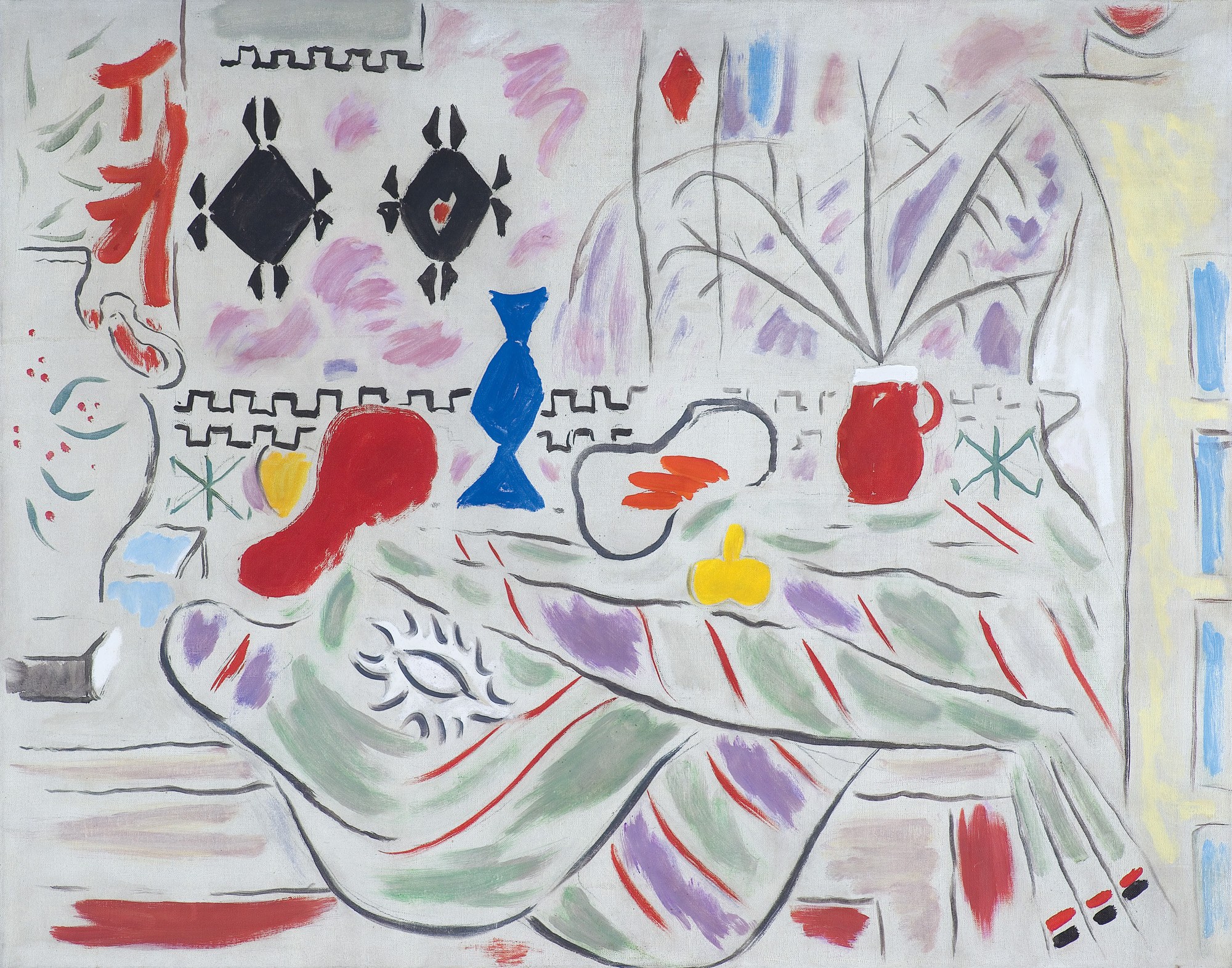
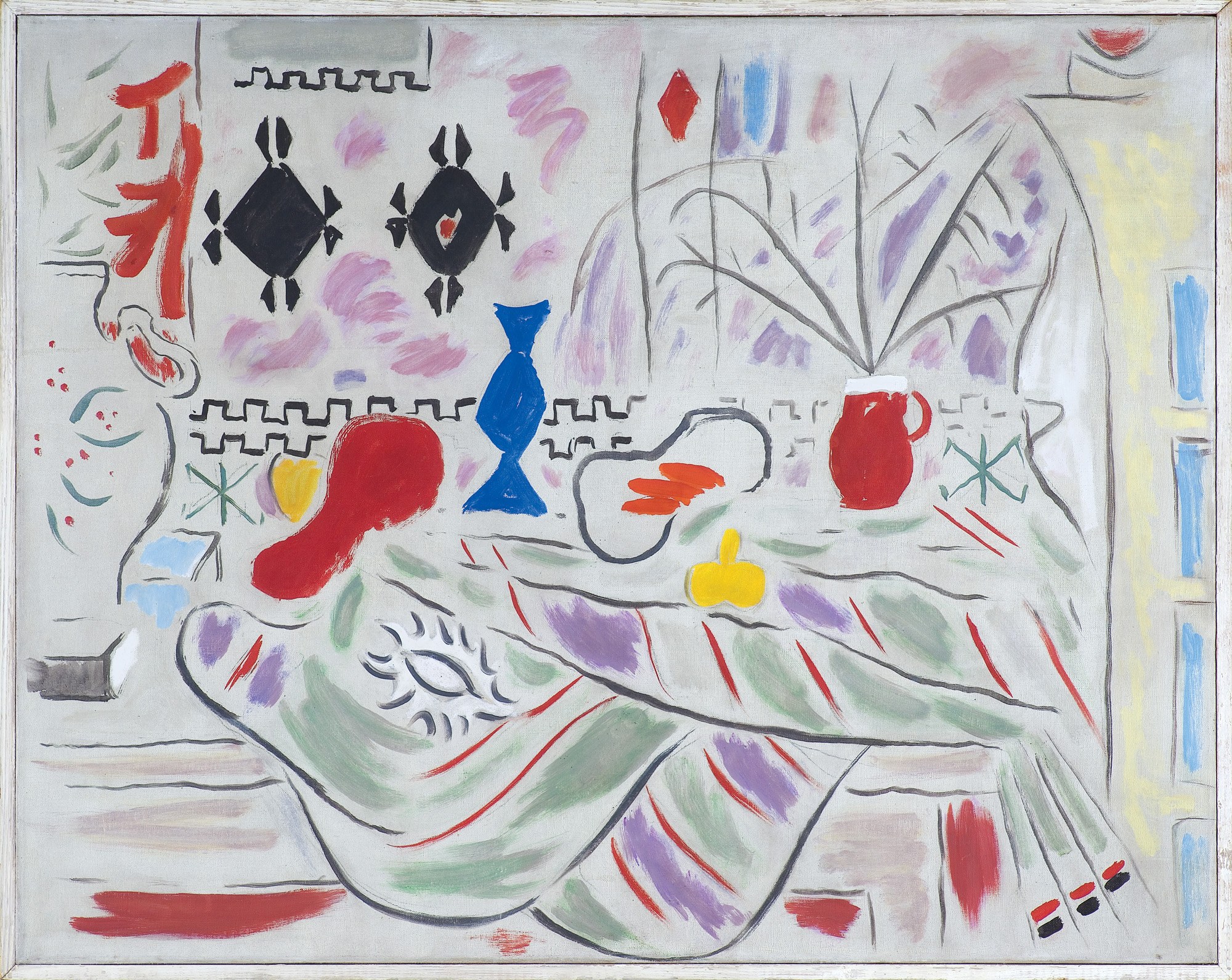
STILL LIFE WITH BLUE VASE AND SHELL VII, 1957
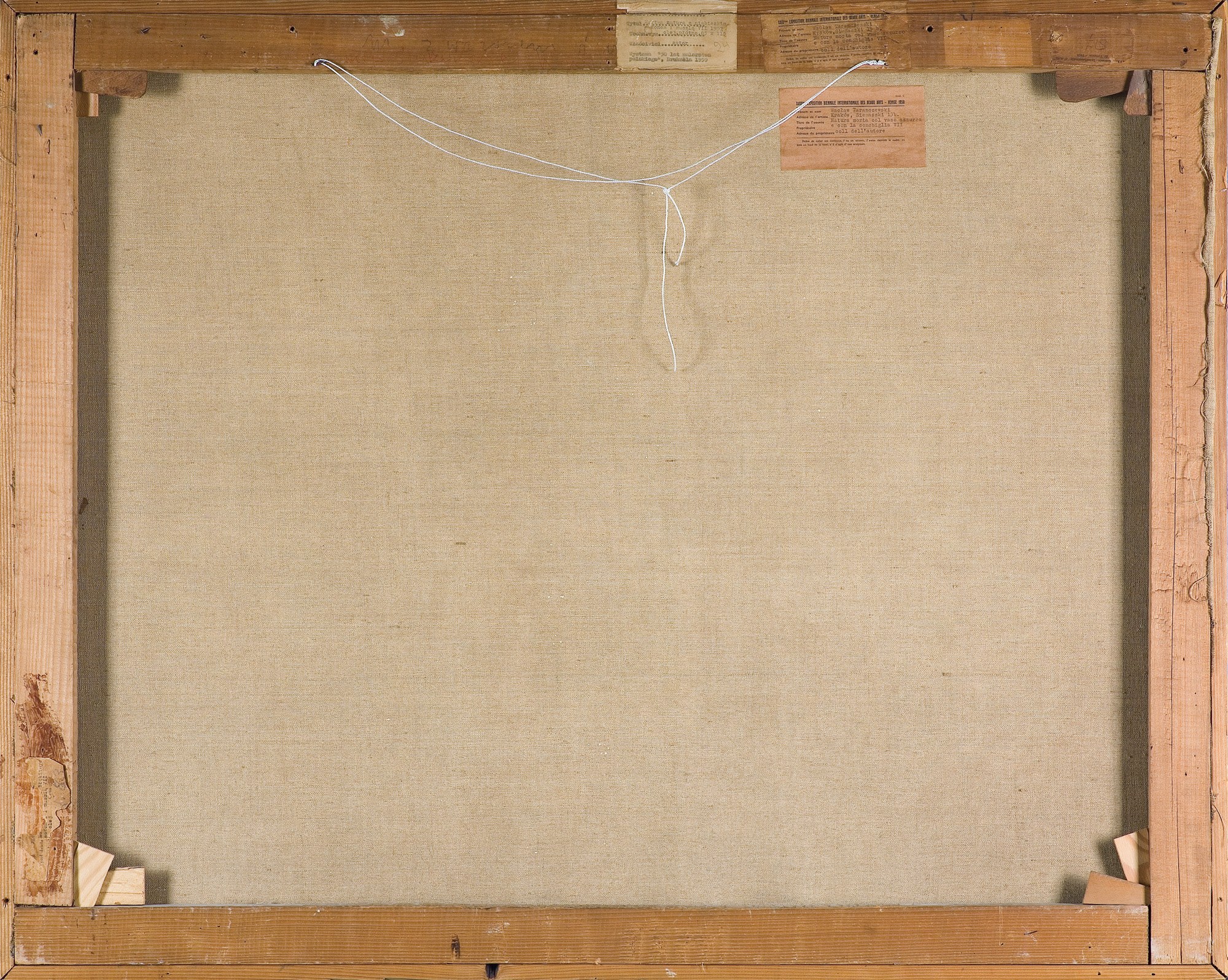
on the reverse on the canvas p.g. sticker of XXIX Venice Biennale 1958 with details of the painting
on the g. loom strip: m. with vase and [...], next to three stickers:
- exhibition sticker 50 years of Polish painting, Brussels, 1959;
- sticker of XXIX Venice Biennale 1958;
- XXIX Venice Biennale sticker with number 57 [?].
Image described and reproduced:
- Zdzisław Kępiński, Wacław Taranczewski, Poznań 1958, in list of works item 83, p. 96; il. b/w, p. nlb;
- XXIX Biennale Internazionale d'Arte. Bozze di stampa. Catalogo opere, Venice 1958, in list of works item 49, p. 312;
- Art polonais. Poolse Kunst, catalog of the exhibition of Polish art at the Palais des Beaux-Arts, Brussels 20 III - 12 IV 1959, cat. no. 100 (as Nature morte VII, 1957), p. nlb;
- Waclaw Taranczewski, ed. by Paweł Taranczewski, Kraków 2008 (painting described in the calendar as exhibited at the XXIX Venice Biennale, p. 164).
In his painting, Waclaw Taranczewski usually worked in cycles, returning to his chosen motifs, persistently digging into the compositional concept and in each successive painting trying to bring out something else from the motif in order to show the richness and complexity of the visual relations contained in the subject. The motif was often a still life, composed of several objects, repeated in successive paintings of the series.
As Ewa Herniczek wrote, in her text on Taranczewski's work: the artist was close to (...) certain arrangements or even single objects - a blue vase, a shell, dried twigs, a striped cloth or a Hutsul kilim. Sometimes he was inspired by depicting not so much the elements of still life, but combining them with a specific spatial situation. (...) Insightful observation always stood at the basis of the painting, but the way to reach the painting finale, was never simple. Waclaw Taranczewski's artistic attitude accentuated the spontaneity of perception as much as intellectual reflection. (...) Taranczewski's late paintings are characterized by austerity of painterly notation, simplicity of forms reduced to arrangements of lines and spots of color, which are only an allusion to empirically cognizable reality. The dispersion of compositional elements, accentuating the physical plane of the painting while simultaneously attempting to introduce a "physically graspable" third dimension (collage) indicates that the artist was still searching for answers to his questions about the mutual relations of spatial reality and its flat representation. (Ewa Herniczek, Waclaw Taranczewski, in Waclaw Taranczewski, collective work, ed. Paweł Taranczewski, Krakow 2008, pp. 22, 26, 38)
In 1950, Waclaw Taranczewski left Poznan and moved permanently to Krakow, where he was given an apartment on Prądnik, Siemaszki Street. In the artist's Krakow studio, Taranczewski's work found a continuation of his earlier motifs, such as Still Life with a Mermaid and Concert in the Atelier, but new subjects also appeared, including Still Life with a Blue Vase and Shell. In the 1950s, the painter completed several paintings with this motif. Art critic Zdzislaw Kepinski wrote about the first versions, in a 1958 monograph dedicated to Taranchevsky: The first study from nature, and this time dense and somewhat vibrant, but the plane steeper and the board tighter than ever in the first studies. In subsequent versions of the subject, the artist underpainting with tempera, rubs the color planes lighter and lighter, gaining inner light, life and depth. The paintings become more and more succinct, moving toward an even more planar approach, with a composition deliberately broken into seemingly separate particles, yet linked by a painterly logic by a seasoned master.
♣ A fee will be added to the auctioned price in addition to other costs, based on the right of the artist and his heirs to receive remuneration in accordance with the Law of February 4, 1994 - on Copyright and Related Rights (droit de suite).
Waclaw Taranczewski (Czarnkow, March 4, 1903 - Krakow, February 11, 1987) studied from 1921 to 1929 alternately graphics at the School of Decorative Arts in Poznan under Jan Jerzy Wroniecki and painting at the Academy of Fine Arts in Krakow under Fryderyk Pautsch and Felicjan Szczęsny Kowarski. With the latter, in 1929, he moved to the School of Fine Arts in Warsaw, where he completed his education in 1931. From 1932 he remained friends with Tadeusz Piotr Potworowski. Together with Kowarski's students, he belonged to the "Prism" group (1933-1939). In 1935 he went to Paris and from there to Italy. Upon his return, he was entrusted with running a gallery called Salon 35 in Poznań, which he did until the outbreak of World War II, organizing more than 50 exhibitions there. In 1937 he traveled with Potworowski to Greece and Italy. He survived the war and occupation years in Poznań, working as a laborer and teaching drawing secretly. In 1945, he was elected the first president of ZPAP and took over the management of the reactivated School of Decorative Arts (since 1946 the State Higher School of Fine Arts). In 1947 he was given the Chair of Decorative Painting at the Academy of Fine Arts in Cracow and settled there permanently in 1950. His painting is an individual, conscious synthesis of colorism and tendencies close to cubism. They are characterized by natural harmony and coherence of composition, color, spatial plans. Taranczewski is also one of the most outstanding post-war artists of monumental painting. He created, among others, the plafond of the auditorium of Adam Mickiewicz University (1947), frescoes in the churches of the Blessed Virgin Mary (1954) and St. Martin in Poznan (1957), as well as stained glass windows in the cathedrals of Poznan and Warsaw.













Πρόσφατες επισκοπήσεις
Συνδεθείτε για να δείτε την λίστα θέσεων
Αγαπημένα
Συνδεθείτε για να δείτε την λίστα θέσεων