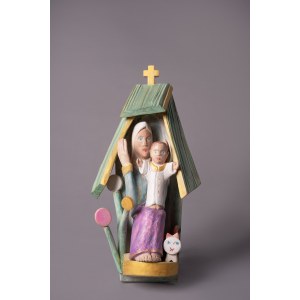
Stanislaw Kulon, Chapel
Polychrome wood,
Signed work, UNIQUE.
Year of creation: 2020
Height: 35 cm
_____
"Prof. Stanislaw Kulon was born in 1930 in Sobiesk in the Eastern Borderlands. In 1940, he and his family were deported by the Soviets to Siberia, where he lost his parents and three siblings. He returned to Poland in 1946.Initially he stayed at the orphanage in Sopot, then studied under Prof. Antoni Kenar at the High School of Visual Arts in Zakopane, from which he graduated in 1952.Between 1952 and 1958 he studied at the Department of Sculpture at the Academy of Fine Arts in Warsaw in the studios of Prof. Ludwika Nitschowa and Prof. Marian Wnuk. He received his diploma with honors in 1958.
From 1988 to 2000 he was a professor at the sculpture department. Currently, in retirement, he continues to create.
Stanislaw Kulon's work is bold, Polish, full of faith, knowledge of physical, spiritual and moral man; sacred and earthly at the same time. It is a masterpiece in individual works and as a whole. It is European and national. Folk - as in the parochial Kresy and Mazovia, and at the same time universal. It is imbued with a deep sensitivity to beauty and truth, powerful, innovative. Although "written" in perishable wood, it is imperishable. It is an individual manifestation of the Artist's exceptional diligence and creative discipline, and a mysterious continuation of the world's art heritage.
Attentive eyes will notice and features of the art of primitive peoples, Romanesque and Gothic elements, and features of innovative creative experiments of the 20th century. It is an engaged art, innate in human life and its affairs: great and ordinary, political and domestic. Stanislaw Kulon notes and expresses love in sculpture: agape and eros; life and its end, joy and suffering. The structure and its own material-wood dynamics is a testimony to the Master's humble conversation with nature. It is a record of cooperation: finding the "hints" existing in wood, which become personal visions, fixed through strenuous hard work, including physical work, and creative exploration. Stanislaw Kulon's sculptures, even when they are as filigree as twigs - have weight and meaning."
~Jacek Chromy