


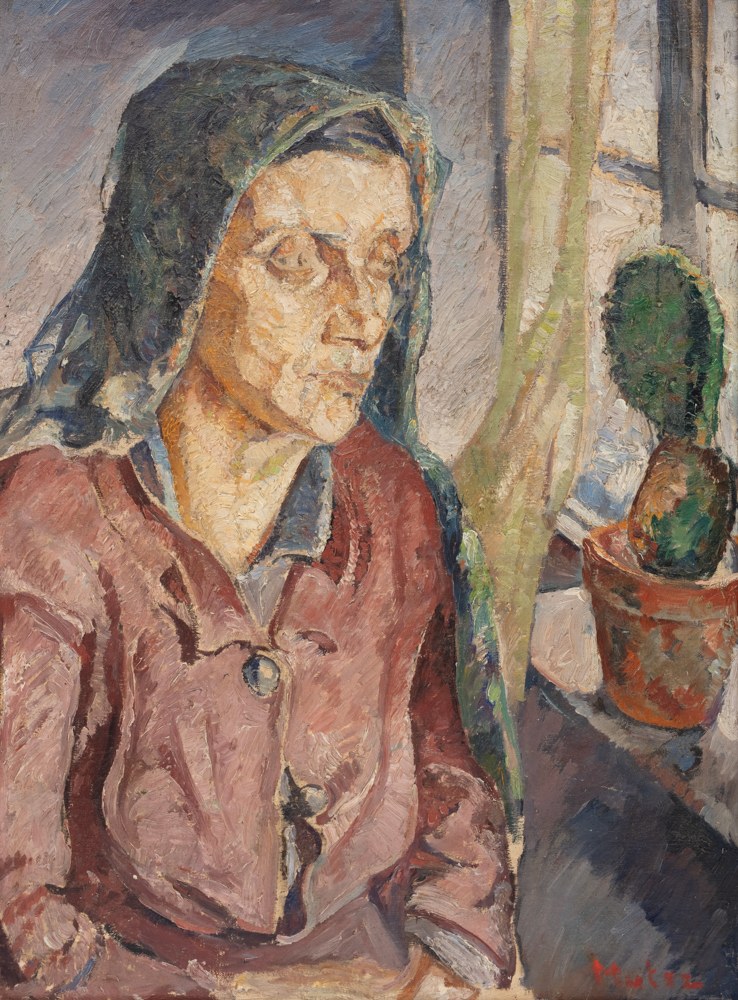
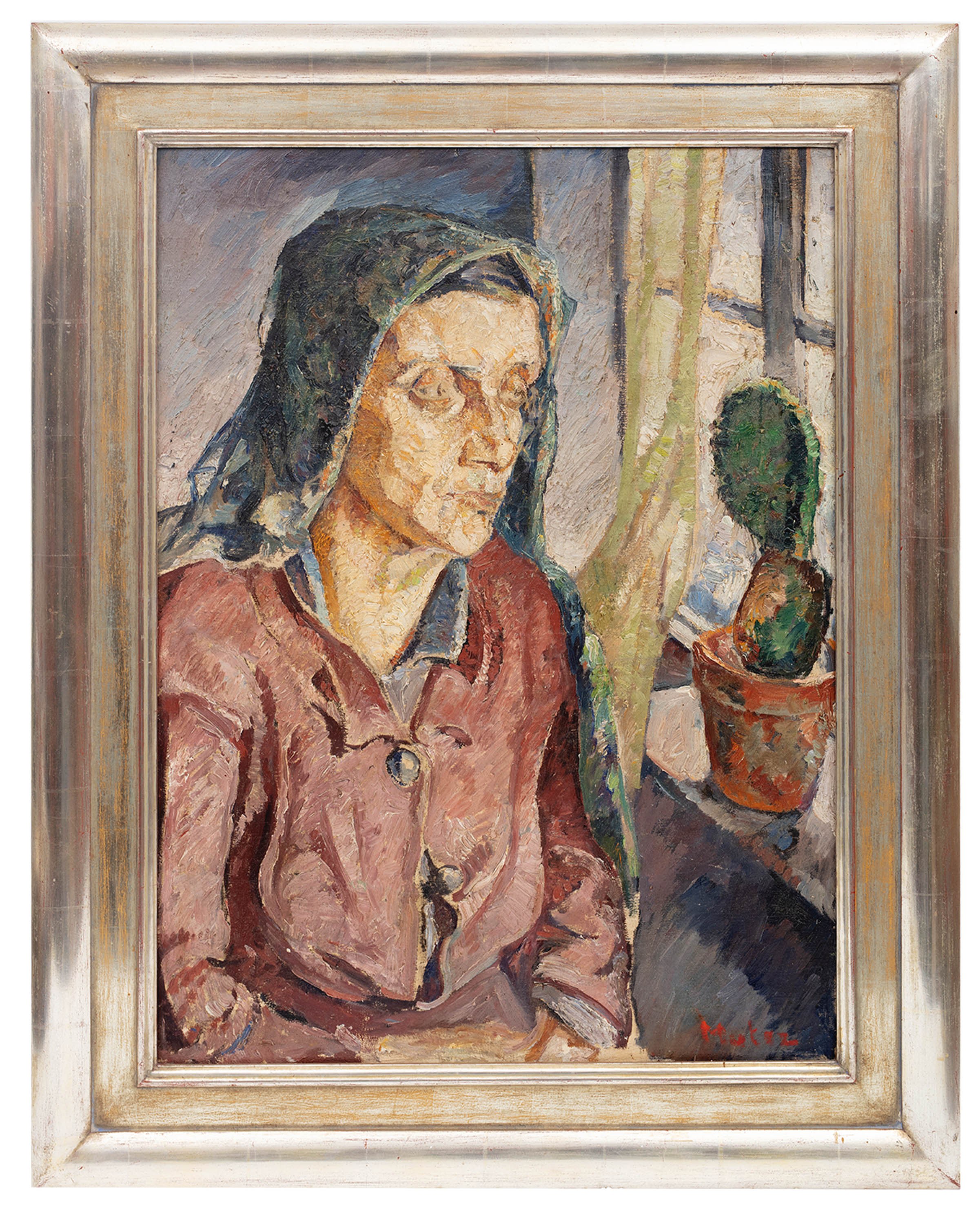
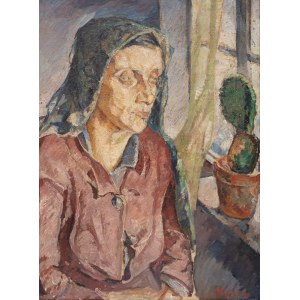
oil, canvas, 73 × 54.5 cm
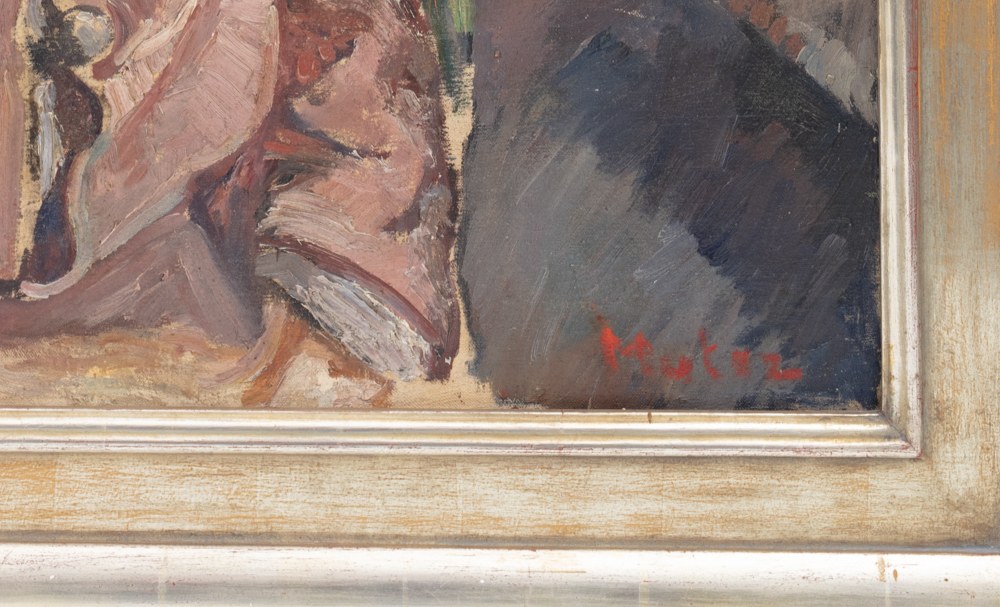
Signed p. d.: "Muter"
"Mela Muter's portraits are the deeply taken quintessence of a human being, perceived in some very elusive, sometimes perhaps the only moment of inner betrayal before another human being. She is a portraitist gifted with a great ability to penetrate into human life, an ability to convey a very laboriously refined truth about the person being portrayed in the expression of the face, in the arrangement of the body, in the position and expression of the hands, and to give this truth in a very absolute form."
M. Sterling, From the Paris studios. August Zamoyski - Mela Muter, "Voice of Truth," 1929, No. 6, p. 3.
In her work, Melania Muter eagerly reached for motifs of landscapes, still lifes, but it was the portraits that became the true painting showcase of the artist, valued by both critics and the public. Muter's portraits can be divided into two galleries. The first is paintings in which the artist adoringly immortalized anonymous figures of children, elderly women and men stigmatized by an often harsh working-class life, beginning with her first artistic journey to the Brittany coast. The second gallery, are paintings of a more representative nature, where Melani's models included some of the most prominent figures from the world of science, culture, politics, and she was posed by, among others: Leopold Gottlieb, Władysław Reymont, Auguste Rodin, Diego Rivera, Henryk Sienkiewicz, Leopold Staff and many others. Mela was able to show, in her characteristic way, not only the external appearance of the portrayed, but also his personality, although the artist herself did not agree with this statement - "... when you say, trying to make me a compliment - you create psychological portraits - I rebel! No, I don't paint psychological portraits at all, I don't even know what it takes to create a psychological portrait. I never ask myself whether the person in front of my easel is good, false, generous, intelligent. I try to capture and portray her, as I do with a flower, a tomato or a tree, to get into her essence; if I succeed, I express myself through the prism of her personality..." ("Collection of Bolesław and Lina Nawrocki, Mela Muter (Maria Melania Mutermilch) 1876-1967.", Exhibition Catalogue, National Museum in Warsaw, December 1994 - February 1995, Warsaw 1994, p. 35).
The presented "Portrait of a Woman" fits perfectly into the whole post of Melania's portraits - "Bodies that are healthy and beautiful, faces with correct 'classical' features have no charm for her. She shows a marked attraction to characteristically reptilian figures, to peculiar types and anthropological specimens. Yellow gypsies, Jews with long, humped noses and crooked lips, blacks, glowing with the whites of their eyes and the red of their puffed-out lips pose as models for her. How far we are from Weiss's blushing, gushing women! Ms. Muterova's people have fever in their blood. The hectic inner life has destroyed their bodily beauty. Their faces and hands, helter-skelter with the work of thought, radiate nervous restlessness." (M. Wallis, "Przegląd Warszawski" 1923 No. 25, quoted in Mela Muter, Painting/Peinture. Catalog of the Collection of the University Museum in Toruń," edited by Mirosław Adam Supruniuk, Slawomir Majoch, Toruń 2010, p. 100).


![Mela MUTER [Maria Melania Mutermilch] (1876-1967), Portret młodej kobiety, lata 30. XX w.](https://img1.one.bid/img/8512/2545921_1w.webp)










Πρόσφατες επισκοπήσεις
Συνδεθείτε για να δείτε την λίστα θέσεων
Αγαπημένα
Συνδεθείτε για να δείτε την λίστα θέσεων