


57.0 x 74.5cm - watercolor, gouache, cardboard
signed l.d.: Z. STRYJEŃSKA
Zofia Stryjeńska, one of the most colorful figures of Polish interwar art, earned the name "princess of Polish art déco" not only due to the unique aesthetics of her works, but also due to her uncompromising love of folk culture, especially highland folklore. In her work, highland culture was not just an ornament - it became a symbol of primordial, unspoiled national identity and spirituality.
Stryjeńska drew inspiration from music, dances, rituals and folk costumes, especially those associated with Podhale culture. The figures in her paintings are often dressed in stylized, richly decorated highland costumes - with clearly marked embroidery, corsets, sashes and hats. The distinctive lines and intense colors she uses convey the energy and rhythm of life of mountain villagers. The highlanders in her works are deeply rooted in tradition, which the artist translates into a painterly language full of lyricism and poeticism.
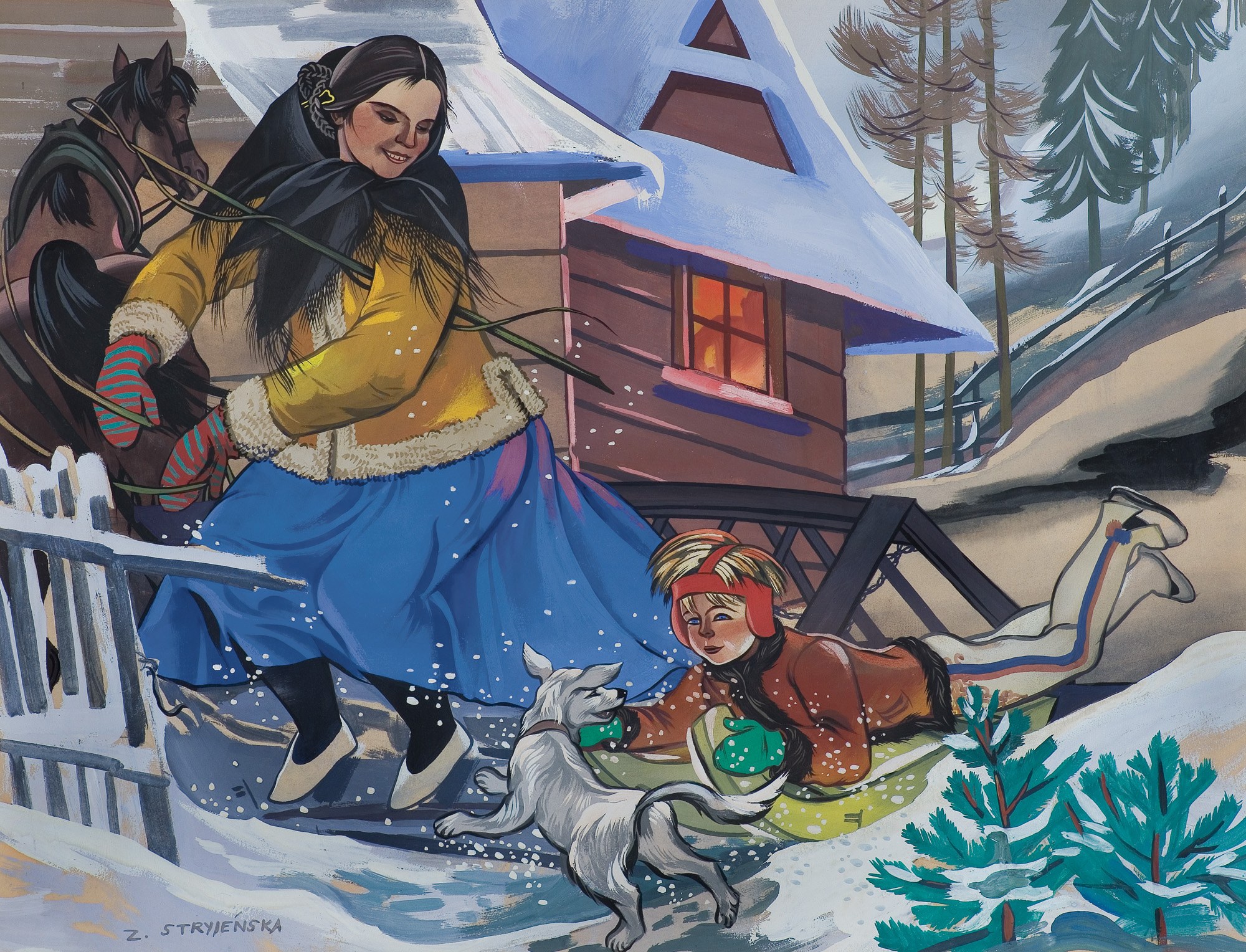
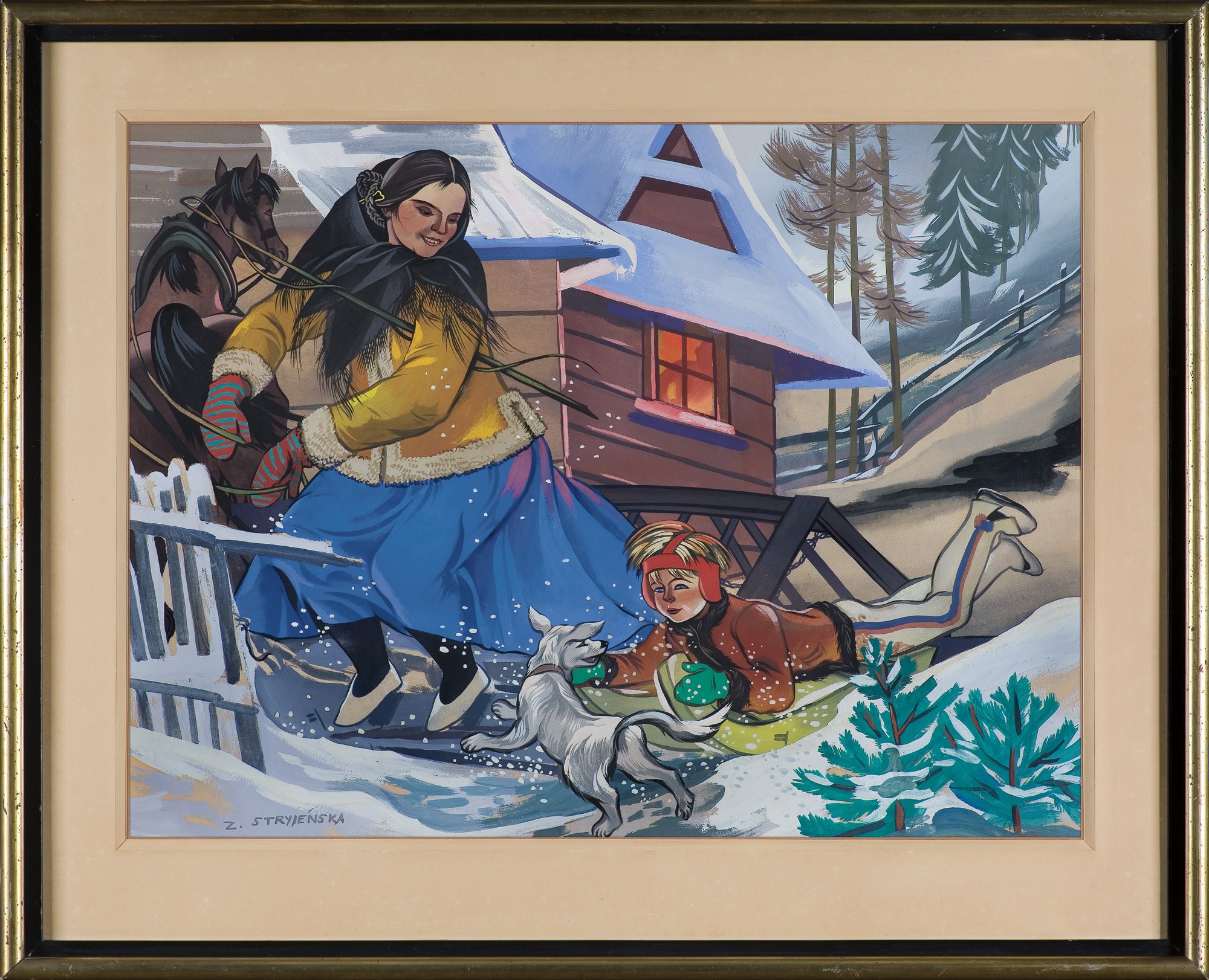
This elaborate composition shows a scene from the life of the highlanders, depicted with flair and theatrical flair. Zofia Stryjeńska, spins a visual tale of highland customs, paying homage to them with passion and imagination. Her paintings are an expression of her fascination with folklore, which the artist saw as the quintessence of Polishness. With a commitment worthy of an ethnographer, she took care to be faithful to details - especially in her depictions of regional costumes, full of intricate embroidery, patterns and colors. For color you have to go to the countryside," she used to say, rejecting the monotony of gray everyday life in favor of a world full of color and rhythm. Stryjeńska's paintings exude intense, saturated colors, dominated by joy and energy. She deftly uses drawing, and thanks to her freedom of composition and use of perspective shortcuts, she is able to give the scenes a unique dynamism. Works such as On the Sled, which are maintained in a cheerful, idyllic mood, perfectly fit in with her colorful, lively narratives of Polish folklore.
A special place in the artist's work is occupied by works thematically dedicated to highland culture. In her paintings depicting holidays and rituals, Stryjeńska combined Christian motifs with ancient Slavic mythology and pagan symbols, creating a vision deeply rooted in Polish folklore. The highlanders here become, as it were, the guardians of these ancient values. It is also not without significance that Stryjeńska saw folklore as the foundation of Polishness - at a time when the country was regaining its independence, the artist treated art as a form of patriotic expression. Highland art, with its independence, strength of character and spiritual richness, fit perfectly into this trend. Zofia Stryjeńska created her own unique artistic language, in which highland folklore played a key role. Thanks to her, the culture of Podhale gained not only a new visual interpretation, but was also immortalized as part of the national heritage.
♣ A fee will be added to the auctioned price, in addition to other costs, based on the right of the artist and his heirs to receive remuneration in accordance with the Law of February 4, 1994 - on Copyright and Related Rights (droit de suite).
Zofia Stryjeńska, née Lubanska (Krakow 1891 - Geneva 1976) - painter, illustrator, stage designer - was one of the more colorful figures of the Polish artistic community in the interwar period. After a short period of study with Leonard Stroynowski and at Maria Niedzielska's school in Cracow, she left for Munich, where in 1911-1912 she studied at the Academy of Fine Arts in male disguise (women were not admitted at the time). She made her debut at the Kraków TPSP in 1912 with a series of cartoons of Polish fairy tales inspired by folk tales. In 1916 she married Karol Stryjeński. She lived in Cracow until 1919, later living in Paris, Cracow, Zakopane and Warsaw. In 1925, she achieved international success at the Decorative Arts Exhibition in Paris, receiving the Gran Prix in four divisions (painting, poster, textile, illustration) and the Diplom d'Honneur for her toy designs. She was involved in decorative architectural painting, polychromy, illustration, stage design (including Karol Szymanowski's Harnasie; 1938), industrial design (kilim designs, toys). She created her own specific style in decoratively stylized, colorful, dynamic and temperamental paintings; tempera, watercolors and gouaches. In their subject matter she referred to legends, beliefs, history and folk customs. She published several graphic volumes (Slavic Idols, 1917 and 1922) and albums of reproductions (Polish Dances, 1927; Pascha, 1929; Piasts, 1929; Slavic Gusła / Magie Slave, 1934). Her works were also popularized by numerous color postcards.













Πρόσφατες επισκοπήσεις
Συνδεθείτε για να δείτε την λίστα θέσεων
Αγαπημένα
Συνδεθείτε για να δείτε την λίστα θέσεων