


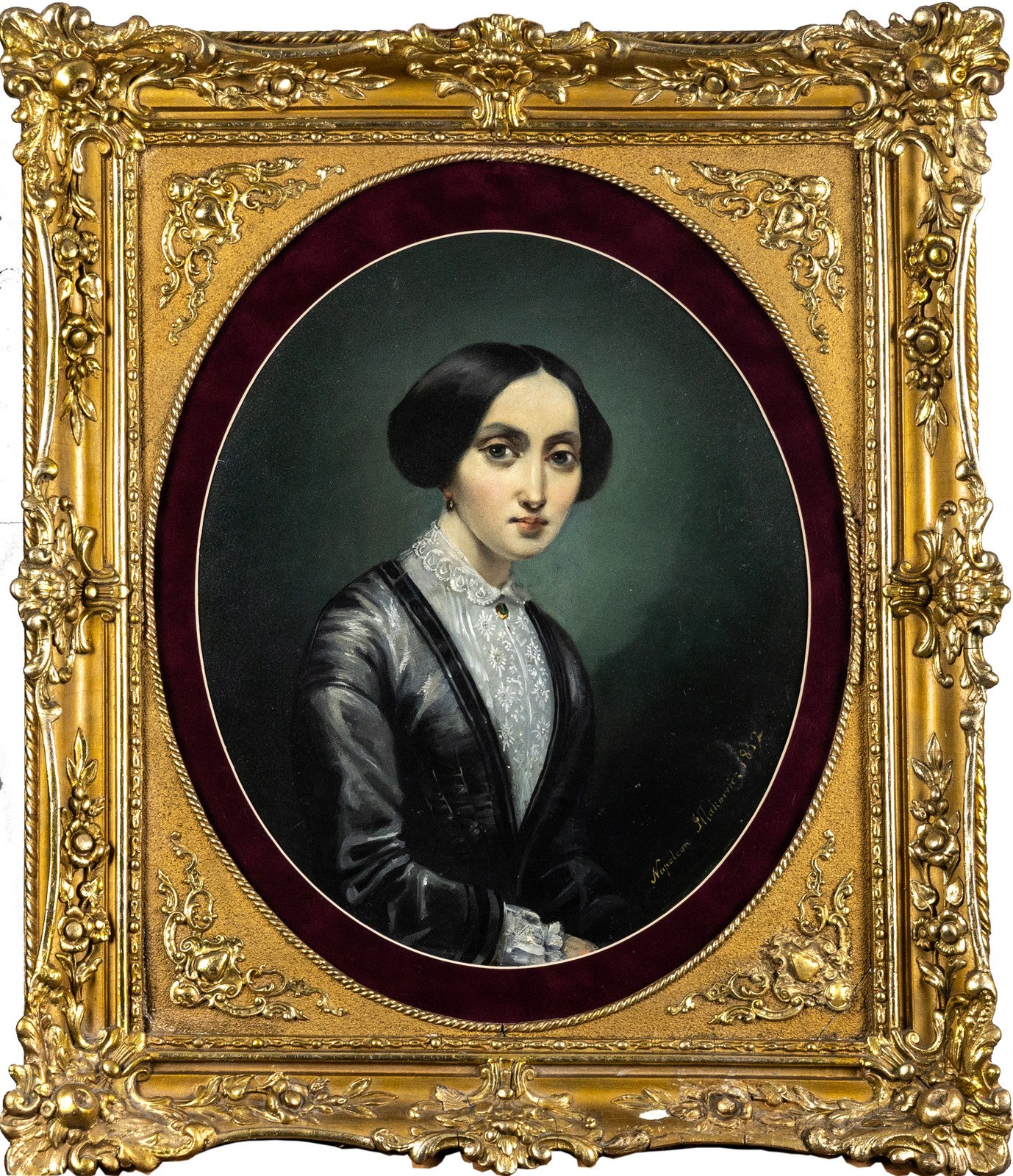
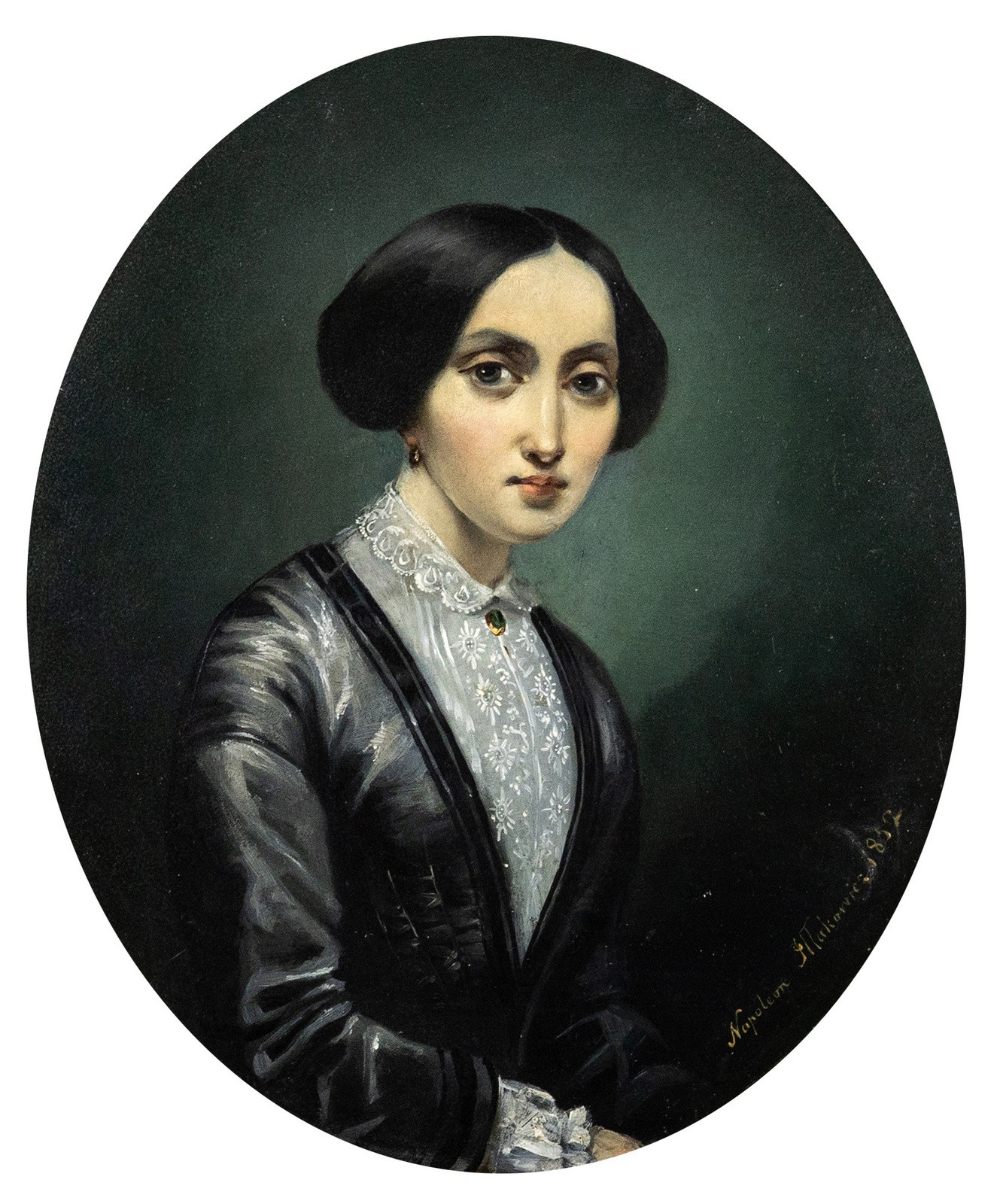
Napoleon Iłakowicz (1811-1861)
Portrait of a woman
1852, on card, al., 39,5 × 32,5 (oval)
Signed. AK: Napoleon Illakowitz 1852
Napoleon Mykolas Julius Ylakowicz (1811-1861): life, works and participation in the Masonic movement
Napoleon Michał Juliusz Iłłakowicz (Polish: Napoleon Michał Juliusz Iłłakowicz) was one of the most interesting figures of Lithuanian art and culture in the first half of the 19th century. He was not only a talented painter and decorator, but also an active participant in the uprising of 1831, and later a political emigrant, whose work and activities reflected the national and spiritual aspirations of his time.
Napoleon Michał Juliusz Iłłakowicz, nicknamed Cibulskis, was born on 2 December 1811. His parents were Teodor Iłłakowicz (b. 1783) and Magdalena Dworzecka (b. 1791) of the Dworzecki family. The family belonged to the Samogitian noble family of the Yłakowicz (Ilłakowicz, also known as Načko-Iłłakowicz), who used the coat of arms "Doliva".
In their youth, the Ylakawiczs were taught the rudiments of drawing by the parish priest of Paberže, Canon Franciszek Kochanowski. Later, he studied at the Vilnius Gymnasium under the teacher Maciej Przybylski, and in 1830 he began his studies in painting at Vilnius University, then known as the Imperial Vilnius University, under the painter Jan Rustem. His studies were interrupted when Ylakavičius became involved in the 1831 uprising.
During the uprising, he commanded an infantry squad and fought at Karmėlava, Biržai, Vilnius, Šiauliai and Degučiai. After the defeat of the uprising, Ylakavičius had to leave his homeland and emigrate to France, where he studied art in Paris from 1833 to 1836 and later in Spain. In 1837, on his way from Zaragoza to Madrid, he was captured by the Carlist partisans of General Ramon Cabrera, imprisoned and sentenced to be shot, but on the General's intercession, he spent two years in captivity, painting portraits and religious paintings.
After his release, Ylakavičius returned to France, where he worked on decorations for the theatre, churches and palaces in Bordeaux. He later worked in Paris in the workshop of Michel Martin Drölling and at the Samur Cavalry School, where he was assistant to Professor Charles Aubry in the lithography workshop.
While living in France, Ylakavičius established contacts with the Masonic lodges. Research shows that he belonged to the Lodge Des Patriotes in Paris in 1839, the Loge du Triangle in Bordeaux in 1851, the Grand Orient de France in 1852 and the Loge Française de la Tolérance in London.
His participation in Masonic lodges gave him the opportunity to join the so-called "Great Emigration" (émigration polonaise), a political and cultural network of Lithuanian and Polish nobles, officers and intellectuals who had fled to Western Europe after the defeat of the uprising of 1830-1831. Masonic lodges became an important channel for political, cultural and spiritual contacts. Masonic lodges supported artists by finding them lucrative commissions.
In 1848, Ylakavičius moved to Lviv and in 1857 he returned to Vilnius. He settled in Vokiečių Street, in the so-called Samsono house (now Vokiečių Street 10), where he had a studio. It became a meeting place for Vilnius artists, intellectuals and patriots. Researchers mention that the painter Vincentas Smakauskas and several young painters who had studied privately with him used to visit here.
Napoleon Mykolas Julius Ylakavičius was not only an artist, but also a public figure who combined the ideals of art, politics and spiritual freedom. His life trajectory reflects the fate of the Lithuanian and Polish intelligentsia of the 19th century: struggle, exile, creation and return. He died on 7 November 1861 in Vilnius and was buried in the Suderve Parish Cemetery.








Πρόσφατες επισκοπήσεις
Συνδεθείτε για να δείτε την λίστα θέσεων
Αγαπημένα
Συνδεθείτε για να δείτε την λίστα θέσεων