


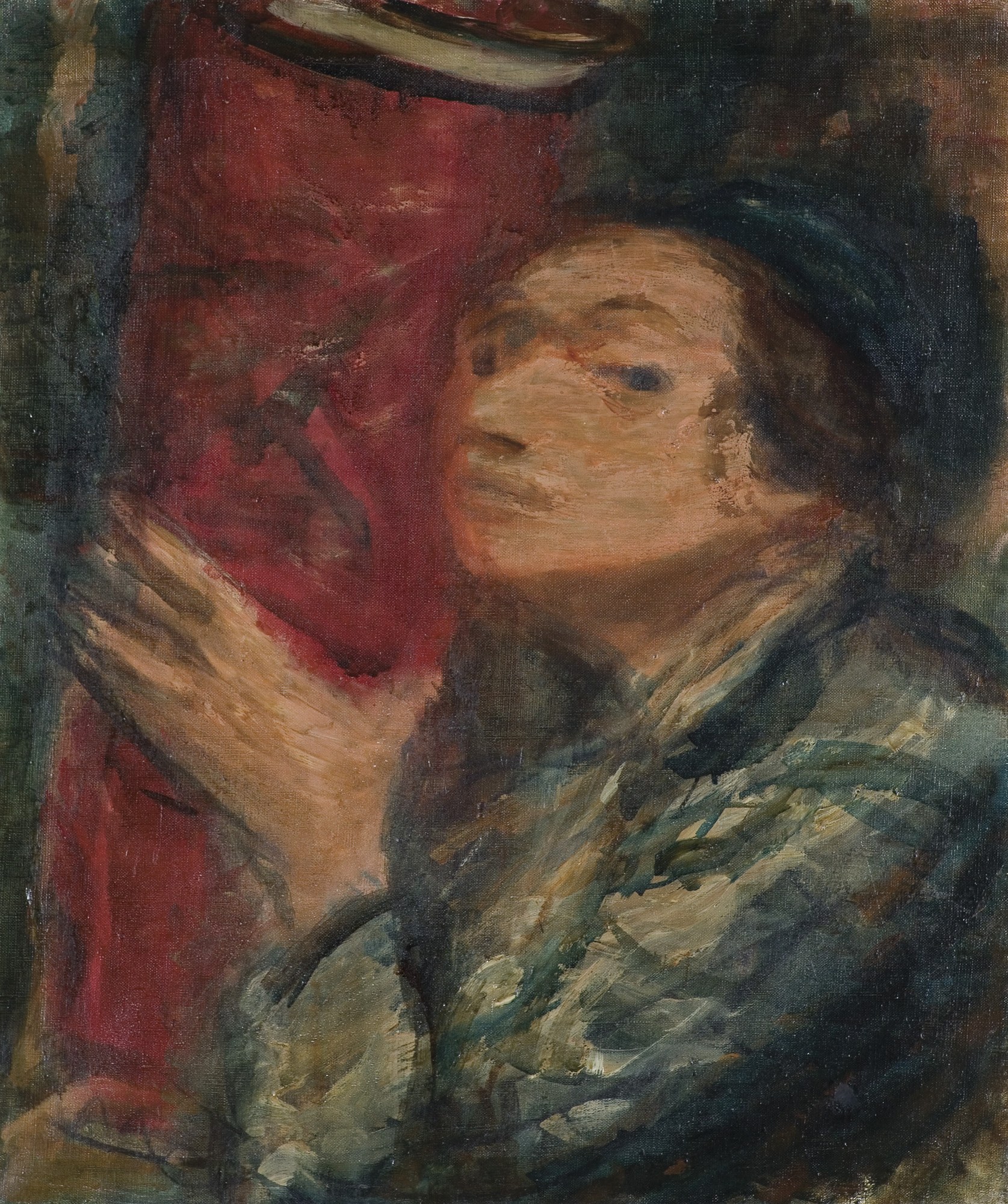
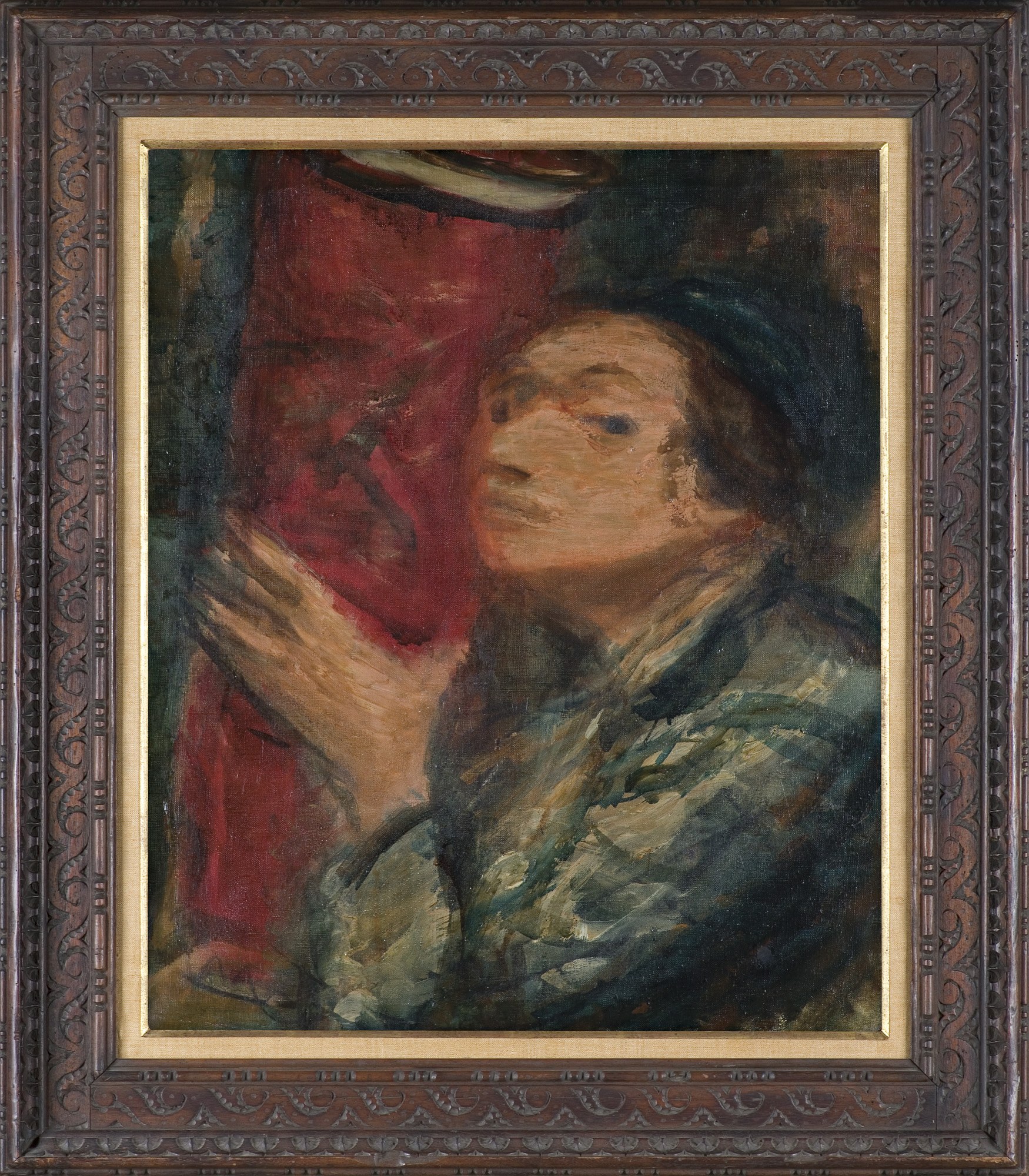
65.0 x 54.5cm - oil, canvas signed l.d.: M
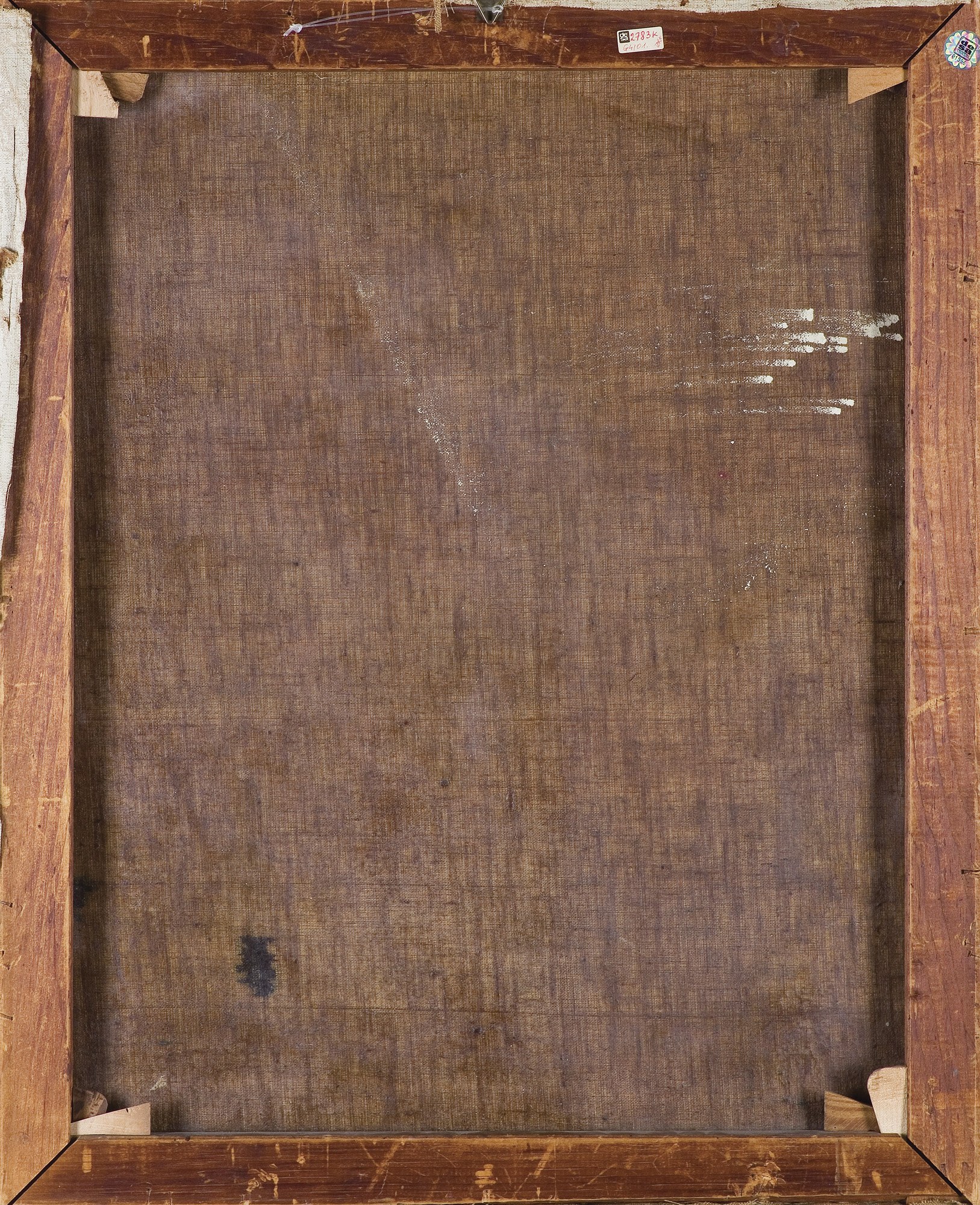
On the upper bar of the painting loom two auction stickers.
On the upper slat of the frame three auction stickers, on the left and right side stickers with the numbers: 94 i 86.
The painting reproduced and mentioned in:
- Jerzy Malinowski, Painting by Zygmunt Menkes, "Pamiętnik Sztuk Pięknych" 2003, no. 2, p. 78.
The most iconographically interesting seems to be Self-Portrait with Torah. This painting is a special work in the history of Jewish painting. For the Torah is not held by a rabbi or (symbolic) Father, but by the artist, thus emphasizing his cultural affiliation. It refers to (...) M. Gottlieb's work Jews praying in the synagogue during Yom Kippur. In this painting, Gottlieb, by placing his figure next to a rabbi, contrasts his own "skeptical" attitude with the ossified tradition of the rabbis (...). Although Menkes' pose in Self-Portrait with Torah refers to Gottlieb's pose, the ideological meaning of the painting is different. For it does not signify opposition to tradition, but acceptance of it.
Jerzy Malinowski
After staying in Paris for several years, around 1928, Menkes began searching for his roots. Like other Jewish artists of Polish descent, he was experiencing his national identity, accompanied by worldview dilemmas. Hence, two religious themes appear in his paintings - Jewish and Christian. As Jerzy Malinowski writes, the former includes ecstatic synagogue scenes, biblical scenes and depictions of Jewish families passing on national traditions from father to son. The motif of the Torah itself ("clothed" or rolled up) appears several times in Menkes' eighth-century works. It is present in the works: Raising the Torah (Ecstasy, 1928), Father and Son, Young Talmudists (1928) and The Family. It is also present in Jewish Old Men (circa 1932). Interestingly, in the context of the offered Self-Portrait with Torah, the boy visible here in the foreground holding the Torah is, as Jerzy Malinowski notes, probably a self-portrait of the artist from his youth.
♣ A fee will be added to the auctioned price in addition to other costs, based on the right of the artist and his heirs to receive remuneration in accordance with the Law of February 4, 1994 - on Copyright and Related Rights (droit de suite)
Zygmunt Menkes (Lviv 1896 - Riverdale, New York 1986) began his study of painting under Kazimierz Sichulski at the Lviv School of Art Industry. Then, between 1919 and 1922, he studied under Wojciech Weiss at the Academy of Fine Arts in Krakow. In 1922 he went to Berlin, where he met Alexander Archipenko and benefited from his guidance. Since 1923, he was permanently in Paris. Associated with the École de Paris circle of artists, he was friends with, among others, E. Zak and M. Chagall. He participated in the Autumn, Independent and Tuileries Salons, and exhibited in many Parisian galleries. He often traveled to Poland; he was a member of the New Generation grouping in Lviv and the Zwornik Association of Artists in Cracow, and participated in exhibitions in Lviv and Warsaw. He traveled extensively, including in 1928 he was in Berlin, and in 1935 in Spain (together with A. Nacht-Samborski). In 1935 he went to New York, where he settled permanently and where he had a solo exhibition in 1936. Over the years he worked with art galleries there and taught at the Art Students League. He painted portraits, nudes, figurative compositions, still lifes and landscapes, and after 1940 also paintings referring to the martyrdom of the Jews. His painting underwent various stylistic transformations. In the Paris period, his paintings were close to the currents of Expressionism and Fauvism. In the post-war period, he limited his colors, introduced a strong contour line, rich texture and, with time, an increasingly pronounced geometrization of forms.













Πρόσφατες επισκοπήσεις
Συνδεθείτε για να δείτε την λίστα θέσεων
Αγαπημένα
Συνδεθείτε για να δείτε την λίστα θέσεων