


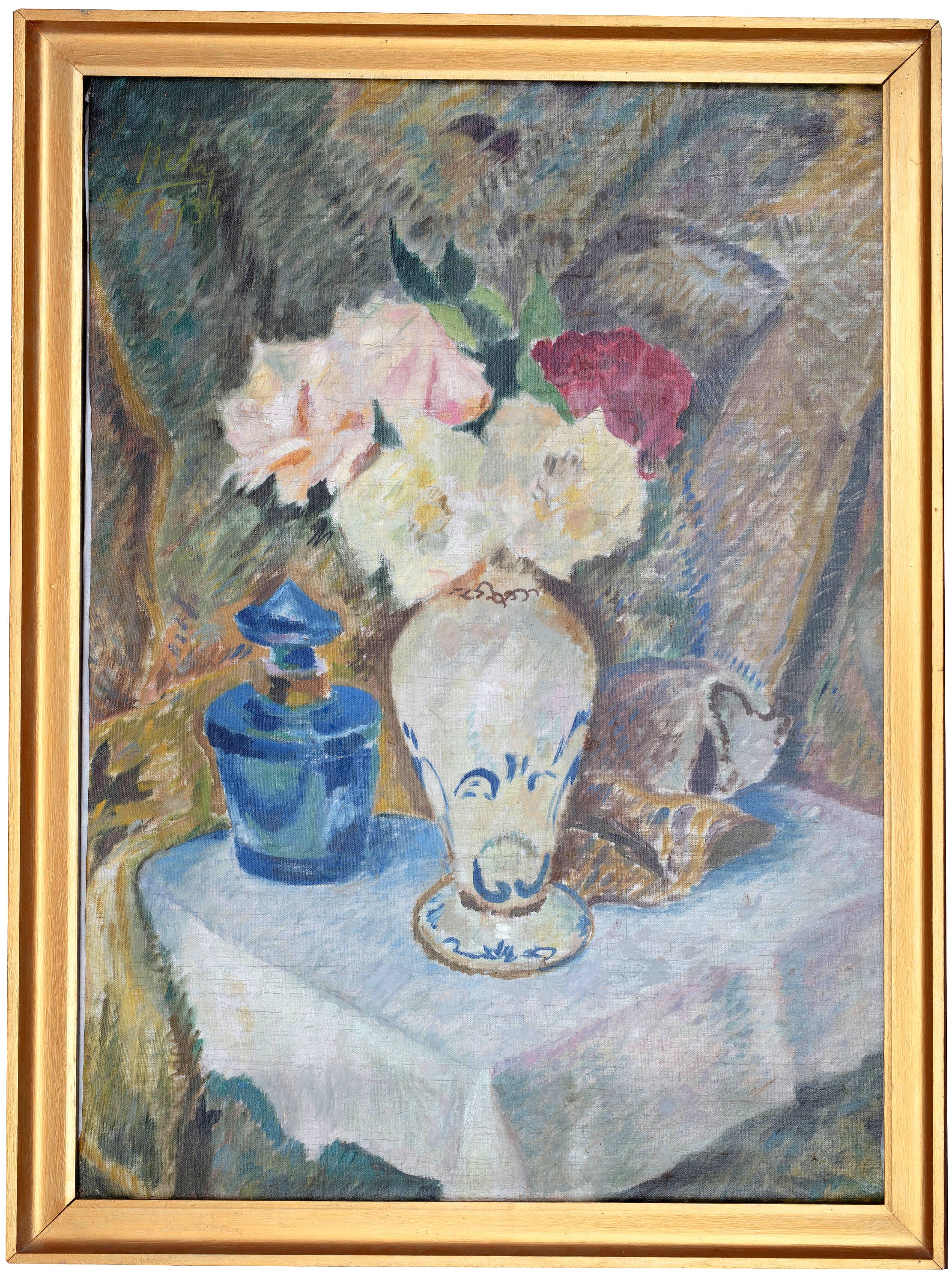
oil, canvas, 70.5 × 50.5 cm
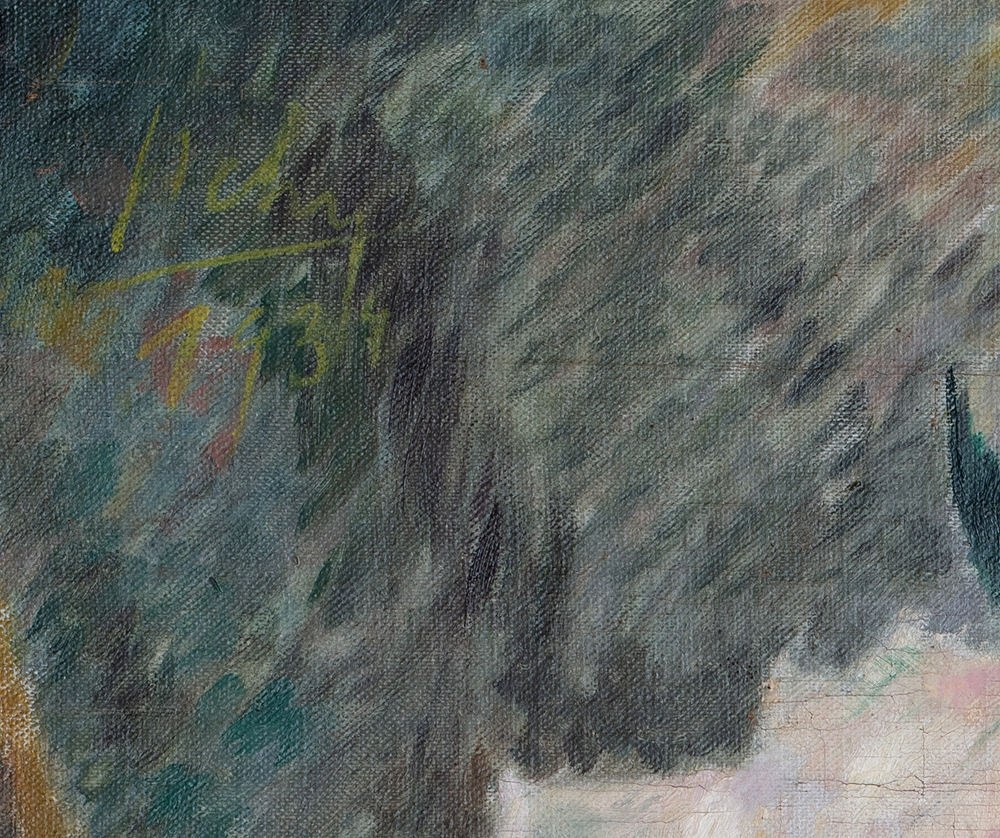
Signed l. g.: "Sich/1934"
Provenance: Collection of Magdalena Migdalewicz (1908- -1986). An acquaintance of Kazimierz Sichulski, she lived near the Armenian Cathedral in Lviv and had a collection of paintings by Polish painters. She was closely connected with the Polish intelligentsia. She selflessly helped Poles in distress. In the 1970s, she donated the painting to friends. Since then it has been in a private collection in Poland.
In his work, Sichulski paid a lot of attention to flowers: once they were large-scale studies of plants, while at other times he used motifs taken from nature in Hutsul-themed paintings, transforming them into ornaments close to Art Nouveau. Flowers were a compositional element in still lifes, sometimes appearing as a minor detail in caricature - but many times they were present. And just as the entirety of Sichulski's painting oeuvre shows the transformations along the path of artistic development, so on the example of flowers one can trace the course of stylistic evolution in the artist's work. Still Life with Apples and Asters, offered in the catalog, is a transitional stage between the richly decorative line, full of subtle charm, marked in the spirit of the Art Nouveau style, in which the influence of the lessons learned from Mehoffer and Wyspianski manifests itself, and the striving for the simplification of forms and their strong stylization and geometrization, revealed in a later period. In the presented composition one can easily detect formal solutions close to the post-impressionist manner of Cezzane. However, as rightly noted by Wladyslaw Kozicki in his monograph on the artist: "The new revolutionary trends in art were not without influence on Sichulski. Although he never adopted the conventions of Cubism and Formism, they were marked in his painting of the time in the form of geometric stylization, in the form of conscious cubism. W. Kozicki, Kazimierz Sichulski with 32 reproductions, Warsaw 1928, p. 10
"There is something of the elixir strangeness in these enlarged flowers, and it seems that Mephisto could give such a large actual flower to Faustus in his hands, and just touching it, just looking at it and inhaling it, would make the old man a young man. Enlarged to the same size as in Sichulski's, the flower is a completely separate painting motif - a motif that has only been discovered, in fact, in recent times, with such a distinct, peculiar expression that it must be recognized as an independent type. But it must be treated as in Sichulski's work: not flatly, placard-like - but taking into account all the transitions of color and taking into account the material, tactile properties of all parts of the flower." Marian Olszewski, Sichulski's Exhibition, "Gazeta Wieczorna" 1911, no. 402











Πρόσφατες επισκοπήσεις
Συνδεθείτε για να δείτε την λίστα θέσεων
Αγαπημένα
Συνδεθείτε για να δείτε την λίστα θέσεων