Other titles: Fair in the Borderlands, Polish Fair [Eng.], Market in the Borderlands
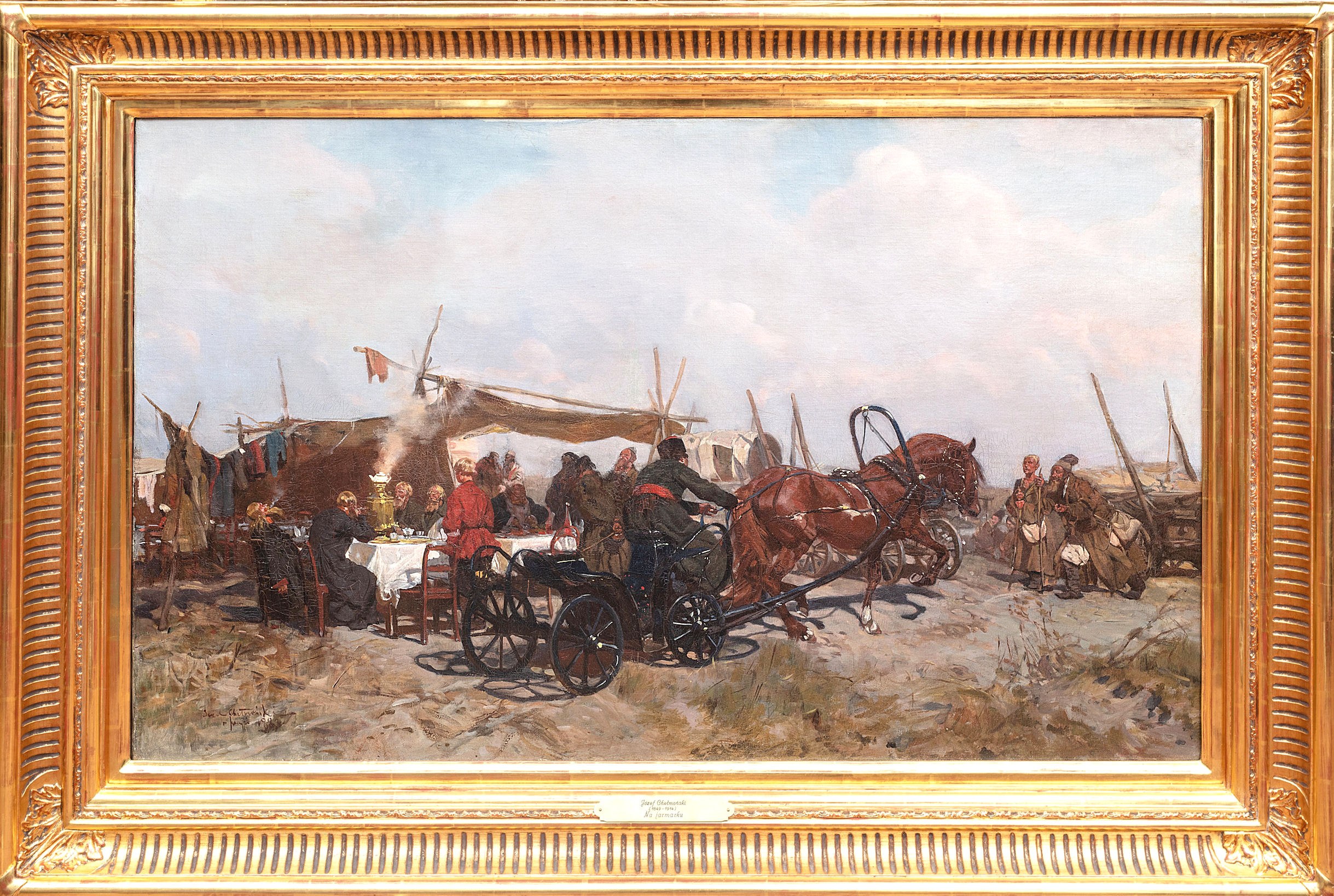
oil on canvas, 57 × 92.5 cm
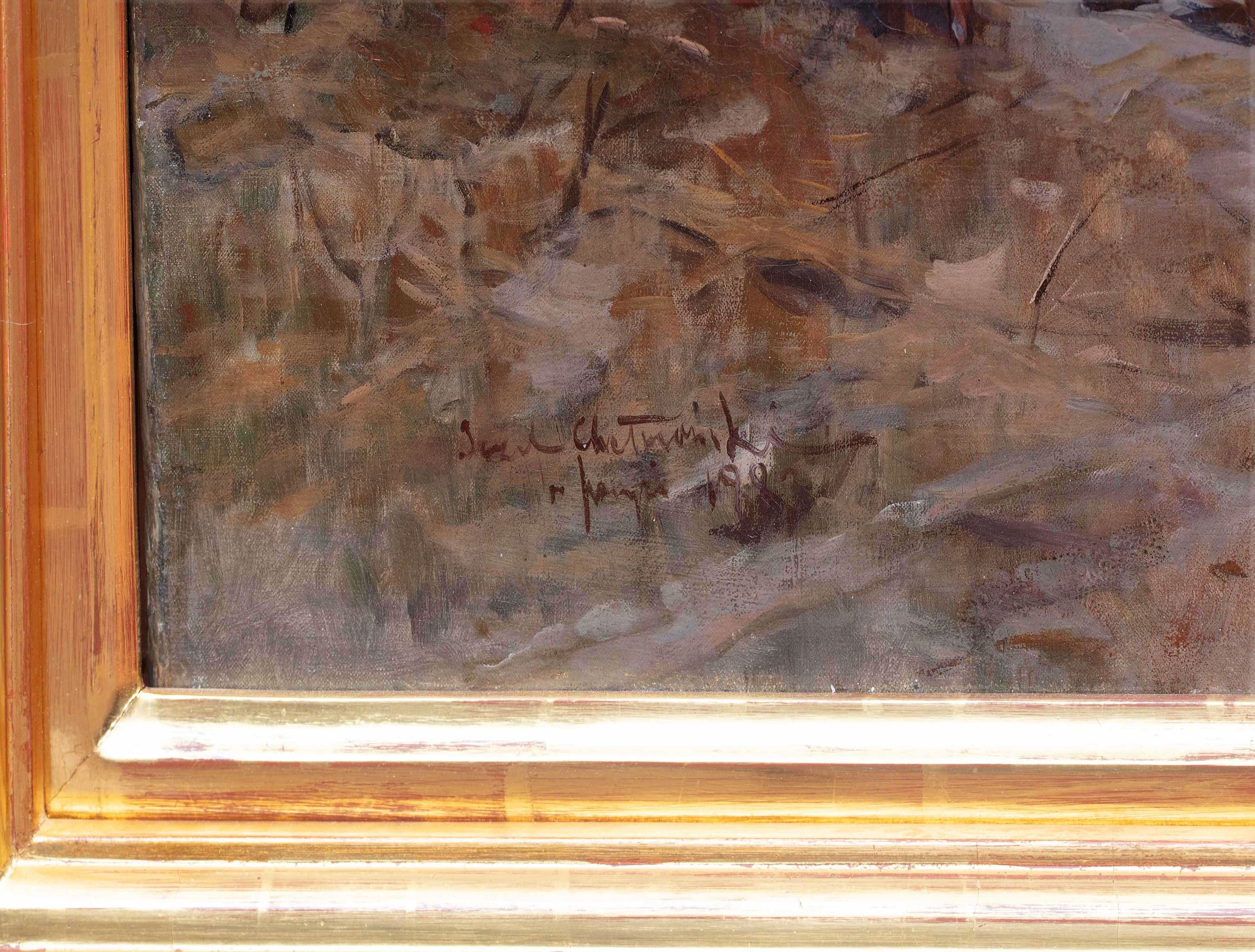
signed and dated lower left: “Józef Chełmoński/in Paris 1883”
Exhibited:
– 2025 Poznań, National Museum, Józef Chełmoński 1849–1914 (March 7–July 13, 2025)
– 2025 Kraków, National Museum, Józef Chełmoński 1849–1914 (August 8–November 30, 2025)
– 2024 – Warsaw, National Museum, Józef Chełmoński 1849–1914 (September 27, 2024, through January 26, 2025)
– 2010 Museum in Łowicz, Tadeusz Matuszczak, Fairs. The Theme of Markets and Fairs in the Work of Józef Chełmoński
– 2009 – Radziejowice Palace, Ministry of Culture and National Heritage Creative Work Center II, Tadeusz Matuszczak, At the Fair. The first public exhibition of the painting since it was painted in 1883 (May 15–June 25, 2009)
Described and reproduced in:
– “CHRONICLE. KRONIKA.” Edited by Z. Michael Legutko. “PRO ARTE. Polish Art in the Western World. Polish Art in the World” [quarterly, Brooklyn, NY]. Summer 1987, p. 36, ill. (as: Józef Chełmoński—Polish Fair, 23 × 36 in./59 × 91.5 cm)
– Auction catalog. [Organizer:] Z. Michael Legutko. Lipert Gallery, 147 Milton Street, Brooklyn, NY 11222. Brooklyn, NY, May 16, 1987, (listed as: Polish Fair, 1883).
– “CHRONICLE. KRONIKA.” Edited by Z. Michael Legutko. “PRO ARTE. Art in the Western World. Polish Art in the World” [quarterly, Brooklyn, NY]. Fall 1987, p. 79 (listed as: Polish Fair/Targ na Kresach).
– “Józef Chełmoński (1849–1914).” Vol. I, Monographic Exhibition (edited by Tadeusz Matuszczak. National Museum in Poznań. Poznań 1987, p. 36, footnote 68 (as: At the Fair, 1883)
– Tadeusz Matuszczak, “Józef Chełmoński.” Kraków, Kluszczyński Publishing House, 2003, color ill. on p. 71 (titled: At the Fair, 1883, oil on canvas, 59 × 91.5, private collection).
– Auction catalog “Art Auction.” AGRA-ART, Warsaw, Hotel Bristol, March 22, 2009, lot 47, two color illustrations. 1: FAIR IN THE BORDERLANDS, 1883
– “ArtBusiness” 2009, No. 5 (“Collector” No. 3 – listed as Józef Chełmoński/1846–19141 “Fair in the Borderlands,” 1883
– Tadeusz Matuszczak, Józef Chełmoński, “At the Fair,” [First public display of the painting since its creation in 1883], Radziejowice 2009.
– Józef Chełmoński 1849–1914 [exhibition catalog], vol. 2,
in Warsaw, Warsaw 2024, cat. no. 120, p. 157.
Provenance:
– Collection of Dr. Eugene L. Slotkowski (1920–2007), Chicago. Dr. Eugene was a well-known pediatrician and collector of Polish descent. He was the son of Joseph B. Slotkowski, founder of the Slotkowski Sausage Company in Chicago. He authored numerous publications[1] in the field of pediatrics. As part of the activities of The Kosciuszko Foundation American Center for Polish Culture in New York, he established the “Publication Found Achievements Award.” His pride in his Polish heritage fueled his passion for Polish culture, art, and history. Since the 1950s, he had been a passionate collector of Polish paintings. His collection included works by, among others, Henryk Siemiradzki (“Dance Among Swords”), Wierusz-Kowalski, Juliusz Kossak, and another painting by Chełmoński, “Czwórka” (The Drive) (oil on canvas, 45.7 × 76.5 cm). His collection was later dispersed.
— In 1986, the painting was purchased by Zbigniew M. Legutko at the Lipert Gallery in New York. Zbigniew Michał Legutko (1940–2006)—he began his career in the late 1970s as THE LIPERT STUDIO (17 Norton Road, East Brunswick, New Jersey). For many years, he organized auctions of Polish paintings; he was the editor and founder of the magazine “PRO ARTE” (1987–1988) (Polish Art in the Western World) “dedicated to Polish art abroad,” and was the curator of solo exhibitions and author of publications on, among others, Stanisław Eleszkiewicz, Eugeniusz Wolski, and Zygmunt Menkes. He helped build collections—including those of Ewa and Wojciech Fibak, Tom Podla, Bożena and Jacek Blach, and Barbara Piasecka-Johnson.
– Since 1987, the collection of Marion J. Dudek (a collector from Palm Desert, California). Purchased at auction on May 16, 1987, at the Lipert Gallery.
– 2009: private collection, Poland (purchased at the Agra-Art auction on March 22, 2009). On loan to the Palace in Radziejowice
The painting *At the Fair* dates from Chełmoński’s Paris period. It was painted in 1883. The painter lived and worked in Paris—then the center of the art world—from late 1875 to mid-1887, a span of nearly twelve long years. After clashes with critics and fruitless attempts to “make a living from art” in Warsaw, here in Paris the artist quickly achieved spectacular success—both artistic and financial. Parisian art dealers took an interest in Chełmoński, among them Adolphe Goupil, the most powerful dealer of the time. As fortune would have it, the exotic borderland themes of his works perfectly suited the tastes of American collectors, whose trips to Paris in search of “art” played a significant role in sustaining the business of Parisian art dealers. The demand for Chełmoński’s works was to remain steady for five years (1876–1881). And so, here in Paris, the artist’s brief and only period of financial success and social prominence began. The time had certainly come—one Chełmoński had long awaited—though it was perhaps not entirely in keeping with his nature as more of a “country man” than a “socialite.”
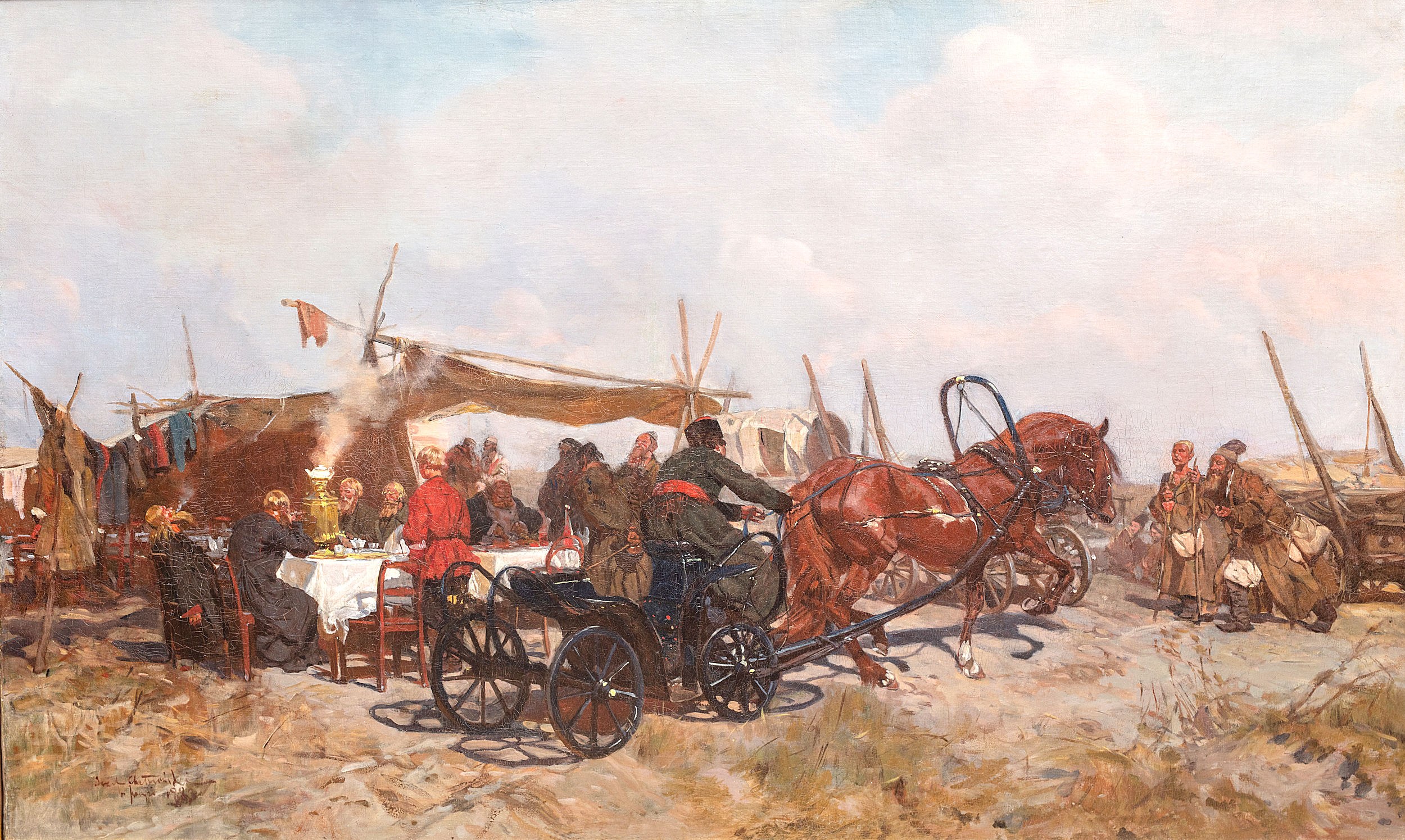
This period of prosperity for Chełmoński ended on July 15, 1881, with a drastic increase in customs duties on paintings imported into the United States. Goupil stopped buying Chełmoński’s paintings, and their prices plummeted. Despite this, there were almost no buyers to be found. For Chełmoński, a time of struggle and hardship began. In my opinion, this was also a time of gradual quieting down, a departure from the dynamic, large-format canvases featuring galloping steeds and crowds of borderland characters brimming with energy. An era of distinctly smaller, calmer canvases had arrived. Yet they were fascinating for what might be called “small realism,” delighting the viewer with a wealth of details through which we savor this exotic, borderland everyday life. The painting “At the Fair” dates from this very period; it enchants with the atmosphere of a lazy, sweltering day at the end of summer and the hustle and bustle of the fair. In a borderland restaurant sheltered by tarps, at simple tables set with white tablecloths, fairgoers are seated. At a corner table, a group is enjoying tea. In the center of the tabletop stands a hot samovar, gleaming with the yellow sheen of polished metal. A white porcelain teapot sits atop it, sending thick wisps of steaming tea into the air. To the side, a young waiter in a bright red smock patiently awaits orders from a group of four bearded men. The two closest to us appear to be priests in black cassocks. The one sitting across from them gives the impression of a merchant with the features of a Russian peasant. The heads are captured and painted masterfully, with expressive patches and splotches of paint. And the figure of the priest, with his head thrown back and a beard sticking out like a tuft of straw, leaning dangerously far back in his chair and puffing smoke, borders on genius. At the neighboring table, a portly, balding dandy with a handsome yellow mustache is gorging himself. He has tied a large white napkin under his chin. And rightly so, for it has been densely splattered with stains. He is surrounded by a little circle of three Jewish merchants in the midst of a heated discussion. In contrast to the yellow tableware at the first table, red dominates our nobleman’s table, accented by the vertical red of a slender carafe. A beggar is making his way toward the revelers with long, energetic strides. His left hand is extended in a characteristic gesture of begging. Leaning on his beggar’s staff, he leads a young, blind companion at his side. A black-lacquered carriage of striking design is just passing in front of the revelers. Beside it, in a harness adorned with a plaited rope, a thoroughbred chestnut horse walks at a trot. At that moment, the coachman dramatically turns his head to the right, for, having leaned out, the coachman spotted at the last moment an unhitched wagon standing on the left and, to avoid snagging on its rear wheels, violently pulled the right rein. The painting captivates with its gallery of characters and a wealth of exotic objects, items, props, and details that we savor as we wander through the fair. Stanisław Witkiewicz, a close friend of Chełmoński’s, wrote the following about his fairs:
“He wanted his painted fair to buzz with all the commotion and clamor of real life—the whinnying of horses biting at each other, the clatter of carriages, the singing of swollen, scarred beggars, the crack of whips, and the merchant’s cry: ‘Los ni springen’ [Yiddish—‘don’t let it jump’] (...), all of this shrouded in clouds of steam, splattered with mud—was meant to burst forth from the canvas, framed in gold, and come to life.” (…). The painterly freedom with which Chełmoński, using confident and varied brushstrokes, constructs this unique architecture of a borderland fair is breathtaking and commands admiration.The painting is executed with the dynamic brushstrokes and touches characteristic of Chełmoński’s Parisian period, employing varied patches of color, oscillating between small, fine spots and free, broad applications; ranging from thick, textured applications to almost dry, smooth, rubbed-in ones, sometimes with a distinct brushstroke and sometimes almost glazed. In Chełmoński’s case, the expressive emphasis on the painterly material described above in no way diminishes—but rather enhances—the accurate, realistic illusion of the depicted scene. For Chełmoński is a master of drawing and observation, which is why his painting—based on a drawn framework and precision of perception—is so fascinatingly faithful to nature and its forms (…).”
The appearance of the theme of borderland fairs in Chełmoński’s work from 1882–1883 is closely linked to the artist’s stay in the borderlands in late summer 1881. As I have recently been able to determine, based on an analysis of Chełmoński’s letters to his wife, the painter left Paris for Poland by train around August 10, stopping in Munich, where he visited his close friend Stanisław Witkiewicz. From Munich, he traveled directly to Kraków, arriving there on the evening of August 21 or the following morning. On Sunday, August 28, he left Kraków for Lviv, where, at the Kulparków “Institute for the Insane,” he met with his dear friend Adam Chmielowski, who was undergoing treatment there. By August 31, Chełmoński is already in Ternopil. From there, he writes to his wife:
“I am writing to you from the farthest point of my journey. I will make a detour from here, and in two days I will already be approaching you [in Paris—TM]. I’m seeing some lovely things here. We’ll be able to come here for the summer instead of going to the seaside [to the Normandy coast… (TM)]. You can’t write to me because I’m constantly on the road.”
Tarnopol, picturesquely situated on the Seret River, was a city widely renowned for its fairs and weekly markets. So, without a doubt, it was here in Tarnopol that Chełmoński sought inspiration for his paintings. In the letter quoted above, Chełmoński informs his wife that he will be making a detour from Tarnopol. Unfortunately, we do not know where. Perhaps he meant to visit one of the small towns known for their fairs. It could have been Kozowa or Ułaszkowce. Jarmolińce seems less likely, as it is located too far from Tarnopol. “[…] In Chełmoński’s estate, within the family collection, large-format professional photographs have been preserved, depicting a multitude of borderland types and figures, architectural views, genre scenes, and landscapes. I therefore have reason to assume that Chełmoński, in addition to his drawn sketches from life (though sometimes based on his—I have no hesitation in saying—brilliant visual memory), in addition to photographs of subjects that interested him, which he commissioned personally, also made use of the aforementioned supplementary photographic material. Thus, it should be assumed that Chełmoński, in his paintings, created depictions of a fair—subordinate to artistic as well as commercial rules—rather than a reproduction of a specific, real scene. What is important, however, is that the image proposed by Chełmoński, through the evocative power of his artistic vision, became more real than raw reality itself—it created a synonym for the Polish fair with all its exoticism and picturesque charm” (T. Matuszczak, “Józef Chełmoński, Jarmark na kresach,” Radziejowice 2013, p. 18).
A characteristic feature of Chełmoński’s Parisian period is that the signature (first and last name) on his paintings was written in uppercase letters, without Polish diacritical marks, just as the year the painting was created was almost always specified with the word: “paris” written with a lowercase letter. For clarification, it should also be noted that during his stay in Paris, Chełmoński used two forms of his first name in his signatures: JOZEF or JOSEPH. The signature on our painting is written in cursive, with Polish diacritical marks, and the place of origin is written in Polish: “w paryżu.” All of this could indicate, in my opinion, that the painting was commissioned from Chełmoński by a fellow Pole, hence the signature in his native language. (…) Unfortunately, it has not been possible to identify the commissioner. Moreover, the entire century of the painting’s history is shrouded in mystery.
The quoted excerpts are from: Tadeusz Matuszczak, “Józef Chełmoński, ‘At the Fair’ [The first public display of the painting since it was painted in 1883],” Radziejowice 2009