


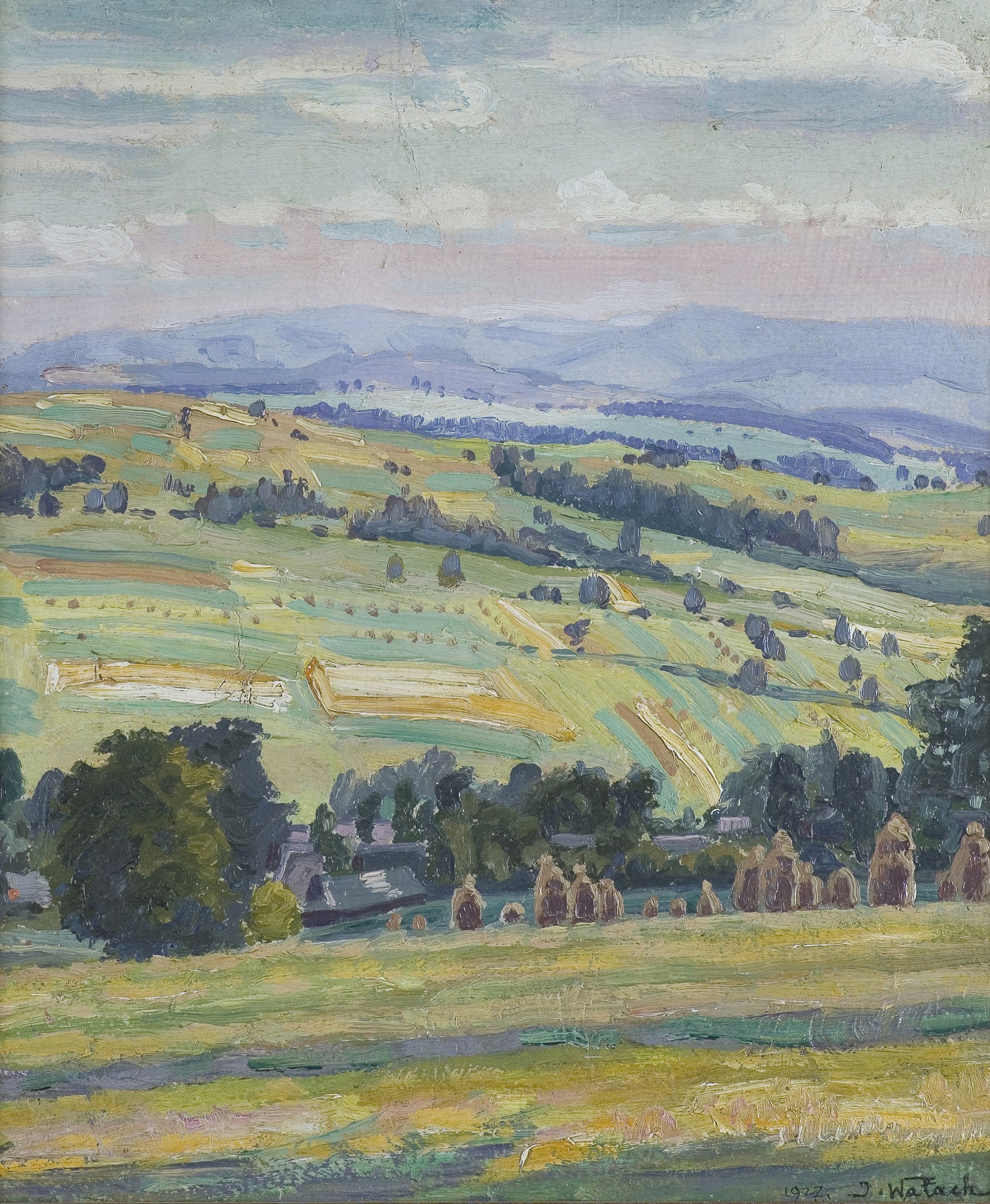
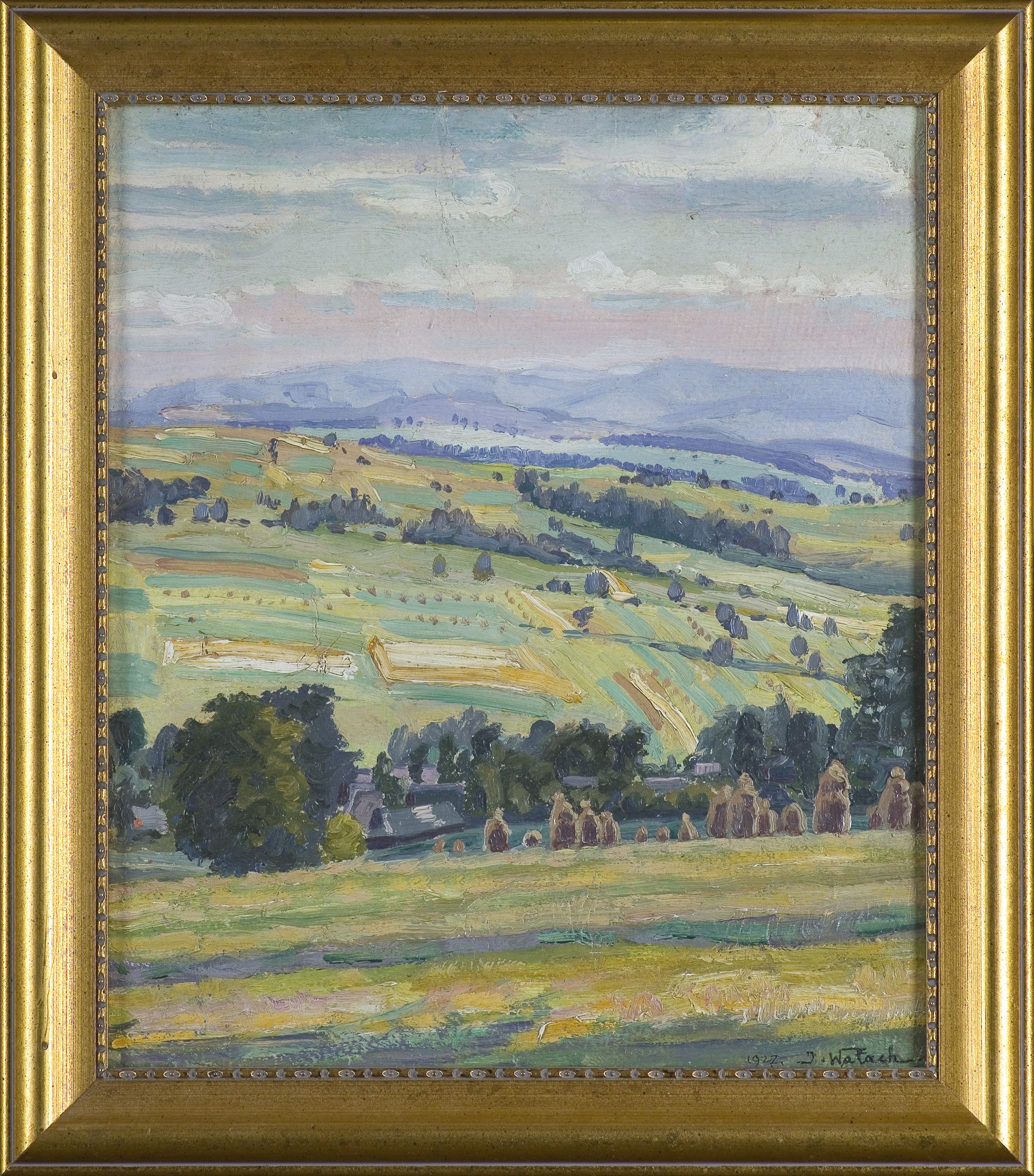
34,0 x 29,3cm - oil, cardboard
Signature p.d.: 1922. J. Walach
On the reverse a sticky note in checkered paper (ink): No. 14 1926 | Jan Walach art | "View on Slovaks" | from gold grape | Oil cardboard | 40 zl. | Jan Walach | Silesia Istebna.; l.d. sticker of Warsaw Zacheta (stamp, print, ink): 17016 Author Walach Jan | Title View on Slovaks Type of work ol | Price 40 Ownership Date sent 192; on sticker (in blue crayon): N
♣ a fee will be added to the auctioned price in addition to other costs resulting from the right of the artist and his heirs to receive remuneration in accordance with the Act of February 4, 1994 - on Copyright and Related Rights (droit de suite).
Jan Walach(Istebna 1884 - Istebna 1979) - painter, graphic artist and sculptor came from a family of highlanders from the Beskid region. Since 1898 he was a pupil of the Polish Grammar School of Macierzy Szkolny in Cieszyn, and then of the Sculpture School in Zakopane, where he studied with Jan Nalborczyk (1901-1903). From 1904 to 1908 he studied at the Academy of Fine Arts in Cracow under J. Mehoffer, J. Fałat, F. Ruszczyc and J. Stanisławski. With a scholarship from the Academy of Fine Arts, he went to Paris and continued his studies at the Acadèmie Julien and the École de Beaux Arts. He traveled to Italy and also visited Nuremberg and Prague. In 1913 he was drafted into the Austrian army. He served as a regimental painter and medalist. He drew maps, painted portraits of soldiers and battlefield paintings (Battle of Gorlice, 1915). After the war, he was awarded the gold cross for bravery. In paintings painted after the war, he often took up patriotic themes related to the rebirth of Cieszyn Silesia (Encroachment of Polish troops into Cieszyn, Rally in Jablunkov). He settled in his hometown of Istebna on Andziołówka, and his work "is connected with Istebna, its people, its landscape. He immortalized these themes on canvases in oil painting, watercolor, woodcuts, drawings and sculptures, depicting the vast landscape of the Beskid, wooden huts, interiors of huts, the work of highlanders, games, rituals, they are a realistic document already historical and ethnographic" [quoted by B. Wallach]. He also painted religious compositions. He was the author of polychromies in churches in Istebna, Jaworzynka, Koniaków and Wisła (not preserved). He designed stained glass windows (including churches in Jedlicze, Goleszów), and was involved in sculpture. Since 1932 - encouraged by Jerzy Warchałowski, his patron and friend - he took up wood engraving, achieving true mastery in this field. He exhibited from 1904; in Minsk, Cracow, Katowice and Warsaw. He showed his woodcuts at exhibitions abroad - in Paris (1937, bronze medal), London, Amsterdam, Chicago, Hamburg (1937-1939). After World War II, he continued to live and work in Istebna. He also died there. His work was recalled by a retrospective exhibition organized by the Archdiocesan Museum in Katowice, and also shown in Zabrze, Kosice, Krakow, Zakopane and Warsaw. The artist's home - on Andziołówka in Istebna - now houses a Biographical Museum dedicated to him, which is run by his daughter, the artist-painter Barbara Walach. In addition, the artist's works are in the collections of numerous museums, including the National Museum in Warsaw and the Silesian Museum in Katowice.











Πρόσφατες επισκοπήσεις
Συνδεθείτε για να δείτε την λίστα θέσεων
Αγαπημένα
Συνδεθείτε για να δείτε την λίστα θέσεων