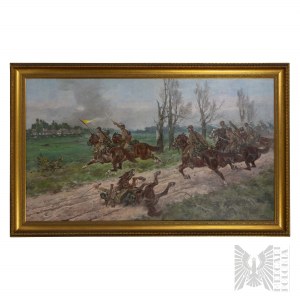


Dimension of thePicture : 70cm x 120.5cm
Dimension of Frame : 83cm x 133cm
Technique : Oil on canvas
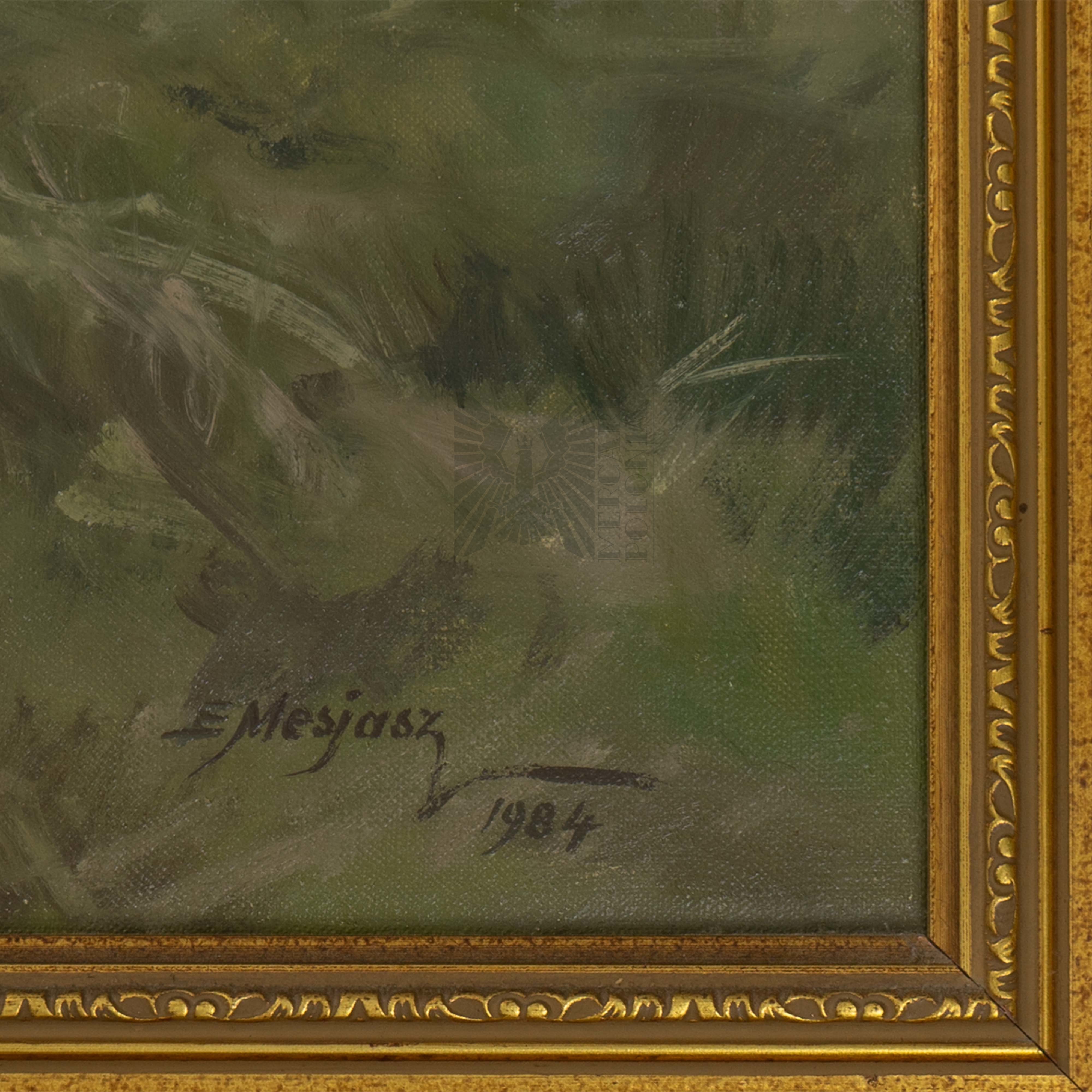
Author : Edward Mesjasz (Częstochowa 1929 - 2007 Częstochowa)
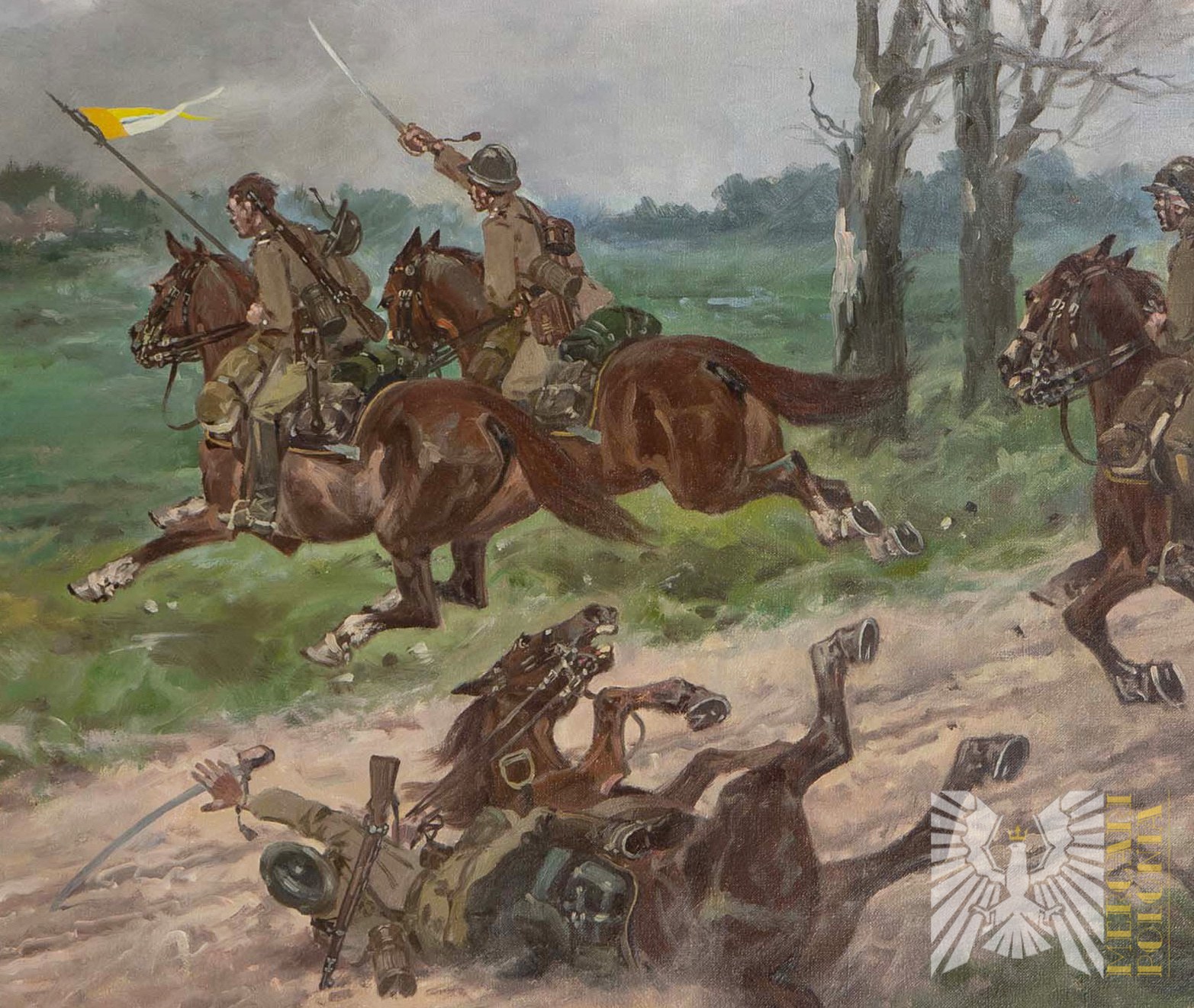
Huge(70cm x 120.5cm) battle painting depicting the 3rd Squadron of the 27th Cavalry Regiment during the Charge at Moraniec by Edward Mesjasz.
The state of preservation can be seen in the photos.
The Battle of Moranets (Lviv Province), the last Charge of the Polish Cavalry during the Defensive War (September Campaign), took place on September 26, 1939. In the course of this clash, the 27th Cavalry Regiment (Nesvizh) of the Novogrudok Cavalry Brigade conducted two charges against a German infantry battalion defending the village of Moranets. Despite the repulsed attack, the German forces decided to leave the village after the battle. As a result of the clash, 20 lancers were killed,
Edward Mesjasz (Częstochowa 1929 - 2007 Częstochowa) - Polish battle painter, known for his depictions of the history of the Polish Armed Forces. He graduated from the Academy of Fine Arts in Cracow, where his mentor was, among others, Jerzy Kossak. After graduating, he worked as a teacher of technical drawing, first at an art high school, then at a textile school. Among his students was the well-known artist Jerzy Duda-Gracz. Messiaen was a member of the Association of Polish Artists, and had several solo exhibitions, including at the War Museum in Ottawa and the District Museum in Czestochowa. His works have also been included in numerous group exhibitions. adorn the collections of many renowned museums, including the Polish Army Museum in Warsaw and the Canadian War Museum in Ottawa. The painted works were underpinned by thorough preparation, with Messiaen visiting battlefields and collecting militaria. Some of Messiaen's most important and best-known works include depictions of Polish cavalry, of which the above work is an excellent example.
----------------------
The following description is from : https://kawaleriaochotnicza.pl/2019/06/06/ostatnia-szarza-wrzesnia-1939/
"Also in Moranets were the Germans. The surprise of both sides is complete. Capt. Koszucki organizes a battle group, which attacks one part of the village over the bridge. The attack collapses in the fire of the enemy's machine guns and artillery. It is necessary to fight for every homestead and for every house. At the same time, Colonel Zelislawski orders the 27th Lancer Regiment to occupy the other part of the village. Due to the lack of time to regroup, Lieutenant Colonel Pajak gives the order to charge. The 3rd and 4th squadrons charge into the village. The opponent of the Polish lancers was a German battalion from the 28th. Infantry Division. Under heavy machine gun and artillery fire, the charge collapsed. In the literature, the question of whether the village was captured or partially occupied, or whether the entire attack collapsed in its foreground, is quite unclear. Let's give the floor to the officers of the 3rd and 4th squadrons, whose units broke in between the village buildings. According to reserve second lieutenant Jozef Tolloczka, the battle took the following course: "My squadron (3rd squadron) as the leading squadron under the command of Major Rudnicki fell into the village. In the square, in the middle of the village, we saw a detachment of German soldiers (about 30 men), who shouted something to us. At the head was probably a German colonel. Major Rudnicki momentarily fired his pistol, putting the German colonel to death, and we all immediately rushed at the group of Germans chopping with sabers or shooting them with pistols. Only a few probably managed to escape. At that moment, and it all happened very rapidly, we received heavy fire from all sides (from the gardens, from the roofs, etc.). The Germans shot at us from hiding. It was then that our squadron commander, Capt. Kwiecinski, was probably killed. (...) We fell to the other side of the village and behind the cemetery we dismounted from our horses to fight on foot. At that time, the next rows charged into the village, other units again dismounted from their horses to fight on foot. The village was taken in two fires, was taken, captured. The Germans surrendered along the entire line. We took a lot of Germans prisoner at that time. (...) "This is confirmed by the second account of a participant in this battle by Second Lieutenant Jan Kanty Drac of the 4th Squadron. "The brigade wanted to break through the Przemyśl - Lviv road to the south more or less in the middle of the distance between these cities closer to Przemyśl. The day of September 26,27th Lancers Regiment in the front guard of the Brigade, I with the squadron as the front guard of the Regiment. At dawn, I encountered enemy outposts by the road, which I endure, drive up to the village /Budy or Bole I do not remember/ where I see the strength of the npl army, guns, etc. I report this to the deputy commander of the regiment and advise him to throw one squadron to the left, the other to the right and I will hit the center of the village all the more so since there is a small bridge over which I have to get through, and that the enemy is just gathering in the strength of about a battalion and I am very weak without c.k.m. I received a dry answer "let you press forward temco ma and that from the beginning, behind you goes the 3rd squadron". I immediately rushed two hand machine guns near the bridge alone in a column of platoons ran at a gallop across the bridge to the village under the cover of the hand machine guns which, after the third platoon passed, were to immediately join the squadron. The enemy, disoriented, took cover in the yards of houses shooting chaotically, but was very numerous. In this impeachment I broke through the village to its southern side chopping and shooting whoever I could along the way. Before I was able to take up positions and press on to the village from the other side, that is. from the south, the enemy opened a murderous fire on the third squadron, on the column of the Regiment and the rest of the brigade. The commander of the 3rd squadron was killed by the first bullets, Captain Major Major Jerzy Kwiecinski Jozef /after the battle, i.e. after 4 hours, we did not find his body, despite the fact that many saw the place where he fell from his horse/, the squadron, however, managed to break through and detach to me, where we attacked the enemy from the rear together. In this battle, as it turned out, with the infantry battalion insuring the Artillery Regiment, which stood about 4 kilometers away, were killed from the 27th Regiment of Maj. Lizon, Lieutenant Olszewski Stefan commander of the 2nd squadron /a very brave officer whose body was completely charred/, second lieutenant in reserve commander of the machine gun platoon /I don't remember the name/, cadet master at arms De La Tour commander of the machine gun platoon, sergeant major Idczak chief of the medical vehicle /hurt arm - he died in the hospital/".From both reports it appears that thePułkopanocontrolled the village of Morance and this is the version we accept. Although, in fact, the fighting was interrupted by the Germans. A German parliamentarian was sent to the Polish side, who offered to surrender on honorable terms.When the Polish side did not agree to these terms they were assured that they would not be attacked by the Germans. There was also an exchange of prisoners of war.The charge at Moranets was one of the major battles of the27th. Lancer Regiment.The losses of the regiment amounted to about 80 men, killed and wounded. Among those killed were: major Wlodzimierz Lizon, commander of the Headquarters of the Novogrodek Cavalry Brigade, rittmaster Jozef Karol Kwiecinski (commander of the 3rd squadron), lieutenant Stefan Zygmunt Olszewski (commander of the 2nd squadron), second lieut. Jerzy de Latour (commander of the 1st platoon in the 1st squadron), Second Lieutenant Ignacy Franciszek Poplawski (commander of the 2nd platoon in the machine gun squadron). Wounded, in turn, were Second Lieutenant Tadeusz Wilk and Lieutenant Waclaw Szypnicki, as well as the26. lancer regiment.In the cemetery in Moranets there is a grave of 18 soldiers killed in that clash. The charge of the27. Lancer regiment was also the last cavalry charge of the 1939 war."