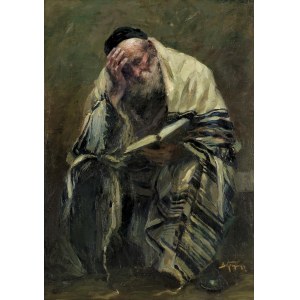
Signed p.d.: Behrmann
As stated by Jerzy Malinowski, works depicting genre scenes depicting Polish Jews were created by the artist after 1910, that is, at the time when he settled in Lodz after returning from his studies in Paris. The organizer of the exhibition, the well-known critic Zygmunt Bromberg-Bytkowski, wrote about his paintings from this series, presented at the 1921 Jewish Art Exhibition in Lodz: Their various subjects and their depiction are always purely painterly. The artist lovingly tries to think through the modest painting problem, which the chosen subject brings to him, to the end and conscientiously solve it. (...) From some of the paintings (...) [it is]evident that the artist knows how to be passionate about his subjects (quoted in J. Malinowski, Malarstwo i rzeźba Żydów Polskich w XIX i XX w., vol. I, published by PWN, Warsaw 2000, pp. 60-62).
Adolf (Abraham) Behrman or Behrmann began his study of drawing and painting at the school of Jakub Kacenbogen in Lodz. Around 1900 he went to Munich, where he initially studied privately, and from 1902 to 1904 studied at the Academy of Fine Arts under Gabriel von Hackl. After a short stay in Lodz in 1905, he went to Paris. He painted a lot, and in 1910 took part in the Salon des Independents exhibition. He returned to Poland in 1911; he lived permanently in Lodz. He took an active part in the artistic life of the city - he ran his own painting school, exhibited a lot, engaged in collecting, willingly making his collections available to those interested. In 1916 - together with Artur Szyk - he founded the Association of Artists and Supporters of Fine Arts in Lodz. After 1920, he traveled a lot - he was in Morocco, Tunis, Algiers, Egypt, Palestine (1924-27), Morocco (1932-35). Later he also traveled to Italy, France, Spain and Germany. He painted landscapes, portraits and genre scenes, still lifes. He exhibited mainly in Lodz, at TZSP in Warsaw and in Palestine, Morocco, New York and Hamburg. In September 1939 he left for Bialystok; he died in the local ghetto. His paintings dispersed; today they are mainly in Polish and foreign private collections, and relatively few have found their way into the collections of the Art Museum in Lodz, the Jewish Historical Institute in Warsaw, the Historical Museum of the City of Cracow, and the National Museums in Warsaw and Cracow.