


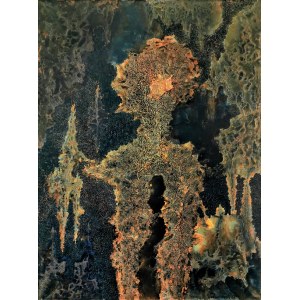
oil, canvas; 131 x 87 cm;
Signed p.d.: J. Tchórzewski 67;
Inscribed on the reverse: HAUT/ J.Tchórzewski 1967 / "Figure";
On the stretcher, fragments of numerous exhibition and inventory stickers.
The featured work by Jerzy Tchórzewski was shown at the 34th Venice Biennale in 1968. The Polish pavilion showed an exhibition of works not only by Jerzy Tchórzewski, but also by Stefan Gierowski. The commissioner of the pavilion at the time was Aleksander Wojciechowski. The featured painting is mentioned in the catalog issued for the exhibition at the 34th Art Biennale.
The painting hung from its creation in the room above the artist's bed.
The painting was exhibited at:
- Zachęta, Warsaw 1968,
- Venice Biennale 1968,
- Retrospective, National Museum, Wroclaw 1980,
- Hammer Gallery, New York 1991,
- Vienna 1987,
- Krzysztofory Gallery Krakow 1987,
- National Museum, Warsaw 1995,
- Kordegarda Gallery, Warsaw 2019.
Jerzy Tchórzewski is considered one of the most important artists in Polish post-war art. He made his debut at the First Exhibition of Modern Art in Cracow in 1948. After graduation, he moved to Warsaw, where he began working at the Academy of Fine Arts in 1954 and was awarded the title of professor in 1987. Tchórzewski's paintings have been described as those that "reflect an awareness of foreboding chaos." His works intertwine surrealism with abstraction, as well as the eternal rediscovery of the human figure. He himself has said of his work that he "tries to wring energy out of the dead matter of painting." His work, on the one hand, arouses anxiety through the aggressiveness of its forms, but also attracts through its strength, energy and mystery. As Tadeusz Różewicz wrote of Tchórzewski, "I warmed my cold hands by the fire of his painting."










Πρόσφατες επισκοπήσεις
Συνδεθείτε για να δείτε την λίστα θέσεων
Αγαπημένα
Συνδεθείτε για να δείτε την λίστα θέσεων