


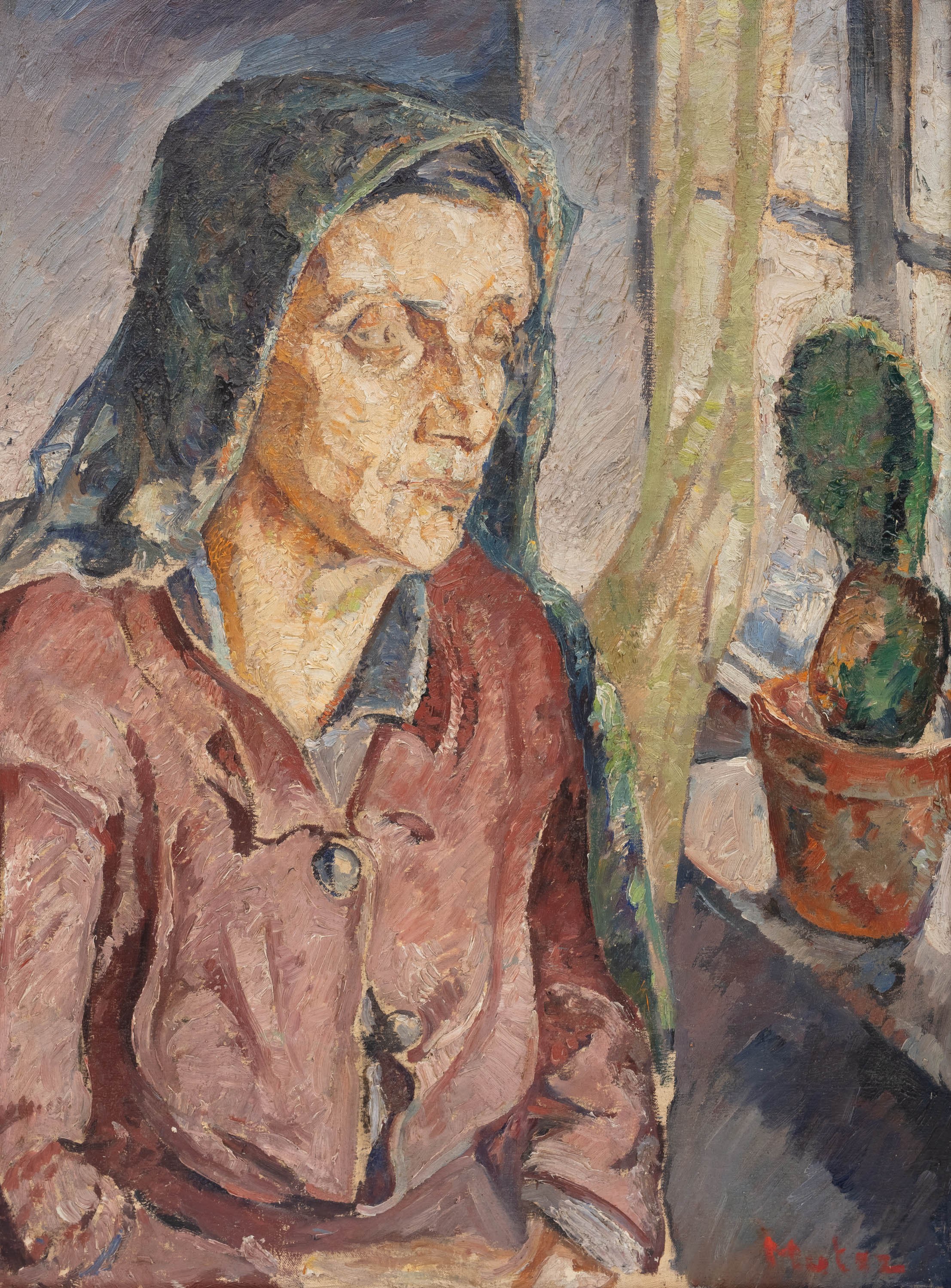
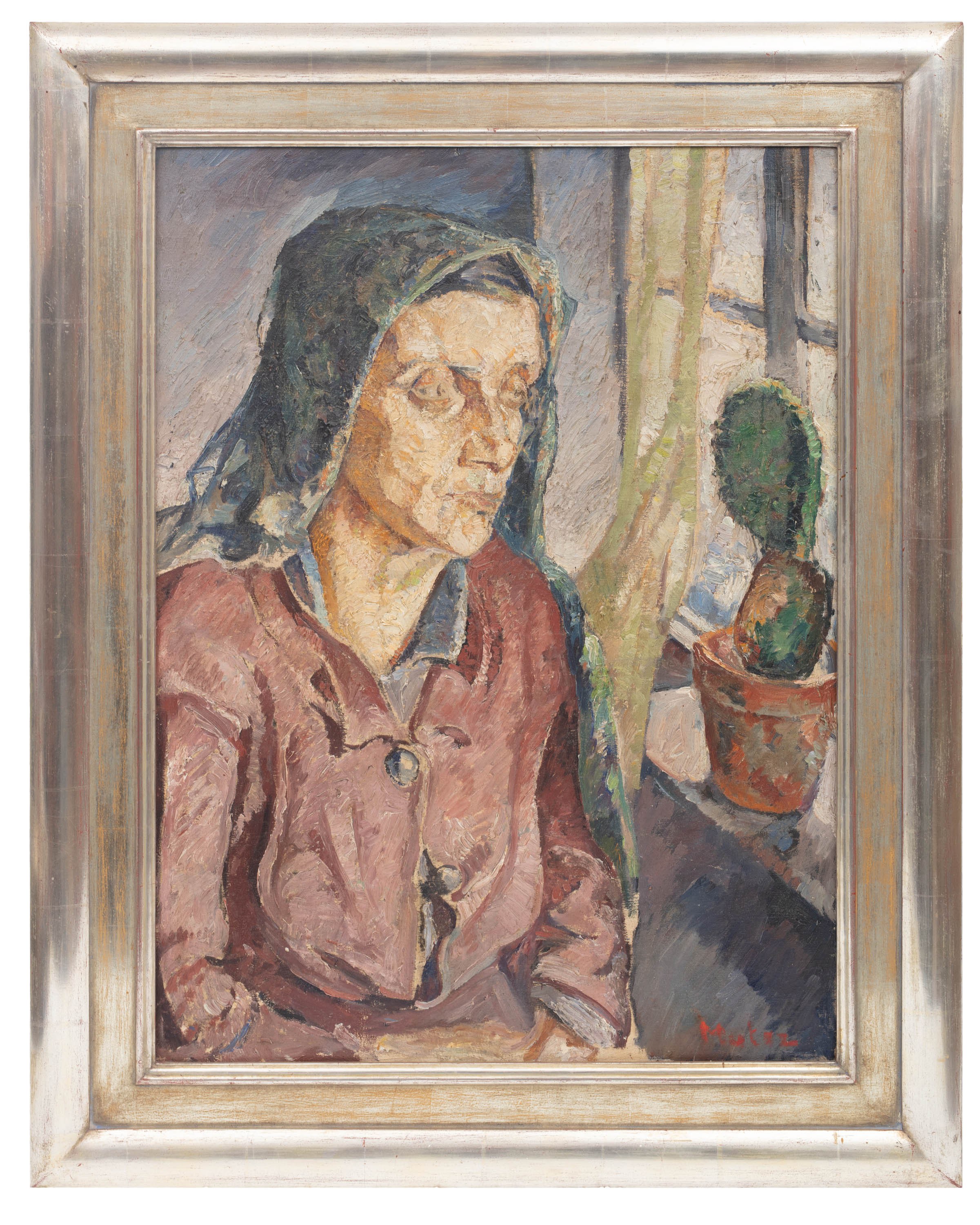
oil on canvas, 73 × 54.5 cm
signed lower right: “Muter”
“Mela Muter’s portraits are a profoundly captured essence of the human being, perceived in some very elusive—and sometimes perhaps the only—moment of inner betrayal in the presence of another person. She is a portraitist gifted with a great ability to penetrate human life, an ability to convey the painstakingly sought-out truth about the person portrayed in the expression of their face, in the posture of the body, in the position and expression of the hands, and of presenting this truth in a very uncompromising manner.”
M. Sterling, “From Parisian Studios: August Zamoyski—Mela Muter,” *Głos Prawdy*, 1929, no. 6, p. 3.
In her work, Melania Muter eagerly drew upon motifs of landscapes and still lifes, but it was her portraits that became the artist’s true calling card, appreciated by both critics and the public. Muter’s portraits can be divided into two categories. The first consists of paintings in which the artist lovingly immortalized anonymous figures—children, elderly women, and men marked by what was often a harsh working-class life—beginning with her very first artistic journey to the coast of Brittany. The second gallery consists of paintings of a more representative nature, where Melania’s circle of models also included the most prominent figures from the worlds of science, culture, and politics; among those who posed for her were Leopold Gottlieb, Władysław Reymont, Auguste Rodin, Diego Rivera, Henryk Sienkiewicz, Leopold Staff, and many others. Mela was able, in her characteristic way, to capture not only the subject’s outward appearance but also their personality, although the artist herself disagreed with this assessment— “…when people say, trying to pay me a compliment—‘You create psychological portraits’—I feel a surge of rebellion! No, I don’t paint psychological portraits at all; I don’t even know what one would have to do to create a psychological portrait. I never ask myself whether the person standing before my easel is good, deceitful, generous, or intelligent. I try to take possession of them and depict them, just as I do with a flower, a tomato, or a tree—to empathize with their essence; if I succeed, I express myself through the prism of their personality…” (“The Bolesław and Lina Nawrocki Collection, Mela Muter (Maria Melania Mutermilch) 1876–1967,” Exhibition Catalog, National Museum in Warsaw, December 1994–February 1995, Warsaw 1994, p. 35).
The presented “Portrait of a Woman” fits perfectly into the entire series of Melania’s portraits—“Healthy and beautiful bodies, faces with regular ‘classical’ features hold no appeal for her. She shows a distinct attraction to characteristically ugly figures, to peculiar types, and to anthropological specimens. Yellow-skinned Gypsies, Jews with long, hooked noses and crooked mouths, Black people, their eyes gleaming white and their puffed lips red, pose for her as models. How far we are from Weiss’s rosy-cheeked, radiant women! Ms. Muter’s subjects have a fever in their blood. Their feverish inner lives have destroyed the beauty of their bodies. Their faces and hands, worn down by the toil of thought, radiate nervous restlessness.” (M. Wallis, “Przegląd Warszawski” 1923, no. 25, cited in: “Mela Muter, Malarstwo/Peinture. Catalog of the Collections of the University Museum in Toruń,” ed. Mirosław Adam Supruniuk, Sławomir Majoch, Toruń 2010, p. 100).


![Mela MUTER [Maria Melania Mutermilch] (1876-1967), Portret młodej kobiety, lata 30. XX w.](https://img1.one.bid/img/8512/2545921_1w.webp)










Πρόσφατες επισκοπήσεις
Συνδεθείτε για να δείτε την λίστα θέσεων
Αγαπημένα
Συνδεθείτε για να δείτε την λίστα θέσεων