


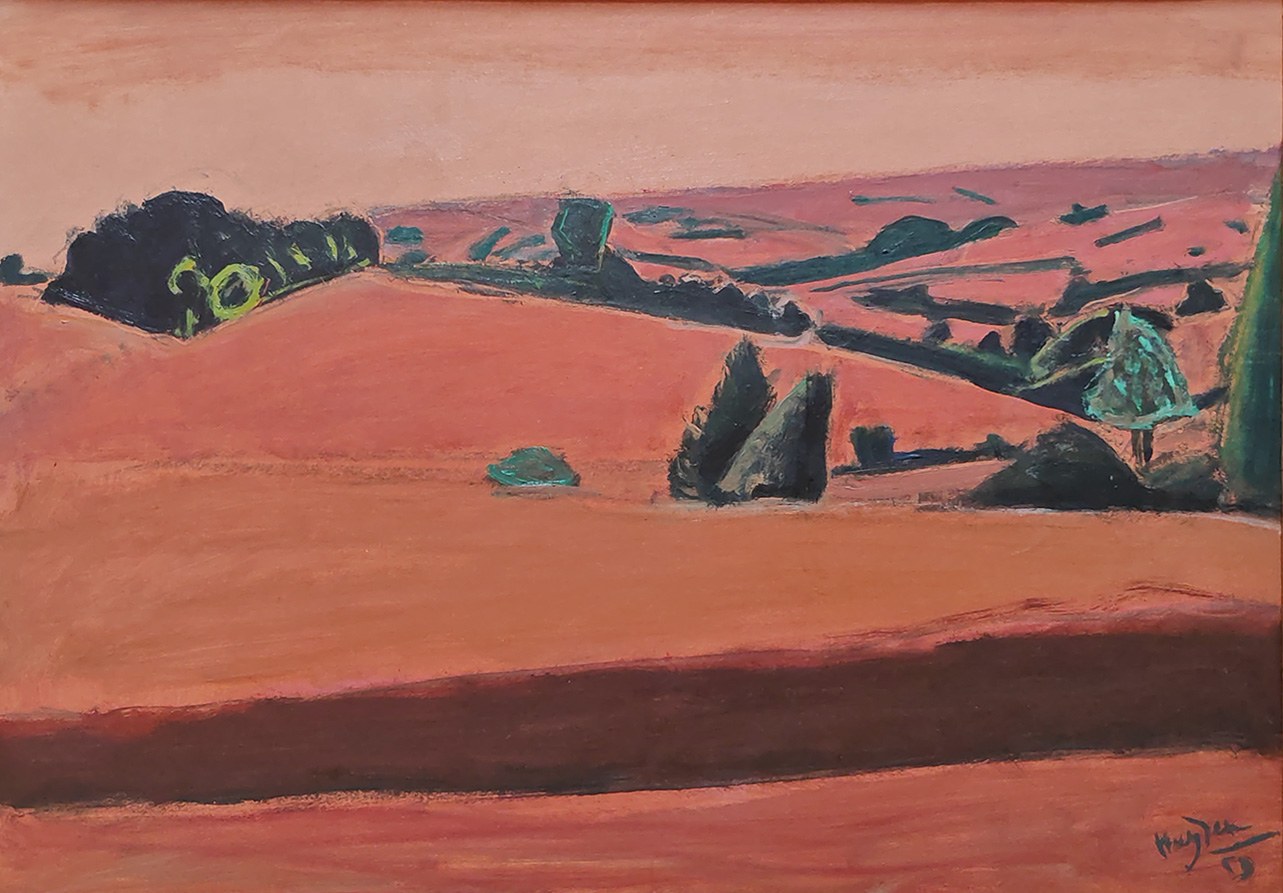


Henri HAYDEN / Henryk Hayden (1883 Warsaw – 1970 ParisRed Landscape, 1959
oil on paper mounted on canvas
dimensions: 33 × 46 cm, 49.5 × 62.5 cm (with frame)
signed and dated lower right: Hayden 59
inscribed and dated on the reverse, on the stretcher
Work has undergone conservation. Certificate of authenticity.
The work dates from Hayden’s late, mature period. The artist synthesizes the landscape almost into an arrangement of colorful planes: reds, browns, and dark accents of green create a composition closer to modernist painting than to classical descriptive landscape painting. The reduced form, strong contours, and decorative color scheme fit well within the artist’s postwar creative period.
Henryk Hayden (Warsaw 1883 – Paris 1970) was one of the most outstanding painters of Polish origin associated with the École de Paris circle. He began his artistic studies at the Warsaw School of Fine Arts; at the same time, he also studied at the Warsaw University of Technology. In 1907, he left for Paris, where he enrolled at the Académie “La Palette.” From 1908 onward, he frequently traveled to Brittany, where he kept in touch with W. Ślewiński. After 1915, he became associated with the Parisian artistic avant-garde circle, including P. Picasso, J. Gris, G. Severini, and H. Matisse. He settled permanently in France. In 1920, he visited his family in Poland, but his ties to his homeland were rather loose—he only rarely sent paintings to exhibitions there. He exhibited extensively in France, however; beginning in 1909, he regularly participated in the Paris Salons and also held solo exhibitions. During World War II, he lived in southern France, where he formed a long-standing friendship with S. Beckett. He painted landscapes, portraits, and still lifes, which initially showed connections to Ślewiński’s style and later (1912–21) to the work of Cézanne and Cubism. After 1922, he created realistic portraits and landscapes; toward the end of his life, he returned to Cubist experimentation.










