


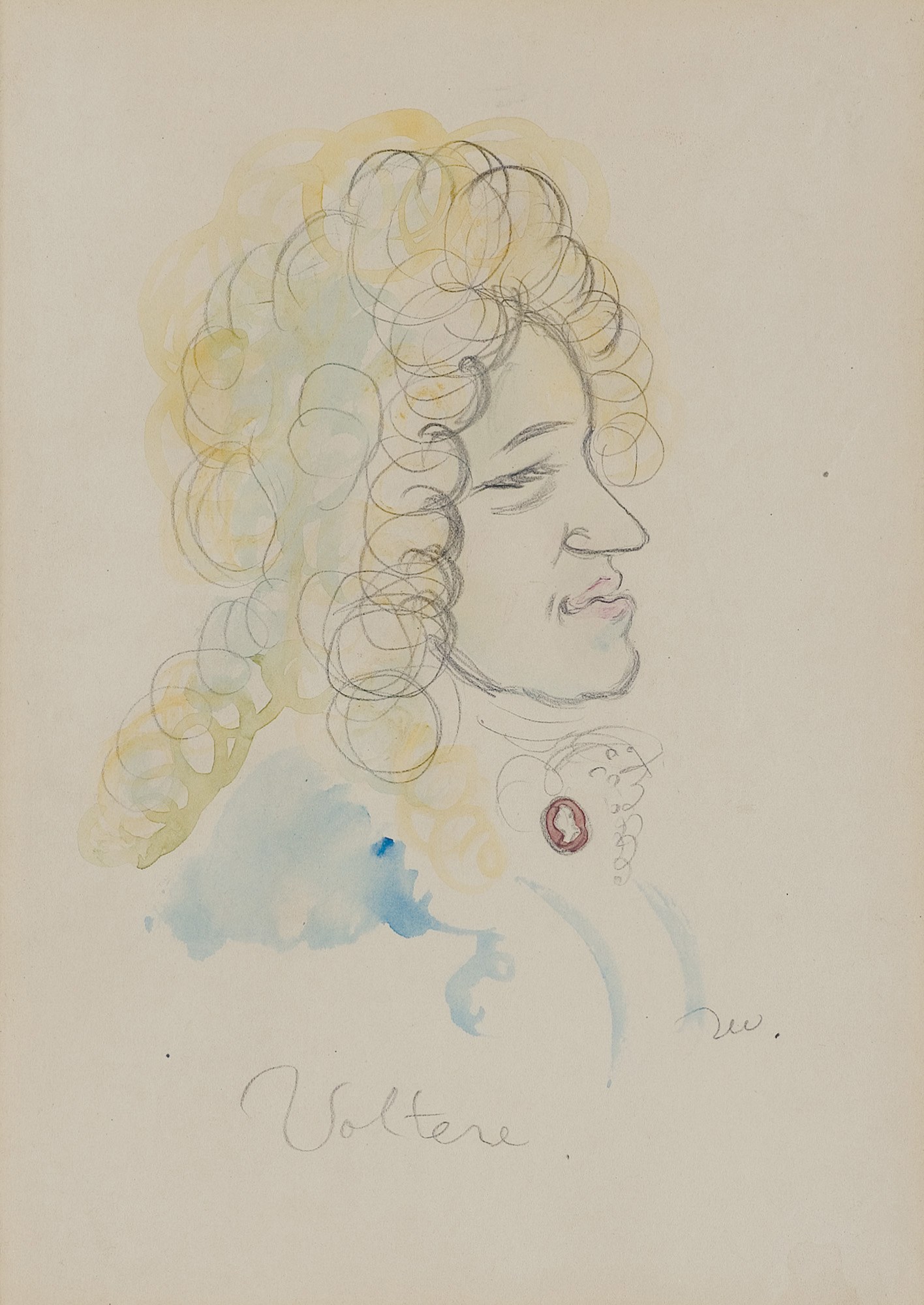
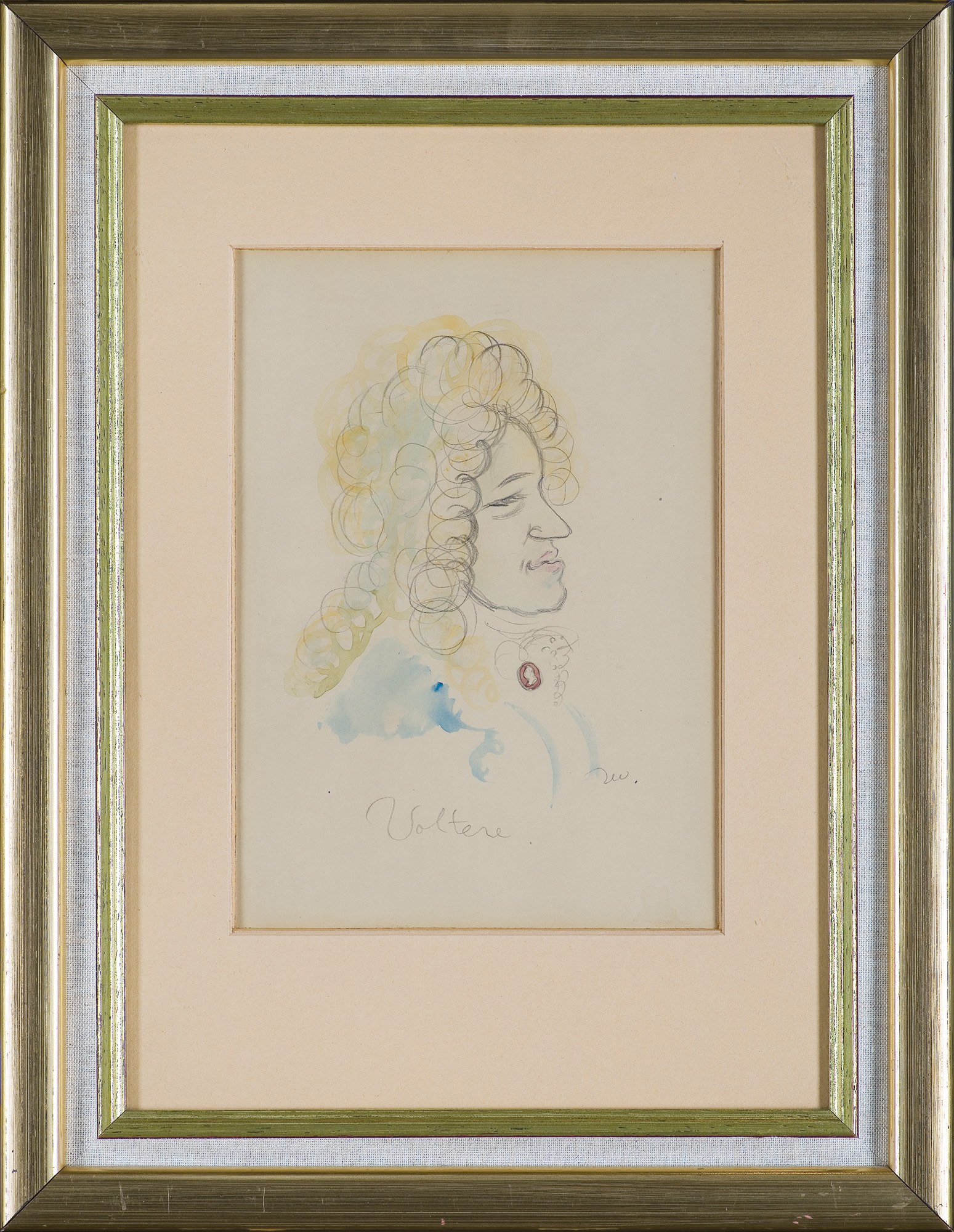
27.3 x 19.3 cm – pencil, watercolor, paper mounted on cardboard
pencil, watercolor, paper mounted on cardboard, 27.3 x 19.3 cm (inside the mat)
signed on the right: ZW. [linked initials]
inscribed below: Voltere.
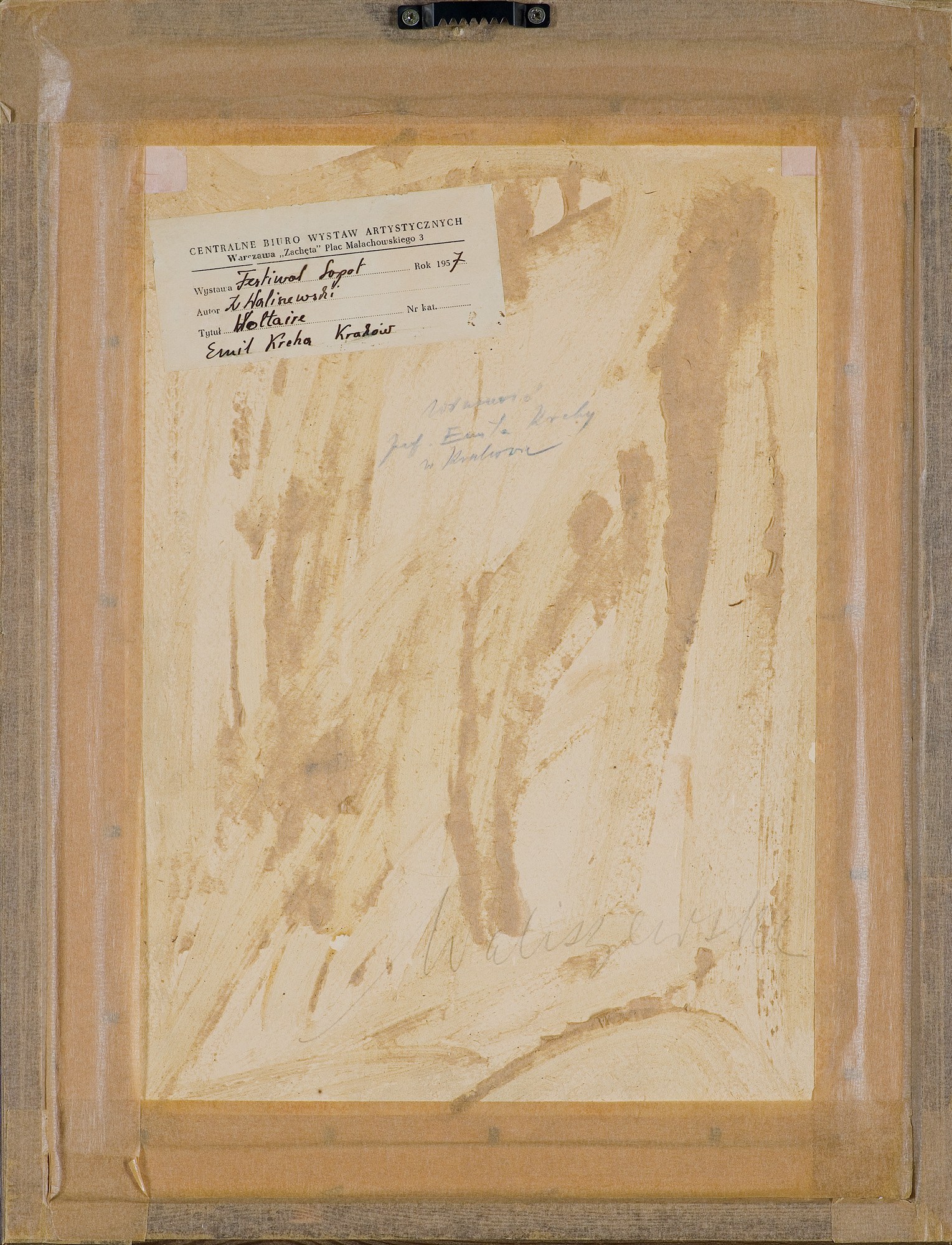
On the reverse, lower left, a sticker (print, ink): CENTRAL OFFICE OF ART EXHIBITIONS | Warsaw “Zachęta” Małachowskiego Square 3 | Sopot Festival Exhibition 1957 | Artist Z. Waliszewski | Title Voltaire | Emil Krcha Kraków; below (in blue crayon): Property of | Prof. Emil Krcha | in Kraków; lower right (inscribed): Waliszewski.
Provenance: In 1957, the painting was part of the collection of painter Emil Krcha in Kraków, who owned numerous works from the estate of Zygmunt Waliszewski.
The painting has been exhibited, mentioned, and reproduced in, among others: – H. Bartnicka-Górska, A. Prugar-Myślik, Zygmunt Waliszewski 1897–1936, Monographic Exhibition, May–July 1999, MNW, Warsaw 1999, p. 228, item III/514.
Zygmunt Waliszewski (St. Petersburg 1897 – Kraków 1936), painter, set designer, illustrator. Demonstrating great artistic talent from childhood, he began his artistic education early in the Painting and Drawing Courses led by Nikolai Sklifasovsky and Boris Fogel, initially in Batumi and later in Tbilisi. As a 13-year-old boy, he held his first exhibition titled “Child Prodigy.” During World War I, he enlisted in the army and fought on the Eastern Front. Many of his sketches and portraits of soldiers from the front are now in the collection of the National Museum in Warsaw. After being wounded, he spent his convalescence in Moscow, where he befriended the local artistic bohemian scene. He returned to Tbilisi, and when Georgia proclaimed its independence in 1918, Waliszewski was actively involved with the group of futurists gathered at the so-called “University of 41.” At that time, he created a formally avant-garde curtain for the State Opera Theater in Tbilisi. The Bolshevik threat forced the artist to leave for Poland, where in 1921 he enrolled at the Kraków Academy of Fine Arts in the studio of Wojciech Weiss and later Józef Pankiewicz. He established contact with the Kraków avant-garde, wrote theoretical treatises, designed sets and costumes for plays, and created painted decorations for the “Gałka Muszkatołowa” Futurist Club Hall. In 1924, he left with a group of students forming the so-called “Paris Committee” to continue his studies in Paris, where Prof. J. Pankiewicz had organized a branch of the Kraków academy. The problem of color dominated his work, and Waliszewski became one of the most prominent representatives of this movement in Polish art of the interwar period. Seriously ill, he returned to Poland in 1930 after having his legs amputated. It was here that he created large-scale compositions such as The Island of Love, the Feast series inspired by Veronese’s work, and numerous landscapes and still lifes considered among his most valuable works. He is the creator of the ceiling painting at Wawel in Kurza Stopka. Additionally, he created caricatures, humorous scenes, and designed posters. He presented his works at exhibitions in Poland and abroad, including in Paris (1930), Geneva (1931), Kraków (1932), Warsaw (1930, 1933), and at the Venice Biennale (1934). His works are held by, among others, the National Museums in Warsaw, Kraków, Poznań, and Szczecin, the Pushkin Museum in Moscow, and the Hermitage in Saint Petersburg. A large collection of drawings and watercolors is held by the Georgian Art Museum in Tbilisi and in private collections there. In 1999, the National Museum in Warsaw hosted a monographic exhibition of his work













Πρόσφατες επισκοπήσεις
Συνδεθείτε για να δείτε την λίστα θέσεων
Αγαπημένα
Συνδεθείτε για να δείτε την λίστα θέσεων