


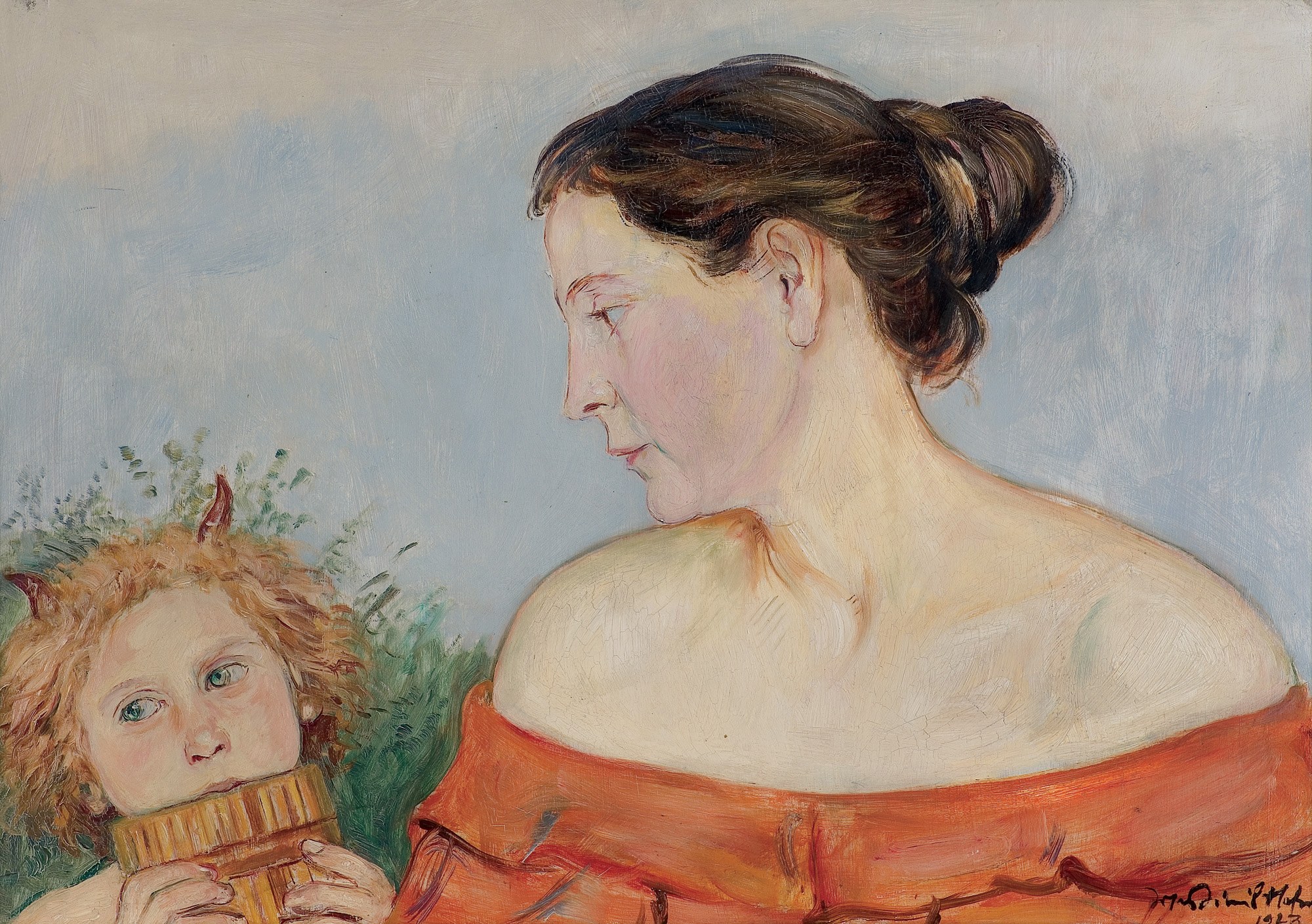
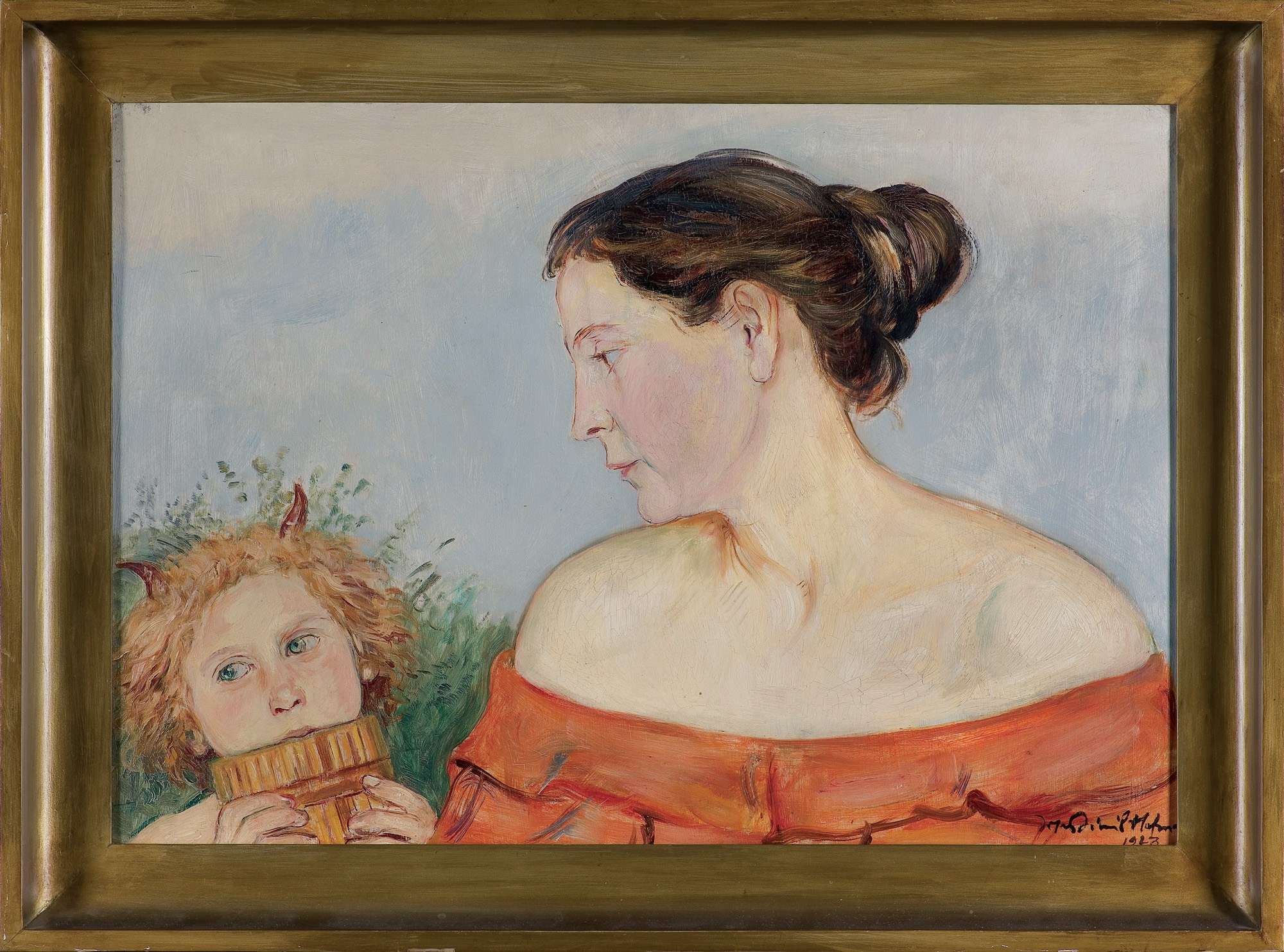
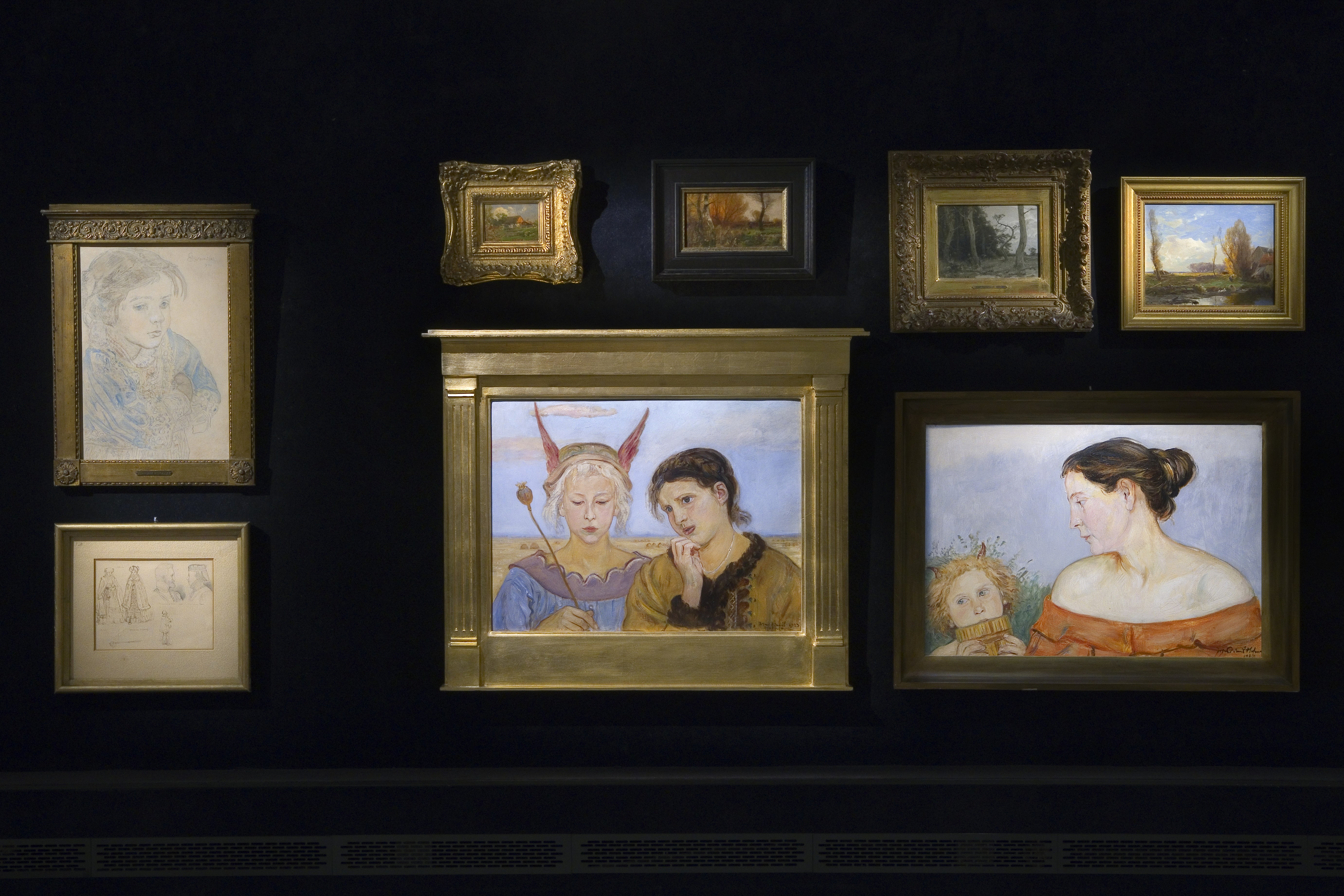
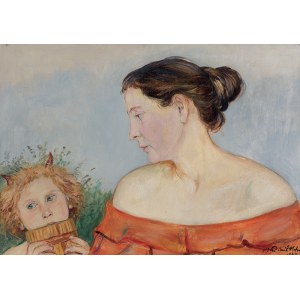
49.4 x 69.4 cm - oil on cardboard
signed lower right: Wlastimil Hofman | 1923
The woman portrayed is Wlastimil Hofman’s beloved wife, Ada, née Goller, first married name Hammer. Born in 1884, she was the thirteenth and long-awaited child of Franciszek Goller. From an early age, her father shared with her his passion for art, literature, and music, shaping her sensibilities and interests.
In 1906, they went together to an exhibition by the “Manes” group. It was then that Franciszek Goller purchased the painting *In the Light of Wlastimil Hofman’s Brush*. A year earlier, Ada had married Ludwik Hammer, Hofman’s cousin. The marriage, however, was not a happy one, and the couple soon began to drift apart. Ludwik worked late into the night
and engaged in numerous affairs, while Ada, childless and left to her own devices, sank deeper and deeper into loneliness. Everything changed when, at Ludwik’s invitation, Wlastimil Hofman came to stay at their home. Ada spent more and more time with the artist. They were united by long, lively conversations and shared interests. Over time, she also began to assist Hofman with his work—she tidied his studio, cleaned his brushes, and purchased the necessary painting supplies. She also often posed for his paintings. In 1917, Ada decided to move with Hofman to Kraków. Life in Kraków, however, did not bring the peace they had hoped for. After Poland regained its independence and the Austro-Hungarian Empire collapsed, a Czechoslovak-Polish border dispute began. Both Ada and Hofman were treated as outsiders, and their informal relationship further fueled the hostility of those around them. In this situation, they decided to leave for Paris. In April 1920, they were married in a civil ceremony there, beginning a new chapter in their life together. As a married couple, they could finally participate openly in social life and build their future without hindrance. Later that same year, they returned to Kraków, where they created a home full of warmth and love—a place that became a haven for them and a space for their shared life and work.
Hofman’s painting clearly draws on the styles of Symbolism and Young Poland. This is perfectly illustrated by the figure of a faun, who accompanies the artist’s wife in the painting. Although the painter had no children of his own, they occupy a special place in his art. These are not merely portraits of young models who visited his Kraków studio. The children in his paintings serve, above all, as symbols of hidden meanings.
Vlastimil Hofman / Vlastimil Hofmann (Prague 1881 – Szklarska Poręba 1970) studied at the Kraków School of Fine Arts—initially under Florian Cynk, and later also under Jan Stanisławski, Leon Wyczółkowski, and Jacek Malczewski. From 1899 to 1902, he also studied under Jean Léon Gérôme at the École des Beaux-Arts in Paris. During World War I, he stayed in Prague and Paris; from 1920 onward, he lived permanently in Kraków. He exhibited frequently; he belonged to numerous artistic associations—he was a co-founder of the “Group of Five” (1905) and the “Group Zero” (1908), a member of the Czech Artists’ Union “Manes,” and, from 1911, a member of the Polish Artists’ Society “Sztuka.” During World War II, he made his way to Jerusalem via the USSR and Turkey, from where he returned to Kraków in 1946. From 1947 onward, he lived permanently in Szklarska Poręba. Hofman primarily painted fantastical and symbolic compositions featuring folk motifs, as well as genre scenes, portraits, and landscapes. Despite close analogies and connections to Malczewski’s art, his paintings are always distinguished by their individual character, style, and mood.













Πρόσφατες επισκοπήσεις
Συνδεθείτε για να δείτε την λίστα θέσεων
Αγαπημένα
Συνδεθείτε για να δείτε την λίστα θέσεων