


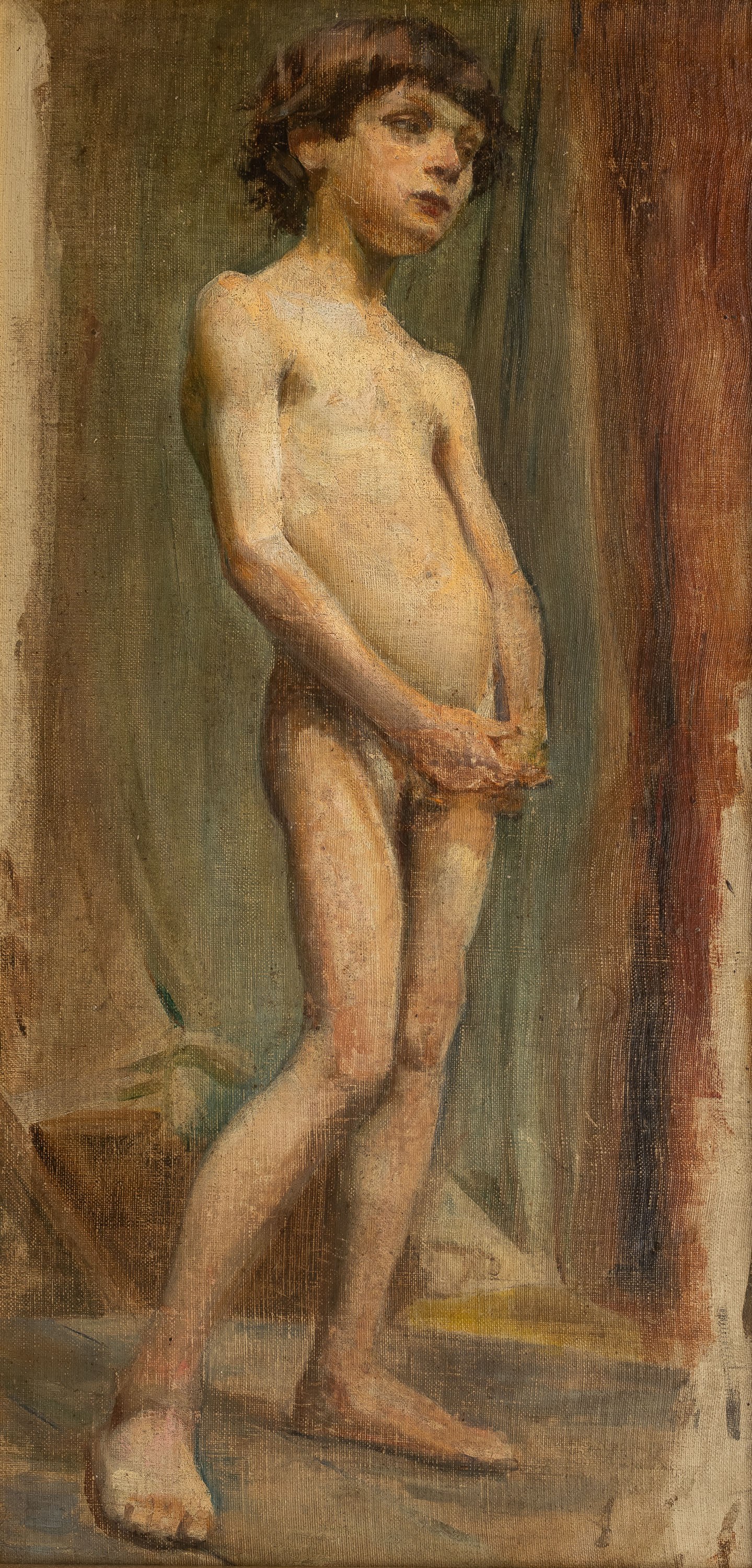
oil, canvas pasted on cardboard, 63 × 32.5 cm
on the reverse, pen inscription in Leonard's hand
Lepszy: Study of Stanislaw Wyspianski sold in the Society of Fine Arts by the artist's widow L. Lepszy.
Long-term deposit at the National Museum in Krakow (NR INW. MNK ND-9546, 2007-2020).
The painting has an expert opinion by Ms. Marta Romanowska in 2001 (expert on Wyspianski's work, creator and long-time manager of the Stanislaw Wyspianski Museum - a branch of the National Museum in Krakow, author of exhibitions, studies and publications on Stanislaw Wyspianski).
Exhibited at:
- Society of Fine Arts in Krakow
- "Wyspiański", National Museum in Krakow, 28.11.2017-05.05.2019
Described and reproduced:
- Łukasz Gaweł, "Stanisław Wyspiański, Life and Works," Kraków 2007, p. 46.
- Marta Romanowska, "Stanisław Wyspiański," Ozarow Mazowiecki 2015, p. 51.
- D.Godyń, M.Laskowska, "Wyspiański", catalog of an exhibition of works from the collection of the National Museum in Krakow, Krakow 2017, (il.) p.337.
"Children were for the artist a medium through which he entered the land of subconsciousness, dreams, another reality".
M. Tomczyk-Maryon, Wyspiański, published by PIW, Warsaw, 2009, p.216.
The featured painting was created during the artist's last stay in Paris, where he returned at the end of March and stayed until the end of September 1894. It is one of the few and at the same time one of the last paintings in oil technique. Wyspianski had to give up oil painting because he was severely allergic to lead - a component of oil paints at the time.
The painter fell in love with Paris from his first stay in 1890. He tied his dreams to this city. As he wrote: "impressive as it is to look at it from the top of the Notre Dame tower - where the Sequana weaves a greenish line, framed in notches of marble, cast with a multitude of gasping and hissing ships - crossed every now and then by bridges - of marble and iron - it weaves its way up to the Eifel tower (....) that you have to breathe with it and such a life is alluring - that one would like for this reason of today - for this full and fresh life to give all of oneself, all thought, all attention - strength and ability to do any work, and for one's homeland to leave only the heart. (...) (D.Godyń, M.Laskowska, "Wyspiański", [cat. exhibition] , MN Krakow 2017 , p. 312). The entire Parisian period was for the artist a search for his own path, and it was here that he formed his individual style. In 1894, the artist wrote "(...) I know how much I know and how much education is needed (...) As you can see, I have no intention of changing, or I would lose a lot in my own eyes." ("Letters of Stanislaw Wyspianski various", Wyd.Lit., 1998, pp.84-95). "(...) I have arranged for myself a program of life until 1905, and until then I would remain constantly in Paris, abroad (...) In general I have great self-confidence and confidence." ("Letters of Stanislaw Wyspianski to Jozef Mehoffer," Wyd. Lit. 1994, pp.209-210).
"Children were for the artist a medium through which he entered the land of subconsciousness, dreams, another reality." (M. Tomczyk-Maryon, Wyspiański, published by PIW, Warsaw, 2009, p.216). The portrayed is a boy "probably about 9 years old, standing in a contra fast, facing three-quarters to his left. With disproportionate limbs characteristic of his age, long skinny legs, thin arms with marked emerging shoulder musculature (a model probably from the proletariat familiar with physical labor..." (excerpt from Ms. Romanowska's 2001 expert report ). Wyspiański painted children both during his stay in Cracow, while traveling abroad and in his beloved Paris. His models were children of acquaintances, caretakers and also (as the portrayed one probably was) street boys or later his own children. The portrayed is a touching and gentle boy, and belongs to those delightful children's portraits as the canon of the artist's most valuable works. (...) therefore, it is necessary to recognize the profound content of Wyspianski's portraits, in which the artist knew how to bring out, despite the stylization, the most essential values of human life. Images of motherhood and portraits of children, belonging to Wyspianski's legacy, also speak to the fact that truly profound artistic experiences, regardless of the forms recognized and used in a given period, lead to works of art of lasting value.
(Skierkowska E., "Plastika Stanisława Wyspiańskiego na tle ównych kierunków artystycznych", Wrocław - Kraków 1958, p. 56)








Πρόσφατες επισκοπήσεις
Συνδεθείτε για να δείτε την λίστα θέσεων
Αγαπημένα
Συνδεθείτε για να δείτε την λίστα θέσεων