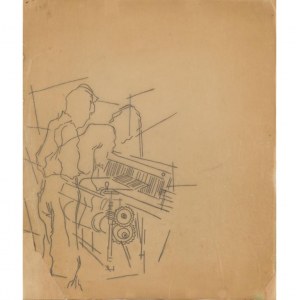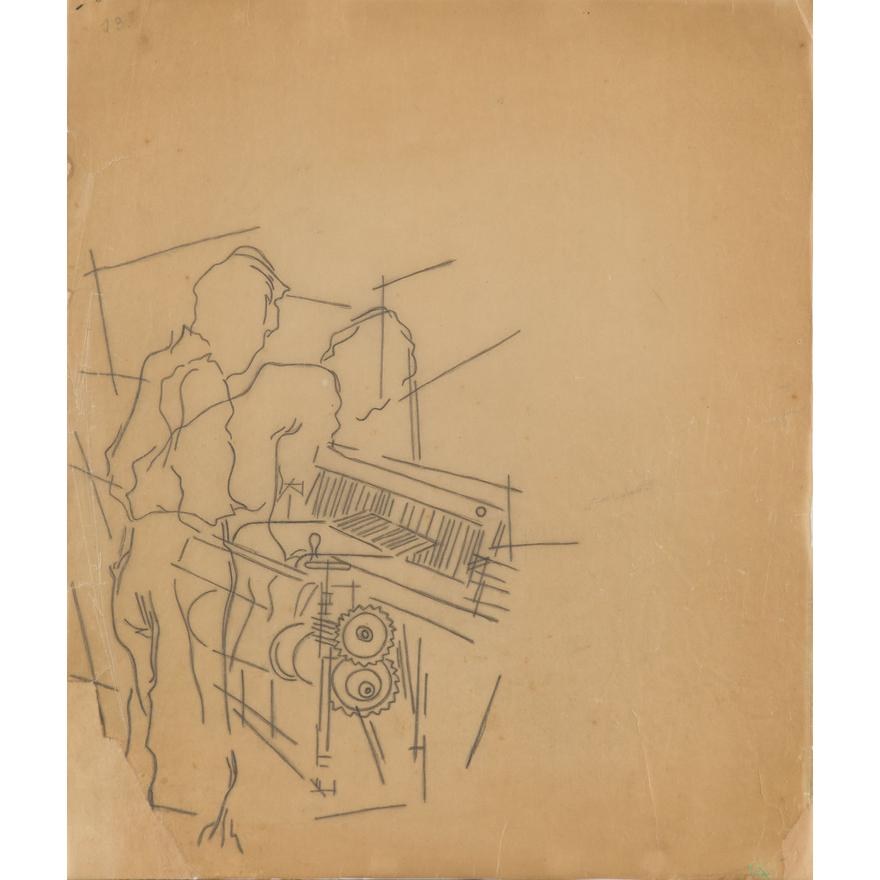

Technique: pencil, tracing paper
Dimensions: 41 x 35 cm (in light passe-partout)
described l.g.:'13'
Additional charges: +5% / 3% Droit de suite
The painting is framed.
Provenance: DESA Unicum, then private collection Lublin, private collection Warsaw
Literature: Wladyslaw Strzeminski Workshop, Anna Wesolowska Gallery, Lodz, June 1985, item 101 (ill.); Wladyslaw Strzeminski 1893-1952. on the 100th anniversary of his birth, catalog, Museum of Art in Lodz, [ed.] Jadwiga Janik, Zenobia Karnicka and Janina Ładnowska, Museum of Art, Lodz 1994, p. 236, item VI.125
Exhibited: "The Workshop of Wladyslaw Strzeminski," Anna Wesolowska Gallery, Lodz, June 1985.
Biography:
Born November 21, 1893 in Minsk, Belarus, died December 26, 1952 in Lodz.
Painter, graphic artist, designer, art theoretician and educator - was a pioneer of the Constructivist avant-garde in Poland in the 1920s and 1930s and author of the theory of Unism.
From 1911 to 1914 he studied at the Military Engineering School in St. Petersburg. Serving in the army as a sapper officer during World War I, he was seriously wounded in 1916; he lost an arm and a leg at that time. In 1918 he attended the First State Free Workshops (SWOMAS) in Moscow, where he established contacts with Kazimir Malevich and Vladimir Tatlin. In 1921, he settled in Vilnius and began teaching drawing, first at the Lukasinski Military Matriculation Courses, then at the gymnasium in Vileyka.
In 1922, he and his wife, the sculptor Katarzyna Kobro, who he met in Moscow, came to Poland, and in the early 1930s they settled in Lodz.
The artist belonged to the leading avant-garde groups of the 1920s - "Blok", "Praesens" and "a.r.". He was the author of many articles and books, including "Unism in Painting" and "Composition of Space and Calculation of Space-Time Rhythm," written with Kobro. Both were key figures for the Museum of Art in Lodz, as it was through their efforts that the International Collection of Modern Art of the "a.r." group was established, which in 1931 gave impetus to the development of this oldest institution collecting modern art in Europe.
(Source: culture.pl; history.pl)