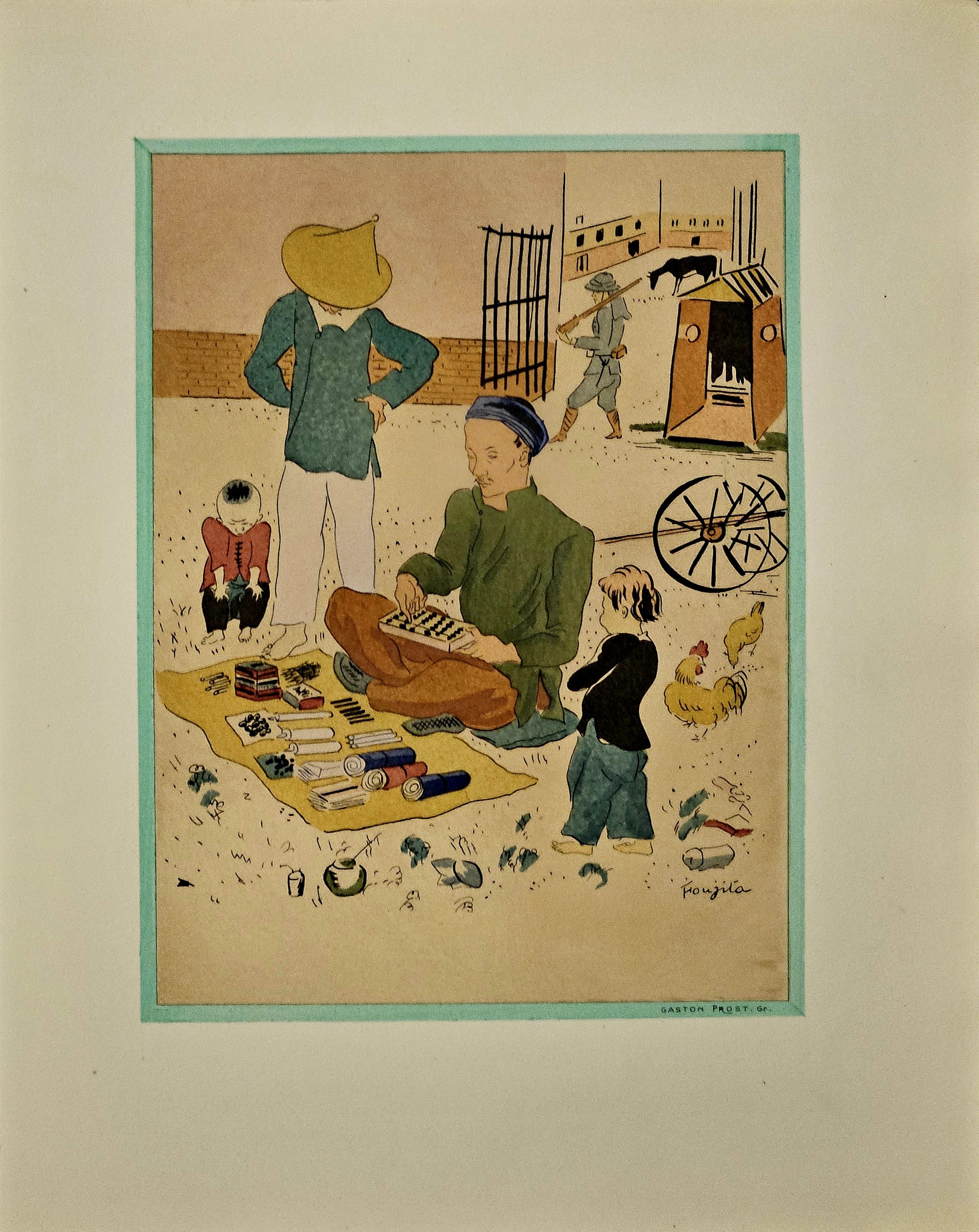
Lithograph, colored with “pochoir” watercolor, paper 28 x 22.5 cm; signed on the stone “Foujita” and bearing the lithographer’s signature in the lower right corner “GASTON PROST GR.”; edition of 97 pieces.
Publisher: Javal et Bourdeaux, Paris
Artist: - lithograph by Atelier Gaston Prost
- watercolor coloring by Atelier Daniel Jacomet
Text by: Jules Boissière
The lithograph is one of 16 works illustrating a collection of short stories, sketches, and reflections by Jules Boissière depicting the world of opium in 19th-century Indochina. The author, a French colonial official fascinated by Indochinese culture, depicts the ritual of opium smoking and describes states of poetic intoxication, hallucinations, and his own visions. The work was first published in Hanoi in 1890. Foujita created a series of 16 drawings, which were published as a portfolio of lithographs in 1928, in a single edition of 97 pieces. Gaston Prost was responsible for transferring Foujita’s delicate, characteristic line work onto the lithographic stone, while Daniel Jacomet hand-finished the prints with watercolor using stencils, giving the prints depth and color.
Pochoir – A work hand-colored with watercolor using a stencil (French: pochoir). This method of applying paint is used primarily for coloring prints, as it allows the artist to produce identical prints. The artist cuts out a stencil and applies it to a previously created print. It is used primarily for prints made using metal-based techniques, such as drypoint, aquatint, etc.
Léonard Tsuguharu Foujita (1886–1968) was one of the most important and colorful painters and printmakers of the Paris School. He was born in Tokyo to a family of a high-ranking military doctor. He graduated from the prestigious Tokyo National School of Fine Arts and Music. In 1913, he left for Paris and settled in Montparnasse. He quickly became part of the Parisian artistic bohemian scene, befriending figures such as Amedeo Modigliani, Chaim Soutine, Pablo Picasso, and Moïse Kisling. Foujita combined traditional, subtle Japanese ink painting with European oil painting and printmaking. He was renowned for his use of an exceptionally precise black line.
Gaston Prost (1881–1967) was a French painter, draftsman, printmaker, and master of lithography. He was hired by the prestigious publishing house Javal et Bourdeaux to transfer Foujita’s sketches onto lithographic plates for the portfolio *Propos d’un intoxiqué* (1928/1929). His task was to precisely reproduce the delicate line work characteristic of Foujita.
Jules Boissière (1863–1897) was a French writer, poet, journalist, and colonial official, associated with the Decadent movement and so-called colonial literature of the late 19th and early 20th centuries. In the second half of the 1880s, he traveled to Asia, where he took a position in the colonial administration in French Tonkin (northern Vietnam). In Indochina, he became fascinated by the local culture and also developed a severe opium addiction. He recorded his impressions, hallucinations, and observations of social life in opium dens in moving, poetic, and decadent texts.