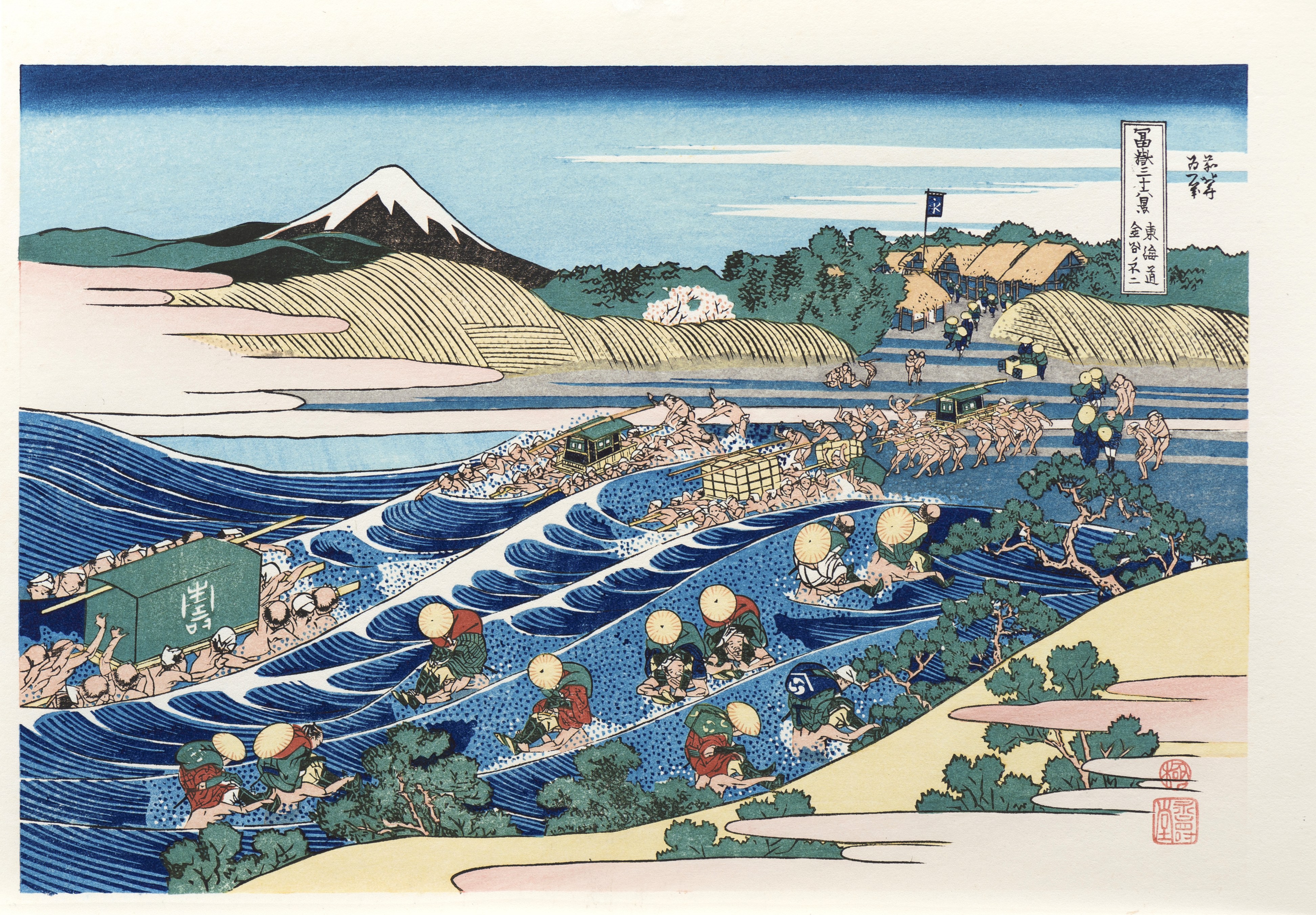
color woodcut, ink, paper, 22x32 cm, signature
Depiction of travelers crossing the swift current of the Oi River. Waves carry the travelers in sweeping motion across the scene, creating a wonderful sense of movement.
The publication of these woodcuts in Yuyudo was overseen by Yoshida Teruji (1901-1972), who was editor-in-chief at Takamizawa's from 1933. In 1955, he became head of Kabukiza's publishing department. He wrote 84 books. He was a director of the Japan Ukiyo-e Society, a member of the Japan Dramatic Society, and chaired the Ukiyo-e Special Appreciation Study Group. He was one of the most talented and well-known figures in the contemporary ukiyo-e world, a world-renowned scholar and an authority on the study of Sharaku art. His most important publications include "Ukiyo-e Taisei" (12 volumes), "Kabuki Chronicles" (edited), "Ukiyo-e Reader", "Utamaro Complete Works", "Harunobu Complete Works", "Toshusai Sharaku", "Kabuki Chronology" (edited), "Ukiyo-e Abuna-e" (3 volumes ), "Encyclopedia of Ukiyo-e" (4 volumes), "Beauty of Ukiyo-e".
Hokusai Katsushika, known mainly by the name Hokusai (born October 31, 1760 in Edo (now Tokyo), died May 10, 1849 there) - one of Japan's most prominent and prolific painters and creators of color woodcuts in the ukiyo-e style. The name Katsushika Hokusai is known worldwide, but it was a pseudonym that the artist used instead of his real name, which was Kawamura Tetsuzo. When signing works, he used many (at least thirty) pseudonyms, including Shunrō, Sōri, Taito, Manji. Although it is unclear why he changed his name, some researchers believe it was to test his talent and increase sales. From an early age, Hokusai had a passion for drawing. He studied at the studio of Katsukawa Shunsho. He became known as an extremely prolific artist, a great draughtsman, landscape artist, illustrator and caricaturist. In his paintings, usually populated with a multitude of figures, he recreated Japan of the time. Among other things, he painted flowers, turtles, pheasants, roosters, one hundred poems, bridges and cascades. Persuaded by his students, he published 15 volumes of sketches and drawings entitled Manga (1814). His works had a profound influence on European Impressionists such as Claude Monet and others. His best-known work is a series of ukiyo-e woodcuts, "Thirty Views of Mount Fuji," which was created between 1826 and 1833 during the Taito period. In addition to paintings and drawings, he created illustrations for more than 500 books, some of which he wrote himself.
Around 1830 he published a timeless woodcut masterpiece, "Thirty-six Views of Mount Fuji." Initially the series consisted of 36 prints, as the title suggests. However, it was so well received that 10 more woodcuts were later added. These exquisite works depict the power and majesty of nature, while showing man's place in relation to the world around him. Hokusai died at the age of 90, which was considered an exceptionally long life in his time. He remained engaged in artistic creation until the end. It is said that he created as many as 30,000 works during his lifetime. The impact of Hokusai's works was so significant on world culture that his name was included in a list of "The LIFE Millennium" - 100 most important events and people of the last 1,000 years, published in 1988 by American Life magazine.
Ukiyo-e woodcuts have been printed several times since the Edo period, always using the traditional method. Since the beginning of the 20th century, Yuyudo Publishing House has distinguished itself as one of the best publishers in Japan. It adhered to the same rigorous standards as the publishers of the 19th century, while some of their colleagues took shortcuts. In the 1950s, as interest in Edo era woodcuts resurged, Yuyudo embarked on a project to reissue prints by great masters from the golden age of Ukiyo-e. To do so, they hired the best printmakers and carvers in the world. The resulting works are among the highest quality editions ever produced. Yuyudo's woodcuts are exceptionally well executed and very carefully designed. Most of the works of the series have the original publisher's folders with the series title stamped on them.