


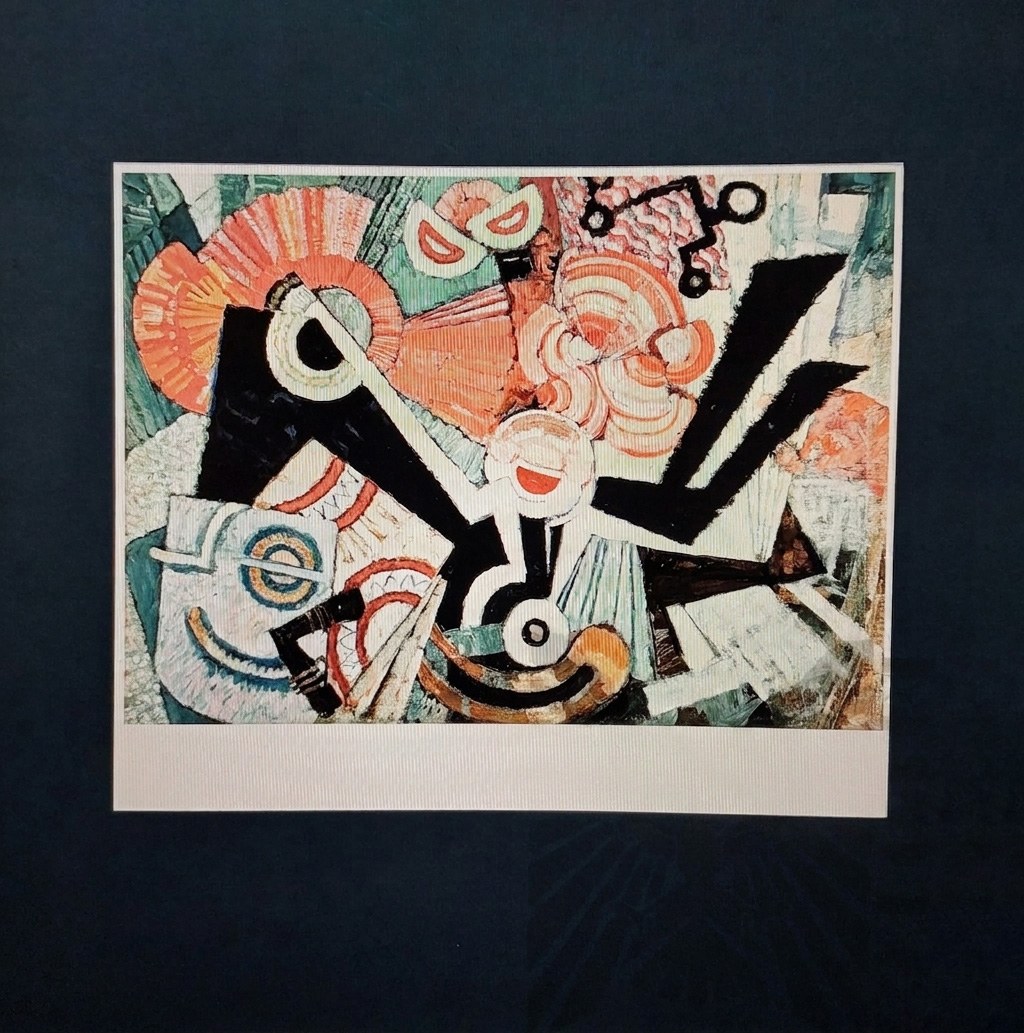
Lithograph, Cotton Cream heavy paper, dimensions: 44 x 46 cm (composition), 70 x 50 cm (sheet), limited edition, hand-numbered 21/350, signed on the plate, under the composition facsimile signature KUPKA p.d., dry stamp of CMOA ( Carnegie Museum Of Art.) l.d., dry stamp of the publisher SPADEM PARIS p.d.(SPADEM is the French equivalent of ZAIKS), on the reverse hologram "verification of authenticity". Original certificate.
František Kupka was a Czech painter who played a key role in the development of abstract art. Although he was born in what is now the Czech Republic, he spent most of his artistic life in France, where he became one of the pioneers of abstract painting, although in his time he did not gain as much popularity as some of his contemporaries, such as Wassily Kandinsky and Piet Mondrian. However, as the years passed, the importance of his work began to be recognized more and more, and he became one of the key figures in the history of modern art.
His abstraction, however, was not just a play of forms and colors - it had its sources in philosophy, music theory and mathematics. Kupka was inspired, among other things, by theories about synesthesia (the combination of the senses) and attempts to render in painting the rhythm and harmony known from music.
"Around one point" (French: "Autour d'un point") is a series of works created by František Kupka. It was created in the 1920s and is one of the key examples of his research on geometry and abstraction. In this series, Kupka explores the phenomena of movement, space and the relationship of shapes, focusing on the dynamics of line and form around a central point.
The series consists of several paintings in which the artist analyzes the development of line and form, circling around a single central point, which symbolizes not only movement, but also the idea of infinity. Geometry plays a key role in this series, and abstraction becomes a medium for exploring not only artistic but also philosophical concepts.
Kupka left behind a rich body of work that was only fully appreciated after his death. His works are now in the world's most important museums, such as the Centre Pompidou in Paris and the Museum of Modern Art in New York.










Πρόσφατες επισκοπήσεις
Συνδεθείτε για να δείτε την λίστα θέσεων
Αγαπημένα
Συνδεθείτε για να δείτε την λίστα θέσεων