


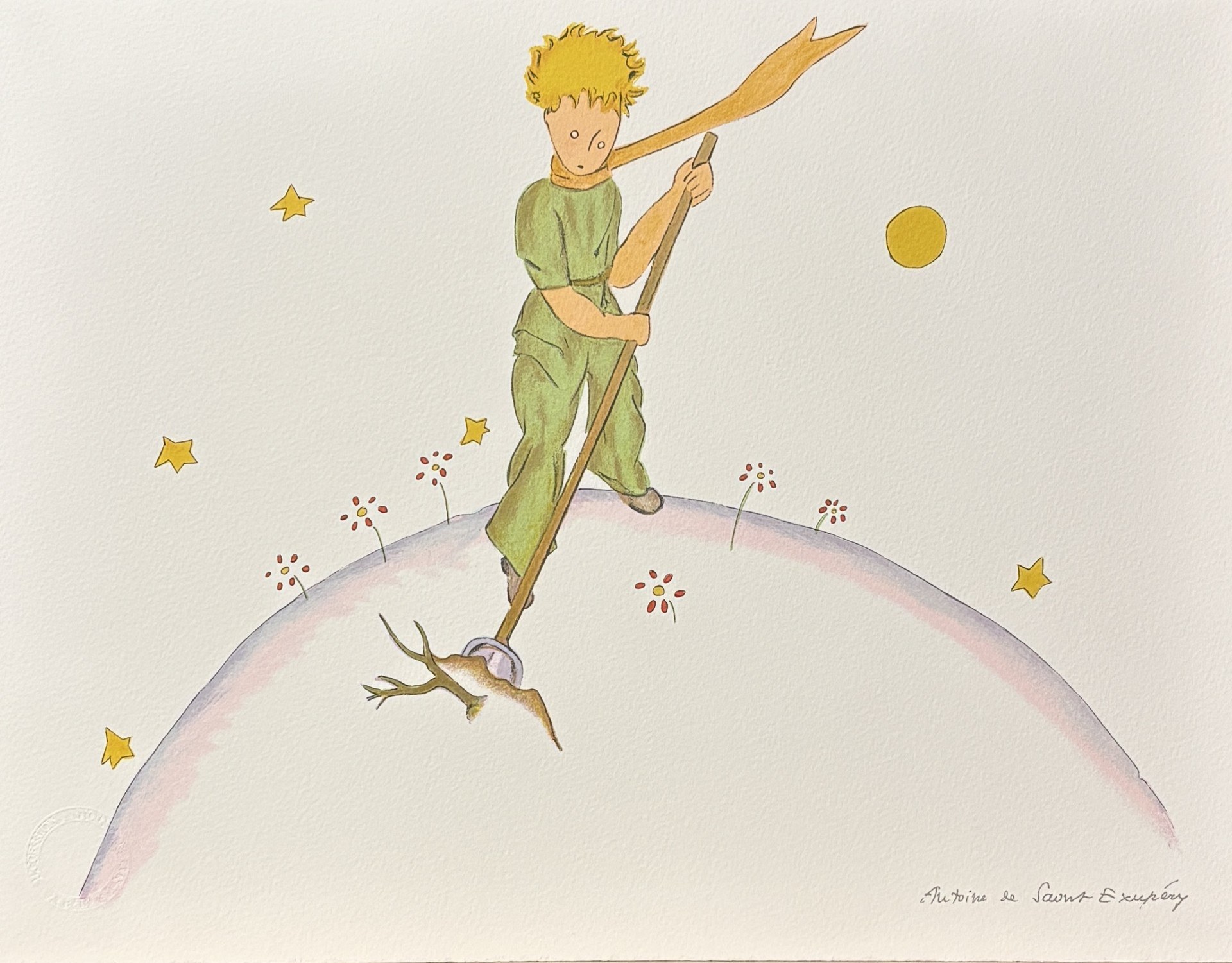
Color lithograph on Arches vellum paper with a watermark; 40 x 30 cm,
Facsimile of the artist’s signature in the lower right corner,
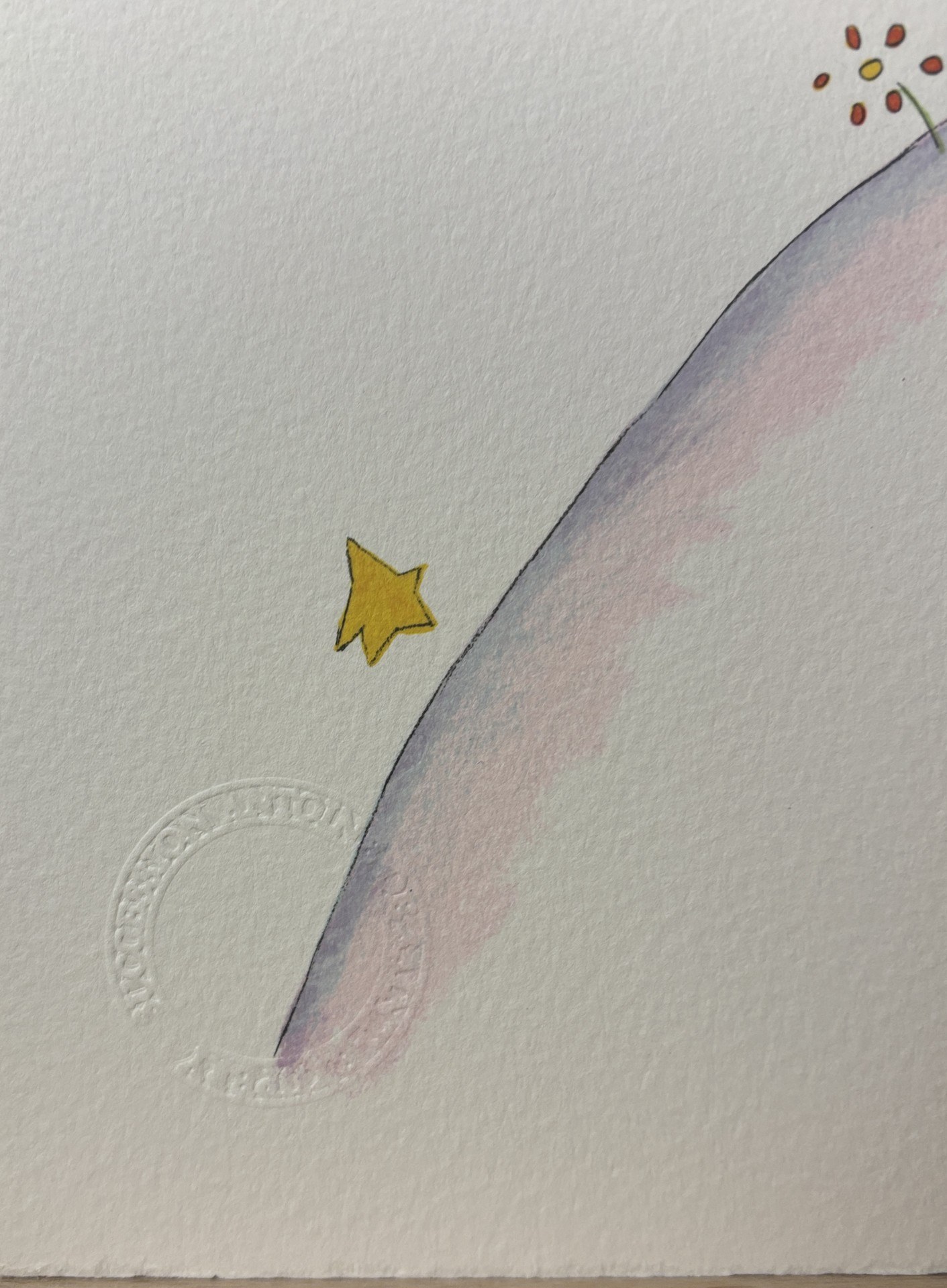
Dry-stamped license mark at the bottom left: “SUCCESSION ANTOINE DE SAINT-EXUPERY” (official, licensed collector’s lithograph, issued on the 80th anniversary of the author’s death)
This is one of the most iconic, original illustrations by Antoine de Saint-Exupéry, taken from the fifth chapter of the book *The Little Prince*. Meaning and context of the scene:
This scene directly refers to the protagonist’s words about the need to regularly maintain order on his planet: “It’s a matter of discipline [...] You have to force yourself to pull up the baobabs regularly, and do so immediately after distinguishing them from the rosebushes...”
On a symbolic level, baobabs represent evil thoughts, neglect, addictions, or destructive ideas (often interpreted historically as totalitarianism or Nazism), which—if not nipped in the bud — will take deep root and completely destroy a person or their surroundings.
“The Little Prince” is a classic of world literature. Published in 1943, this philosophical novella by Antoine de Saint-Exupéry has been translated into over 300 languages and dialects, capturing the hearts of readers from all corners of the world. People continue to buy this book in droves to this day—a total of 140 million pieces have been sold, making it one of the greatest bestsellers in history.
*The Little Prince* is a universal story about friendship, growing up, shared responsibility, and devotion; it has been translated into over three hundred languages. It is not intended solely for children, as it strikes a deep chord with readers of all ages. The book’s universal appeal is further evidenced by the fact that the author dedicated *The Little Prince* to an adult, his close friend Léon Werth—a French writer, essayist, and journalist.
The book was first published in 1943 in New York. The narrator is a pilot who can be identified with the author—Antoine de Saint-Exupéry was himself an experienced aviator. The description of the Little Prince’s appearance also refers to the author’s childhood, when his family called him the “sun king” because of his light, curly hair. The setting of the encounter between the Little Prince and the pilot in the Sahara is also symbolic—in 1935, the author survived a plane crash while flying from Paris to Saigon in an attempt to break a speed record, and the plane crashed in the desert.
The Little Prince lives on the tiny asteroid B 612. He spends most of his time cleaning volcanoes and weeding. One day, he discovers that a rose has grown on his planet. The boy cares for it—he waters it regularly and shields it from the wind. Unfortunately, the flower does not appreciate his efforts. Discouraged by the rose’s behavior, the Little Prince decides to set out on a journey to other planets. On each of them, the main character meets various figures, both real and fantastical, who prompt him to reflect on the world and life. The inhabitant of asteroid B 612 also finds himself on Earth…
Antoine Marie Jean-Baptiste Roger de Saint-Exupéry—a French aviator, writer, and poet. All of his books were written while he was “in the air”—over the Sahara, the Andes, and the Atlantic.
He also served as a correspondent for the French press during the Spanish Civil War. He made his debut with *Mail to the South*; *Night Flight* brought him fame; and in 1939, he wrote his most significant book, *Earth, Planet of Mankind*. In his prose, he championed the brotherhood of all people, the need for courage, integrity, and moral duty. During the war, he took part in reconnaissance flights over France and was killed during one such mission. Before that, he wrote the beautiful poetic tale *The Little Prince* (1943) and began work on his life’s work, the treatise *The Fortress*. He did not live to finish this book; it was published posthumously in 1948.
The covers shown in the images are for illustrative purposes only and do not constitute a commercial offer.










Πρόσφατες επισκοπήσεις
Συνδεθείτε για να δείτε την λίστα θέσεων
Αγαπημένα
Συνδεθείτε για να δείτε την λίστα θέσεων