


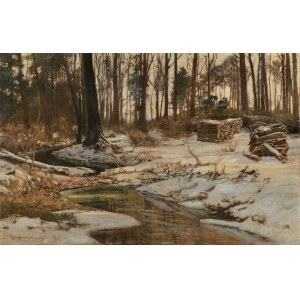
90,5 x 140,0 cm - oil, canvas
Signed l.d.: M. G. Wywiórski
In the early 1990s, Wywiórski, while still not abandoning Cherokee, Caucasian and genre motifs, expanded the thematic range of his paintings. While preparing to paint panoramas, the artist conducted detailed outdoor studies at the appropriate time of day for a given event (photos of such outdoor studies to the Berezina River were published by Tygodnik Ilustrowany in 1896). This guaranteed success in reproducing topographical realities, but also those related to the light and mood of the painted composition. Light, color, mood and variability of nature, became appealing to the artist regardless of the plot of the scene taking place. In the last decade of the 19th century, he moved closer - also under the influence of Young Poland art - to "pure landscape."
The presented painting is an excellent example of the highest mastery that Wywiórski achieved in the field of "pure landscape." The poetic depiction of a forest with a sheaf of winter sun penetrating it is extremely impressive. The viewer can easily feel both the chill that prevails in the winter setting, and can be sure of the warmth he will feel on his face as soon as he steps out of the shadows directly onto the sunlit bank of the stream. It was with such works, quoting after the "Illustrated Weekly" of 1904, that he won the admiration of his contemporaries; it was these works that gave him the name of one of our most outstanding landscape artists.
About the work of Wywiórski, a great bard of the Polish landscape, A. Breza wrote: [...] The depths of forests, the planes of wide fields, whether they are carpeted with flowers or covered with snow, spring swamps, rusty autumn, sun and darkness - all this directly observed, felt directly, and cast on canvas with a skilled hand, a refined technique and a broad pencil. Wywiórski is a finite type of Polish painter, who in all the foreign schools he went through, especially the Munich school, did not forget even for a moment the Polish motifs, his own, familiar. He painted under various influences, he developed his technique in foreign lands, but his thought always remained in the country.
Bibliography:
- Tygodnik Ilustrowany 1904, I, no. 25, p. 486;
- M. Gołąb, Michal Gorstkin Wywiorski, Between the Skies, Zamek Cultural Center in Poznań, Poznań 2004
- A. Bereza, Album of Polish and Foreign Art, Warsaw 1908; and the Earth, Zamek Cultural Center in Poznań, 2004.
Michal Gorstkin Wywiórski (Warsaw 1861 - Berlin 1926) studied in Munich from 1883 to 1887; at the Academy under professors Karl Raup and Nikolaus Gysis, and simultaneously in the private studios of Jozef Brandt and Alfred Wierusz-Kowalski. In 1884 he made his debut at an exhibition at the TPSP in Cracow, and also showed his works in Munich, where in 1894 at the Glaspalast international exhibition he was awarded a medal for his painting From the Lithuanian Forest. In 1895 he moved to Berlin, invited by Wojciech Kossak and Julian Fałat to work on the panorama Berezina (1895-1896). He settled in Berlin for a longer period of time and then stayed in Greater Poland and Warsaw. He also collaborated with Jan Styka on the panorama Battle of Sibiu (1897), and in 1900, together with Kossak, he traveled to Spain and Egypt to make plein air sketches for the intended panoramas Somosierra (not realized) and Battle of the Pyramids (1901). He also traveled to Lithuania, the island of Sylt, Norway, Sweden, the North Sea and the Baltic Sea, painted in Amsterdam, the Crimea and the Caucasus. In his early works, strongly influenced by Brandt and Wierusz-Smith, he painted hunting and genre scenes and paintings with Tartars, Cossacks or Cherokees, which brought him success in the Munich art market. Over time, pure landscape, perceived and painted sensitively and fondly, became the chief subject of his paintings.











Πρόσφατες επισκοπήσεις
Συνδεθείτε για να δείτε την λίστα θέσεων
Αγαπημένα
Συνδεθείτε για να δείτε την λίστα θέσεων