


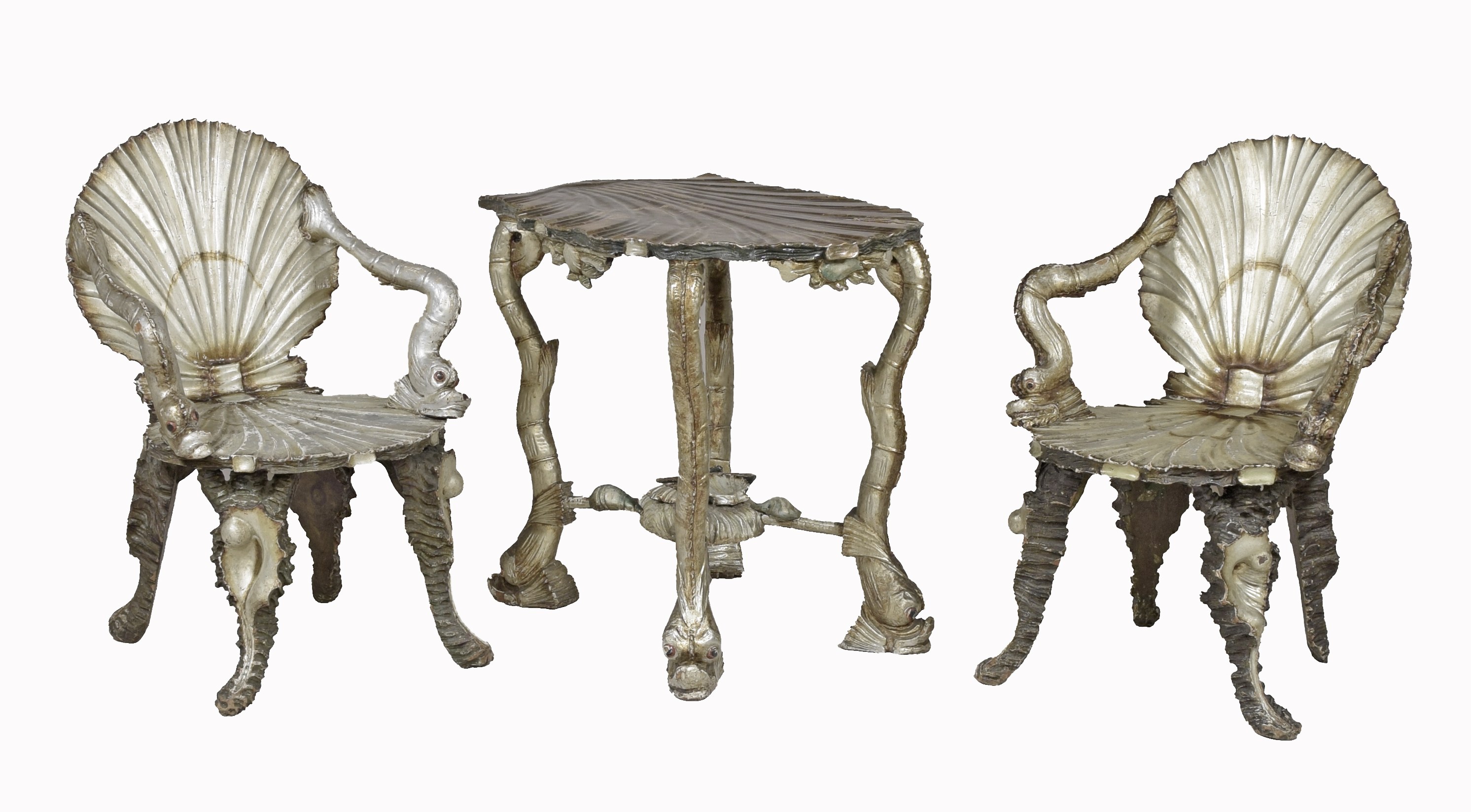
hardwood (poplar?), oak; polychrome, silver-plated;
table—height 74 cm; width 59 cm; depth 88 cm;
2 armchairs—height 88 cm; width 59 cm; depth 50 cm;
Venice, late 19th century
A set consisting of a table and a pair of armchairs with seats, backrests, and tabletops shaped like shells, and legs inspired by the world of underwater creatures, such as seahorses, dolphins, or clams, all carved, painted, and silver-plated.
This furniture was likely made in the late 19th century at the famous Venetian furniture factory “Fabrique Meubleus Pauly & Cie de Venise,” which operated from 1880 to 1930 and, in addition to grotto-style furniture, also produced Renaissance-style pieces.
The factory—or, more accurately, the workshop—was known for high-quality furniture inspired by historical styles, richly decorated with woodcarvings and paintings, as well as adorned with semi-precious stones, mother-of-pearl, and bone.
Wooden grotto-style furniture similar to the pieces presented here had been produced since the Rococo period, and one of its designers at the time was the eminent English designer and architect Thomas Chippendale. Grotto-style furniture was also made from sandstone, faience, and later, concrete. Furniture in this style came back into fashion in the 1880s amid a revival of historical furniture designs, largely thanks to products from a Venetian factory. It took on various shapes, ranging from different forms of clams to crabs and seahorses. Some models were painted, while others were left in their natural wood color. They were used in artificial grottoes in gardens and conservatories, but also inside homes as exceptionally decorative pieces.
The grotto furniture currently on offer and on display belongs to a group of luxury items produced by the Venetian workshop during the early phase of its operation; it is characterized by high-quality woodcarving and painted decorations, featuring well-executed depictions of marine creatures.
The furniture is in fairly good condition, with stable structures and well-preserved paintwork that could use some refreshing.
On the underside of the decorative joint where the table legs meet, there is a stylized inscription painted in white: A. 1746 V. Burrano.
The finish and construction of this furniture suggest it was made in the late 19th century. It is possible that the inscription refers to a design produced by the factory and dated to the year 1746 [A. – Anno].










Πρόσφατες επισκοπήσεις
Συνδεθείτε για να δείτε την λίστα θέσεων
Αγαπημένα
Συνδεθείτε για να δείτε την λίστα θέσεων