


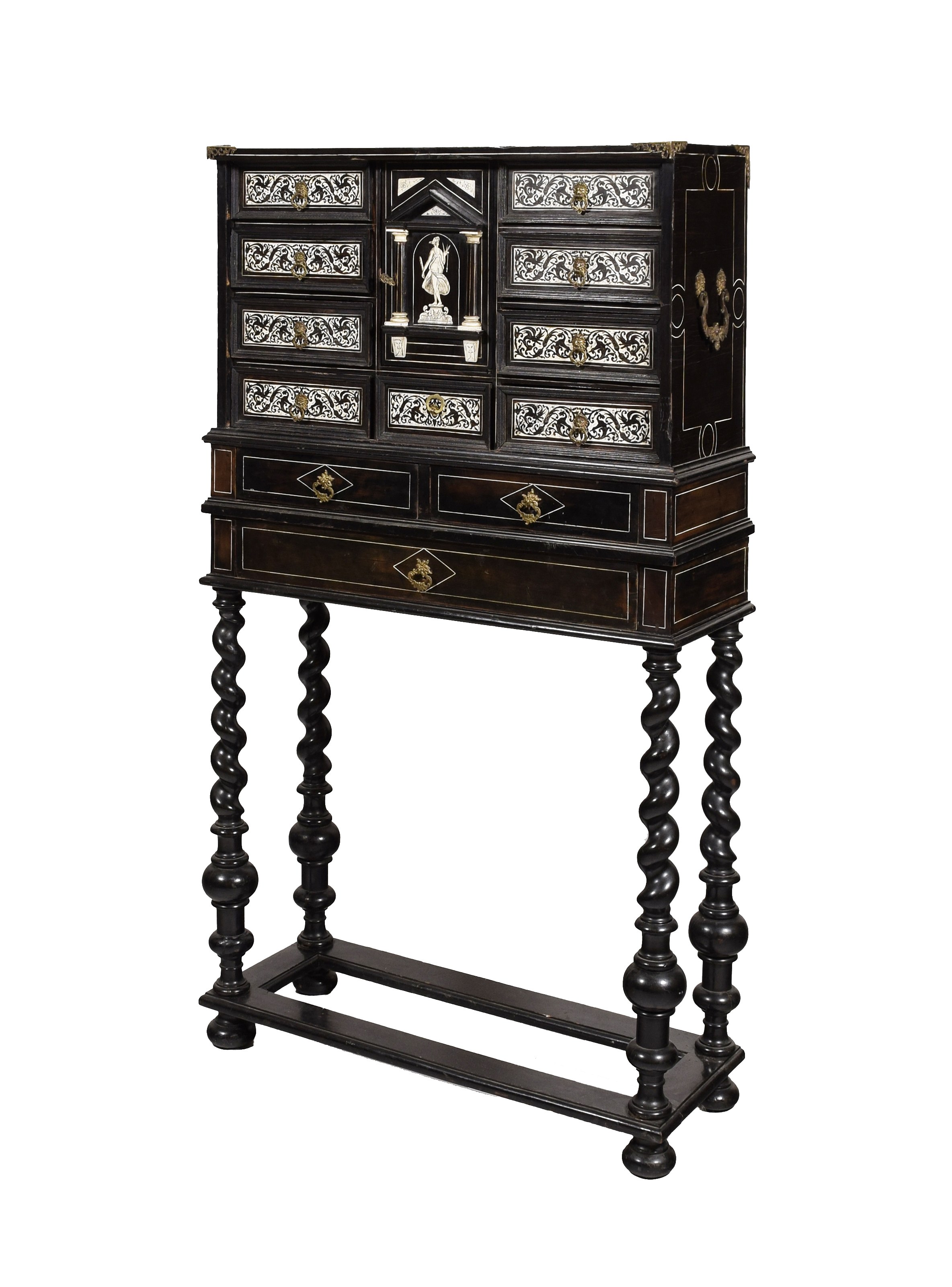
construction - pine, spruce, veneer - ebony, ebony stained pear, inlays - bone, hardware - brass; 137 x 86 x 33 cm;
Cabinet - Italy, 2nd quarter of 17th century; base - Western Europe, 2nd half of 19th century.
In the form of a cuboidal box with nine drawers arranged around a door flanked by columns and surmounted by a tympanum, supported on a table-top base with three drawers on spiral supports, veneered in ebony and stained black, inlaid with a bone vein and a wicker with entwined fantastic animals made of engraved bone, and on the door a man standing on a console, covered with a lion skin. The interior of the cabinet is upholstered in red velvet with a four-field coat of arms embroidered in silver thread, depicting on the right a horse over a pair of bees and four barrels, and on the left a ribbon suspended in the form of an inverted V over flames.
On the top panel of the caboose, on its sides and on the sides and faces of the base drawers, inlaid veining forms geometric fields. Door columns with turned bone bases and capitals, decorated with strips of veining, set on a cornice, and supported underneath by bone consoles with engraved masks. A man, probably Hercules, is captured in a dancing pose, holding various weapons in his hands, mace, daggers, sword. In the crowning decoration of the door tympanum, and in the corners above it, bone fields with engraved flowers.
The handles of the cabinet drawers in the form of an oval rim of two dolphin fish, whose tails are supported in the mouth of a lion, which is a signboard. On the upper corners of the cabinets openwork angles protecting them. Handles on the sides of the cabinets large, in the form of horseshoe-shaped threads on pairs of signboards in the form of lion masks. Handles of the base drawers similar to those of the caboose, simpler, mounted on star-shaped signboards. The base drawer locks are brass, recessed, single-bolt.
The cabinet was made in Italy in the 2nd quarter of the 17th century, probably the front was covered by a hinged lid, as evidenced by the trimmed sides along with a fragment of decoration. On the faces of the drawers, a delicate and beautifully composed decoration of squid-like tendrils, flowing smoothly into the torsoes of dragons and large winged birds was complemented by sublime hardware.
In Western Europe, similar furniture was made in large numbers during the period of the creation of the cabbinet, of which Italian models were equipped with a cabinet-tabernacle. The base was probably tightened in the 2nd half of the 19th century on the model of the original Mannerist bases. Such a practice was widespread to recreate the historical atmosphere and original presentation of the cabinetry.
Cabinets were used to store jewelry, correspondence, documents, but were also used for writing when traveling, thanks to the folding flaps that simultaneously protected the interior of the cabinet.
The design of the caboose after repairs, including replaced laubodnie between drawers, completed door decoration. Secondary lined interior of the cabinet. Very good condition.










Πρόσφατες επισκοπήσεις
Συνδεθείτε για να δείτε την λίστα θέσεων
Αγαπημένα
Συνδεθείτε για να δείτε την λίστα θέσεων