


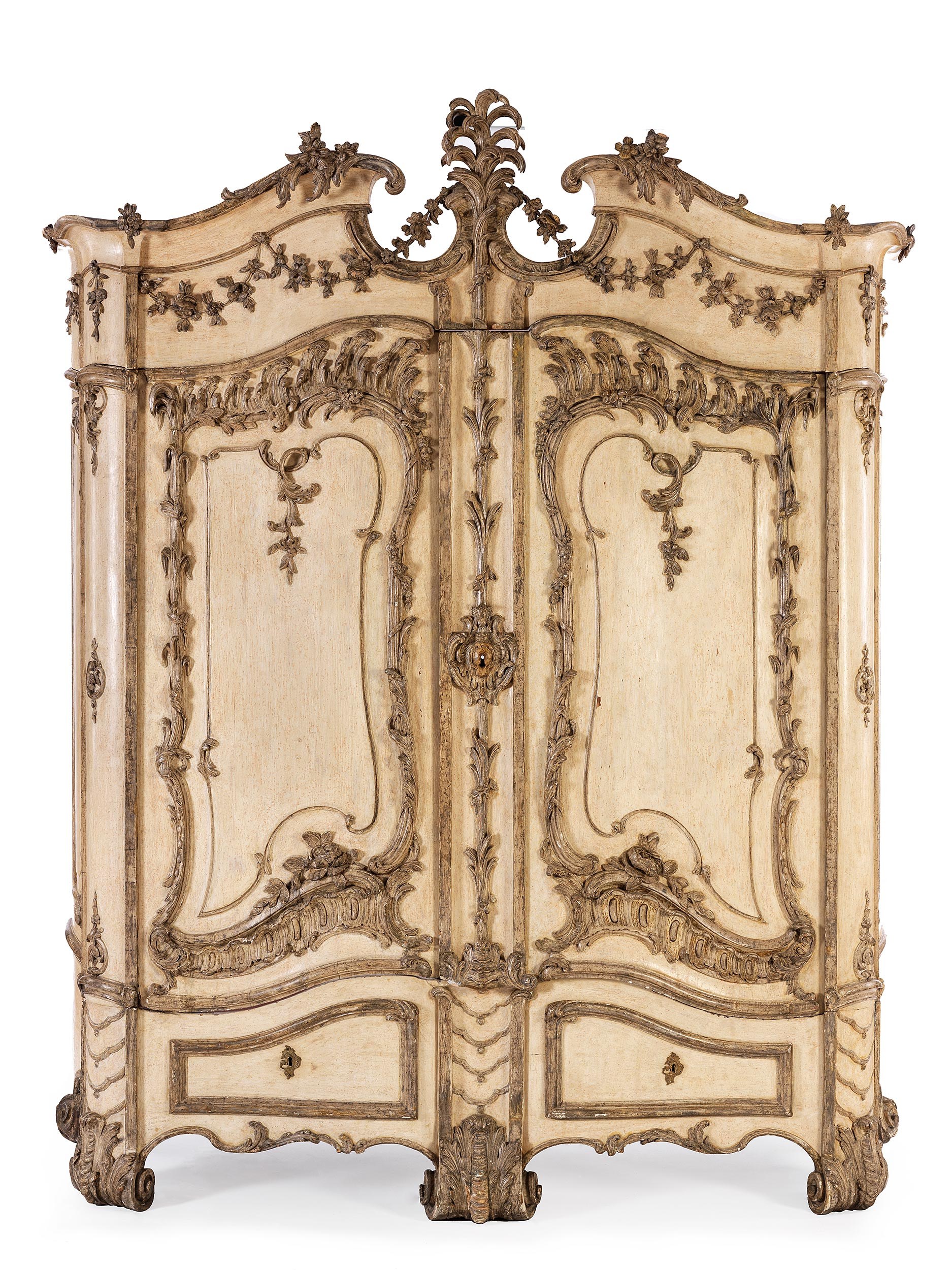
246 x 200 x 66 cm.
Johann August Nahl, 1710 - 1785.
Potsdam, around 1750 / 1760.
Wooden, prismatic corpus with a sprung volute pediment on a wavy cut-out base with pronounced volute feet. The curved, double-door front above a pair of drawers. Painted red on the inside, cream-colored on the outside with partial silvering. Very finely carved with flowers, leaves, rocailles, garlands and decorative frieze. Johann August Nahl, active as "Directeur des Ornements" at the court of Frederick II the Great, played a central role in the design of the numerous building projects that were initiated immediately after Frederick's accession to the throne. These included new buildings as well as the remodeling and refurbishment of royal residences such as Berlin Palace, Potsdam Palace, Monbijou Palace, Charlottenburg Palace and Sanssouci Palace. Nahl had a decisive influence on Frederician Rococo and contributed to the continuity of style that was maintained until the 1760s. Together with other outstanding artists such as Georg Wenzeslaus von Knobelsdorff and later the brothers Johann Michael and Johann Christian Hoppenhaupt, he designed impressive wall decorations as well as accompanying pieces of furniture such as consoles, mirrors, ceremonial armchairs and canapés. These works are characterized by the naturalistic ornamentation typical of Berlin, incorporating elements such as flowers, fruit, birds and musical instruments. The result was an unmistakable, French-influenced Rococo style with a North German-Protestant character, characterized by lively freshness, graceful forms and the generous use of gold. The furniture of the period, particularly that from Berlin and Potsdam, reflected the courtly aspirations of the young kingdom and enjoyed great popularity. They are known for their ornate carvings and gilding. The chests of drawers from the mid-18th century are characterized by their strong, curved outlines, elaborate parquetry and the striking curvature of the middle section. The high, fully carved legs and the low frame emphasize the opulence of these pieces. Colored and gilded console tables with richly decorated naturalistic ornamentation are among the special creations of this period. Particularly noteworthy are the ornaments typical of Nahl, which include melons, cabbage stalks, grotto shapes and wing wings.
Provenance:
Fischer-Böhler, Munich.
Private collection Germany.
Literature:
P. Meister / H. Jedding, Das schöne Möbel im Laufe der Jahrhunderte, Heidelberg 1958, plate 300.
C. Freytag, Bruckmanns Möbellexikon, Frankfurt 1978, plate 70.
H. Kreisel, Die Kunst des deutschen Möbels, Munich, 1970, plate 793.
Cf. G. Streidt / P. Feierabend, Prussia Art and Architecture, Oldenburg 1999, pp. 172 - 206. (1411344) (13)
Magnificent Potsdam cabinet
246 x 200 x 66 cm.
Johann August Nahl, 1710 - 1781.
Potsdam, ca. 1750 / 1760.
Provenance:
Fischer-Böhler, Munich.
Private collection, Germany.
Literature:
Peter Meister / H. Jedding, Das schöne Möbel im Laufe der Jahrhunderte, Heidelberg 1958, plate 300.
Claudia Freytag, Bruckmanns Möbellexikon, Frankfurt 1978, plate 70.
Heinrich Kreisel, Die Kunst des deutschen Möbels, Munich 1970, plate 793.
cf. Gert Streidt / P. Feierabend, Prussia Art and Architecture, Oldenburg 1999, pp. 172-206.








Πρόσφατες επισκοπήσεις
Συνδεθείτε για να δείτε την λίστα θέσεων
Αγαπημένα
Συνδεθείτε για να δείτε την λίστα θέσεων