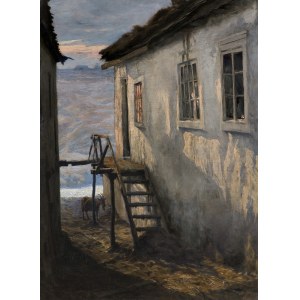
signed l.d.: Henryk Weyssenhoff | Munich 1891
On the reverse:
- in the middle stamp: Albert Speckstein | Munchen
- p.d. posthumous legacy stamp: Henryk Weyssenhoff | from posthumous legacy | Warsaw, on.
- l.d. statement of Kazimierz Buczkowski from 1952.
- in the upper part an export permit.
The Talny notice was created in the third year of Weyssenhoff's stay in Munich. At the time, the artist, who was studying in the studio of Alfred Wierusz-Kowalski, already had a solid education acquired at the Gerson Drawing Class and during five years of study at the St. Petersburg Academy. Hence, the offered work shows the virtuoso technique and color sense of the outstanding landscape painter. The painting is maintained in the convention of Munich painting, with its typical color range. The artist stripped the view of the backstreet of its chatty staffage, focusing instead on conveying the dreamy atmosphere of the borderland town. The tone of muted grays is enlivened by the golden light of the setting sun. Its sharp streams and reflections in the window panes, contrasting with the shadows, create a masterfully played color composition, emanating at the same time the mood of evening silence and peace.
Perhaps it was this painting that Weyssenhoff presented at the Glaspalast exhibition. It's true that no stickers from the exhibition have survived on its back, but a stamp confirming its origin from the painter's legacy may lead us to believe that this is the canvas exhibited under the title Ein Winkel von Talnoe at the famous salon in 1891. Weyssenhoff must have considered this composition exceptionally successful, because in 1894 he again showed the painting under the same title at the Universal National Exhibition in Lviv. The 1894 painting, as we know it from the reproduction in the exhibition catalog, differs from the one on offer in certain details - instead of a goat we see a pig there, while on the stairs - an aged Jew.
Interestingly - infrared observation of the offered canvas reveals the author's repainting; originally the author also placed the same figure of a Jew on the offered work. He also added a girl standing on the porch holding a bowl, spilling food from it for the animal grazing below. The goat visible in the painting in the original also could have been another animal, perhaps a pig - which can be inferred by analyzing the shape of its silhouette.
The above-described repainting reflects the artist's intensive work on the composition. This record gives us not only extremely interesting knowledge of the artist's workshop - but also a wider field for the interpretation of this work, which is so significant in the artist's oeuvre.
Bibliography:
- Illustrierter Katalog der Münchener Jahresausstellung von Kunstwerken Aller Nationen im kgl. Glaspalaste 1891, Munich 1891, cat. no. 1731;
- Illustrated Catalogue of the Exhibition of Modern Art in Lviv 1894, third edition, published by the Directorate of the General National Exhibition, Lviv 1894, cat. no. 267 [as Corner of the Fire (sic!)], ill;
- Aneta Pawłowska, Henryk Weyssenhoff (1859-1922). Forgotten bard of Belarus, DiG Publishing House, Warsaw 2006, cat. no. B.3 (paintings known from titles).
Painter; son of a January Uprising insurgent, he spent his childhood with his family in Kongur in the Urals. From 1874 he studied with W. Gerson at the Warsaw Drawing Class, from 1880 to 1885 he studied at the St. Petersburg Academy, and in 1889 he went to Munich, where he took advice and guidance from A. Wierusz Kowalski. From 11903 to 1904 he stayed in Paris, after which he settled in the family estate in Russakovichi, Belarus. During World War I, forced to leave the estate, he moved to Warsaw. He was primarily a landscape painter, the creator of realistic in form, atmospheric landscapes. An avid hunter, he repeatedly made forest animals or fowl the heroes of his compositions. Weyssenhoff's paintings enjoyed critical and public acclaim, being awarded medals at exhibitions (a silver medal at the 1900 Paris exhibition). The artist was also an illustrator of books - he made, among other things, a series of drawings for his cousin Jozef Weyssenhoff's novel Soból i panna.